University of North Carolina Athletics
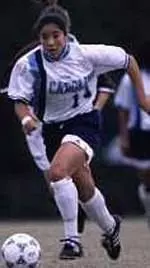
From Fetzer To Finley: Lorrie Fair Helps Lead Women's Soccer In 1999
October 25, 1999 | General
Oct. 25, 1999
By Dave Lohse, Director of Media Relations for Olympic Sports
Very few teams in the history of sport have captured the imagination of a nation the way the United States Women's World Cup soccer team did in the summer of 1999. During their stirring run to the championship, the 20 players on that team became the ultimate American role models, handling themselves at all times with dignity and class. Of the 20 players on the United States roster, only one returned to the college ranks this fall to continue play as an amateur--the University of North Carolina's own Lorrie Fair. The senior from Los Altos, Calif. remains one of the leading candidates for all the various national player of the year awards during the 1999 campaign, including the Hermann Trophy and the Missouri Athletic Club Player of the Year Award. Recently, Director of Media Relations for Olympic Sports Dave Lohse had the chance to sit down and chat with this down-to-Earth and charming Tar Heel who represents all that is right about the future of women's sports in America. The interview occurred shortly after Fair had overcome a series of early-season injuries to begin a string of personal play which has sparked the Tar Heels to a nine-game winning streak and #3 national ranking heading into tomorrow's regular-season finale against Wake Forest at Fetzer Field at 1 p.m. The Tar Heels go into that game 15-2 overall and 6-0 in the Atlantic Coast Conference.
Q: Did any of you on the World Cup team ever imagine going into the event that it was going to turn into what it eventually became?
A: Absolutely not. We knew it was going to be important for women's sports and that is was going to be the biggest event scheduled in the history of women's sports, but we didn't ever fathom we would be playing before sold out stadiums all over the country and before 92,000 at the final.
Q: When the team walked out for its first game at Giants Stadium, what emotions were running through your head?
A: I think I was frozen in awe. I knew my family was somewhere in that sea of people. The Fairs were spread out over each tier of the building. Between my family and my family friends I had about 15 personal supporters. The Fairs were responsible for starting the wave on the third tier.
Q: Each game during the tournament was essentially a cliffhanger. How do you think the fact the American team played so many close games added to the whole atmosphere of the event?
A: I think that like here at Carolina our World Cup opponents marked their calendars. Obviously the other nations wanted to win every game but a big upset over the U.S. was something we knew other teams would cherish. The fact that the games were so close was a tribute to the level of skill in the World Cup.
Q: Do you think the U.S. Team every really played its best game in the tournament?
A: You could see it in spurts. You could see it in places. I don't know if you could take a whole 90 minutes and say that was the best game we ever played. I could say the China game was the best because it took the effort of everyone on the team to survive 120 minutes.
Q: Going into this World Cup you knew essentially that you would be a reserve. But you were only 20 years old playing in this World Cup. How does having this experience benefit you as you seek a larger role on the National Team for the 2000 Olympics and 2003 World Cup?
A: I think it is just the experience. As for it being a reserve role, it is the challenge of getting into the game and finding the pace of the game in the first minute and then making your contribution. Getting a chance to practice six months against my own teammates, who I consider to be the best soccer players in the world, there's no way I couldn't improve.
Q: Talk about some of the other younger players on this year's World Cup team and how all of you feel about the future of women's soccer in the U.S. five and 10 years down the road.
A: I think those of us who are younger are coming out of college at the right time. The new pro league is going to get started in the spring of 2001 and that way the younger players can continue to develop right out of college and use that as a stepping stone to the National Team.
Q: Since UNC players comprised 40 percent of the World Cup roster do you guys take a lot of ribbing from your teammates?
A: Of course. They are always telling us that Carolina Blue is not a color, that it is really Columbia blue or sky blue. We always ask them where their college championship rings are. But of course there is no bad blood amongst the teammates. All of our kidding is in good fun.
Q: As you got ready for the 1999 college season how motivated were you to get the NCAA championship trophy back in Chapel Hill?
A: I don't know if there are words to describe my motivation. Some people asked me if it was going to be a downer to come back and play on a college team after playing on a world championship team and I don't think they understand what it is like to play here. This season is my most special and most cherished. All my focus is on getting that championship back here.
Q: Talk a little bit about having to play 1999 minus players like Cindy Parlow, Tiffany Roberts, Siri Mullinix and Rakel Karvelsson. What has the team done to replace players?
A: Obviously the going has been tough. First and foremost we needed a goal scorer because Cindy and Rakel were two of our primary scorers last year. I don't think anyone can replace how Tiff plays. Her heart is the biggest I've ever seen. She gives everything in every game. With Siri gone, we don't have a lot of keepers with experience, but I do feel we have several great keepers on this team. We just need to get them that experience and Jenni Brannam and Kristine DePlatchett have stepped up big.
Q: Have you ever regretted traveling across country away from your family to spend your college career at North Carolina?
A: Never in a million years. I think UNC and Lorrie Fair is a perfect match. If my soccer career were over, I would still come here because of the people. And despite the fact I've had to skip some school for National Team purposes, I am looking forward to holding that Carolina degree as soon as I can get my hands on it.
Q: I know you are a big fan of all the sports at Carolina because I see you at so many other events. Can you just expound on what it is like to be a part of the extended UNC athletic family?
A: Everywhere you look these days you see Carolina athletes. I think there is a special bond between Carolina athletes. A lot of people seem to wear our gear because it is fashionable. They love the colors. It's Michael Jordan's school. Michael Jordan always wore his Carolina shorts under his Bulls' uniform. UNC symbolizes something special. I like the quote from Charles Kuralt about everyone being bound by special ties to this University. When you hear that and you get chills you know you belong here.