University of North Carolina Athletics
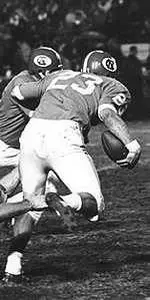
Brewer: McCauley Didn't Come As A Big Star, But Left As One
April 19, 2001 | General
April 19, 2001
By Rick Brewer, SID Emeritus
Previous Car-O-Lines Columns By Rick Brewer
Of all of North Carolina's great football players, few have come to the campus with as little fanfare as Don McCauley.
But, it could be argued that only Charlie Justice has had a greater impact on the Tar Heel program.
Justice, of course, was the sensational single-wing tailback who sparked Carolina to three major bowl appearances in the post-World War II era.
McCauley was the dynamic tailback around whom Bill Dooley rebuilt the Tar Heel program after becoming head coach here in 1967.
However, McCauley came to Chapel Hill when so many fans didn't follow recruiting as avidly as they do now. The players who did attract attention were generally guys who had great high school careers in this state.
McCauley, from Garden City, N.Y., certainly was not the most heralded player in Dooley's first recruiting class. A trio of in-state quarterbacks-- Mike Hipps of Greensboro, Ricky Lanier of Williamston and John Swofford of North Wilkesboro--were regarded as the top prospects by many. Tight end Tony Blanchard, son of the great Army star Doc Blanchard, was another prize recruit.
A number of people, in fact, felt McCauley would be a defensive back in college. But, instead he simply became one of the premier running backs in the history of the collegiate game.
That's why he was named this week to the National Football Foundation's Hall of Fame, joining Justice and end Art Weiner as Tar Heel players who have been so honored. Carolina coaches Carl Snavely and Jim Tatum have also been selected in the past.
Dooley came to Chapel Hall after serving as offensive coordinator for his brother, Vince, at Georgia. He felt the keys to winning games were to be able to run the football and stop the other team from running it.
It was a matter of ball control.
If his team had the football, it would be difficult for the opponent to score unless there were turnovers. Add a strong kicking game and mix in a few passes when the other team was least expecting it and you had a formula for success.
In order to accomplish that, he needed an outstanding tailback for the I-formation he installed. He found that player in McCauley, a 6-0, 212-pounder who was as durable as he was versatile.
McCauley would be the first of Carolina's record 24 players to rush for 1,000 yards. Many people today still regard him as the best.
But, those were the days when freshmen were ineligible for varsity competition. So in 1967 Dooley took his finest athlete, defensive back Gayle Bomar, and moved him from the secondary to quarterback. Bomar ran and passed for 1,402 yards as Carolina struggled to a 2-8 record.
However, this was a team that had been to only one bowl game-- the 1963 Gator Bowl-- since 1949. Talent was thin and the Tar Heels were simply over-matched in almost every game.
Things weren't much better the following year as Carolina finished 3-7. But, in McCauley, Dooley had the player around whom he could build his offense.
N.C. State belted the Tar Heels in the season opener, 38-6. However, McCauley ran for 89 yards on 15 carries and returned seven kickoffs for 174 yards. He finished the season with 360 yards rushing, 23 receptions for 313 yards and 538 yards on 24 kickoff returns.
After a 1-4 start in 1969, Carolina won four of its final five games for a 5-5 record. McCauley rushed for 716 yards down the stretch, an average of 143.2 yards per game. He led the Atlantic Coast Conference with 1,092 yards rushing, had 14 catches for 238 yards and returned 17 kickoffs for 440 yards. That included a 97-yard kickoff return against Wake Forest.
He was named the ACC Player of the Year. But, the best was yet to come.
As a senior in 1970, McCauley had 324 carries for 1,720 yards. He also had 15 catches for 235 yards and two scores. Plus, he took over the team's punting duties, finishing with a 38.4 average on 48 kicks. He was a runaway selection as the league's top player and won consensus All-America honors. He scored 21 touchdowns that year for 126 points, marks that still stand as the best in ACC history.
His 1,720 yards on the ground were an NCAA single-season record at the time, eclipsing the all-time high set by O.J. Simpson two years earlier.
McCauley gained over 100 yards in 10 of 11 games that season. He saved his best performance for his final game. He carried the ball 47 times for 279 yards and scored five touchdowns against Duke in Kenan Stadium, leading Carolina to a 59-34 victory.
It was that win which sealed a Peach Bowl bid for his team-- the first of seven bowl trips for the Tar Heels in that decade.
"Being at Carolina at that time has helped shape my entire life," said McCauley at a New York press conference, announcing the 2001 Hall of Fame class.
"Coach Dooley was an inspiration, teaching me never to give up. I learned the value of hard work. It was tough in those first couple of years. But, it was exciting to see the work we did pay off."
Carolina dropped a 48-26 decision to unbeaten Arizona State in the Peach Bowl. The Tar Heels led 26-21 after two quarters, but a second-half snowstorm and an injury to quarterback Paul Miller slowed the offense after intermission. McCauley was sensational, rushing for 143 yards and three touchdowns.
"The thing about Don was he never complained about what he was asked to do," Miller said after that season. "He might have carried the ball 28 or 29 times, but if we called his number in the huddle, he'd line up and take it again. In fact, I think he actually got better as the game wore on.
"He really was a complete back. In addition to his running, he was a fine blocker and knew how to truly fake a handoff which set up our play-action passes. He probably got hit as much when he didn't have the ball as when he did. I don't know how he went through a whole season without getting hurt."
McCauley said this week that avoiding injury was the main reason he was able to have such a big senior season.
"I was very fortunate to stay healthy that year," he said. "A lot of times a tailback can get a nagging injury that will slow him for the whole year. I never had that problem and I can thank a great offensive line for that."
After each game his senior year when McCauley was surrounded by reporters, he would urge them to talk to other players--his linemen, Miller, Blanchard, wingback Lewis Jolley or someone on defense like new Tar Heel coach John Bunting.
This wasn't because he didn't get along with the media. McCauley was simply that modest and it embarrassed him to get so much attention.
Justice had been the same way in the locker room 30 years earlier.
On the field, both would be the key figures in restoring Carolina to football prominence.
Now, they finally share still one other common bond--they're members of an elite group of college football players, those in the College Football Hall of Fame.