University of North Carolina Athletics
THB Up Close: Sportdoc Thrives At UNC
September 26, 2001 | General
Sept. 26, 2001
By Bill Freehling
UNC Athletic Communications
Despite the nationally competitive caliber of varsity athletes at UNC, the best athlete on the Chapel Hill campus may well be a doctor who takes care of them.
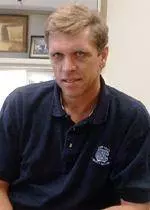
Dr. Louis C. Almekinders, professor of orthopaedics and a team orthopaedist for almost half of the University's varsity squads, is the number-one ranked male triathlete in North Carolina in the 40-44 age category this year.
Almekinders, who displays a vanity license plate in his Burnett-Womack office reading "sportdoc," competes in the North Carolina Triathlon Series (NCTS). With the season's final race coming up Oct. 13 in Pinehurst, Almekinders' lead appears safe.
The standings are based on the average points attained in an athlete's top six NCTS races for the year. Points are awarded for all 14 NCTS events, which include varying race distances. Almekinders mainly competes in Olympic-distance triathlons (mile swim, 40K bike, 10K run) and races half that length.
He has also competed in several half-Ironman races (1.2-mile swim, 56-mile bike, 13.1-mile run). He is considering doing a full Ironman in September 2002, when North Carolina will host its first such event in and around Falls Lake in Durham.
Almekinders qualified for the Dannon Duathlon World Championships in October 1999. The race, which includes only running and biking, was held in Huntersville, N.C., near Charlotte.
Almekinders, who still has a Dutch passport despite moving to the United States from his homeland in 1982, ran for The Netherlands, serving as the only Dutch representative in his age group. He finished 42nd out of more than 200 entrants in a category including all men aged 16-19 as well as 40 and above.
He said his success has motivated him in his training regimen. "It's kind of fun when it turns out you can do pretty well," he said. "It's fun to be competitive."
In order to compete at such a high level, Almekinders trains four to five times each week. He said he generally goes for a short run and bike ride on Fridays, a long run on Saturdays and a long bike ride on Sundays. In addition, he tries to fit in two shorter workouts during the week.
Early in the season, which kicks off in late March, Almekinders generally trains at longer distances but at a slower speed. Bike workouts average 50 miles during this time while runs might comprise 10 miles. Later in the season, Almekinders picks up the pace but reduces distances, biking for 25-30 miles and running 6-7 miles in each session.
Triathlons are the perfect sport for this busy doctor, whose duties include treating varsity athletes and the general student body in the Student Health Service, teaching in the School of Medicine, performing orthopaedic surgeries and conducting research primarily on tendon injuries. All these responsibilities make time-consuming organized sports next to impossible, he said.
"I feel I have to do a sport where I can just go out and do it in one or two hours," he said.
Athletics have always been an important part of Almekinders' life. Growing up in Zwijndrecht, The Netherlands, he swam competitively from age 7 through high school, at which time he realized he "probably wasn't going to be Mark Spitz."
This experience in the water has allowed him to rarely train for the swimming portions of triathlons. "I rely on my experience in high school," he said.
Growing up, Almekinders also played water polo and competed in modern pentathlons, which involve swimming, running, air pistol shooting, fencing and horseback show jumping. While a student at the Erasmus School of Medicine in The Netherlands, he began running marathons. He said he gave this up, however, because it was too hard on his joints.
In the middle of his seven-year medical program, which he completed in 1982, Almekinders spent a semester studying abroad at NCSU. The trip, taken in 1979, was to prove seminal in two major ways.
First, Almekinders met his wife, Sally, who then taught physical education at NCSU. The couple kept in touch after Almekinders returned to The Netherlands, traveling back and forth to visit each other during vacations. "We spent enough money on airfares that we could own a wing of an airliner," he said.
Sally was the main reason Almekinders decided to return to the United States after finishing his medical program in 1982. "The fact that there was excellent sports medicine going on here did not hurt that decision," he added. They were married in 1983.
Second, having witnessed the first Ironman Triathlon in Hawaii in 1978, the physical education faculties at NCSU and Duke decided to organize a triathlon of their own, and Almekinders entered.
Almekinders finished second in his maiden race, beaten only by a Duke medical student and West Point graduate named Curtis Alitz, who later became a professional triathlete before returning to the medical fold at Ft. Bragg.
The Almekinders have been racing in triathlons ever since, never having gone a full year without entering a race. Sally Almekinders, who teaches a triathlon class at NCSU, is ranked second among North Carolina women in the 45-49 age group.
The family success story does not stop there, either. Hans Almekinders, the couple's 15-year-old son, is ranked first in the NCTS' 19-and-under category. The Almekinders have three other children: Anna, 11, Vanya, 12, and Peter, 13. In the New Years Resolution 5K on Dec. 31, 2000, at Camp Lejeune, N.C., Anna and Vanya both placed first in their age categories.
Suffice it to say, it's a very fit family. Almekinders said they plan to continue racing for as long as possible. "It becomes difficult to let go," he said. "As long as the joints hold up, we'll keep doing it."
Almekinders' joints received a temporary blow in 2000, when wear and tear caused some detached cartilage in one of his knees. He required surgery but returned strongly enough to rank third for the year in his age group in North Carolina.
Because of the injury, Almekinders decided not to run in the Elite Masters category this year. Masters entrants, who are 40 and older, must start the race with people of all ages, whereas age groups start with just their own. Nonetheless, if Almekinders had entered the Masters division, he would currently be ranked second in North Carolina.
Furthermore, there are only two men in all age groups of North Carolina who rank ahead of him. Scores between categories can be compared directly because they are computed based on the proportion of time separating the winner and the individual finisher. At age 44, taking the bronze in the entire state is quite an accomplishment.
Almekinders' successes are not limited to triathlons, however. The author of many journal articles and books on shoulder and knee injuries, he is one of three orthopaedic surgeons at UNC, where he has worked since 1989.
After finishing his medical degree in The Netherlands, Almekinders had a yearlong fellowship at Duke and then spent a year in general surgery in Wilmington, N.C. From 1984 until 1989, he was a resident at UNC. Dr. Timothy N. Taft, director of sports medicine, said he jumped at the opportunity to hire Almekinders after the residency ended.
"I knew Louis as a physician as he came through the residency program," he said. "He was one of the better residents in the program, and UNC has one of the best resident programs in the country. We were very excited about the opportunity to keep him on the faculty."
In 1992, Almekinders was one of three orthopaedic sports medicine physicians selected by the American Orthopaedic Society for Sports Medicine for the Traveling Fellowship Program, which sends American doctors to Europe or the Pacific Rim every other year to see the latest advancements in the field.
Almekinders said he spent six weeks touring the "best of the best" sports medicine facilities in 8-10 Western European nations. "It was an amazing experience," he said, and gave him many new ideas that he brought back to Chapel Hill.
Taft, Almekinders and Dr. William E. Garrett, chairman of the orthopaedics department, take care of all of UNC's varsity athletes. Almekinders mostly handles the Olympic sports - lacrosse, wrestling, gymnastics, cheerleading and fencing. Garrett and Almekinders split soccer duties.
"For us in sports medicine," he said, "it's kind of the icing on the cake. It's often the athletes that are incredibly motivated, and it's fun working with a group with that kind of motivation."
Taft, who handles injuries associated with football, basketball and baseball, said Almekinders' athletic feats help make him a success as a doctor. "He's an athlete himself so he understands what it takes to be one."
Among the former UNC athletes Almekinders has treated are Eddie Pope, a defender on the MLS' D.C. United, and Tisha Venturini, a midfielder who won four NCAA soccer championships at UNC, was named the national player of the year in 1994, and participated on the women's national teams that won a gold medal at the 1996 Olympics and the World Cup in 1999.
Venturini, who now plays for the WUSA's Bay Area CyberRays, the first champions of the new league, required Almekinders' care after breaking the fifth metatarsal in her left foot during her sophomore year in October 1992. He inserted a screw into Venturini's foot to stabilize the bone. Twenty-two days later, she was back on the field.
"I recovered pretty quickly," she said. "Dr. Almekinders was hesitant in letting me back so soon, but I was pretty insistent so he let me go. I finished the rest of the season, won a national championship and didn't have any problems."
The next summer, while training with the national team in northern California, Venturini felt more pain in the same foot. This time, Almekinders performed a bone graph and encouraged her to take her time returning to action. Venturini heeded his words.
"I followed his instructions and didn't try to rush back like I did the first time," she said. "My foot healed wonderfully - I was able to concentrate on playing soccer and not worrying about my foot."
Venturini said Almekinders always supported her at games and was a pleasure to work with. "Dr. Almekinders is a great man and doctor. He was always so honest, patient and positive. I felt very comfortable with him as my doctor and will always be appreciative of what he did for me and my career."
The news of his triathlon successes came as no surprise to her. "He was always in such superb shape and extremely dedicated to being the best at whatever he was doing," she said. "I wish him all the best."
Tar Heel athletes like Venturini will be happy to learn that Almekinders plans to continue at UNC. He said he and his family love the community as well as the University. Its size is especially appealing to him.
"There are so many things going on," he said. "It's great to work with lots of athletes in many sports -- it keeps you sharp."
Taft, who supervises Almekinders within the sports medicine division, said he couldn't be happier with the triathlete doctor.
"He's been a tremendous addition to our staff and we're just tickled pink to have him," he said. "He's a cracker-jack physician, and we're blessed to have him with us."
Bill Freehling is a second-year master's student in Carolina's School of Journalism and Mass Communication. He lives in Durham.