University of North Carolina Athletics

Baddour on the State of the Athletic Department
October 18, 2004 | General
Aug. 18, 2004
In college athletics, summer is a time to tie up the loose ends from the just-completed year and look ahead to the upcoming campaign. Tar Heel Monthly sat down with athletic director Dick Baddour to get his thoughts on a variety of topics of importance to UNC athletics.
THM: Where do we stand with the signage issue?
DB: The task force appointed by the chancellor and Board of Trustees has completed its work and adopted a resolution (see sidebar). That resolution acknowledges the significant financial needs we have, especially with the scholarship program, facility demands and operating budgets for individual sports. It recommends the University move forward with further investigating the financial impact. If the value is right, we should look at a small number of companies that have national impact and present it in a first-class way. The trustees meet again on July 21 and 22. The University Affairs Committee will consider it on July 21 and the full board will consider it on the 22nd. Athletics will take its directives from the trustees.
THM: Could signage be in place for this season?
DB: I doubt it could be in place for this football season. We've got to test the market and analyze the level of interest. We need to have detailed discussions of how to present signage in a tasteful way. We laid out a process last fall and we've stayed true to that process. I'm very pleased with the amount of input we've had. All constituencies, including faculty, students, alums, the Rams Club, and University staff have been involved. That's the way the University of North Carolina should look at a complicated issue like this.
THM: What facility projects are on the horizon right now?
DB: We'll finish the tennis facility this summer with the resurfacing of courts, new seating, landscaping and a scoreboard. It's an outstanding collegiate tennis facility.
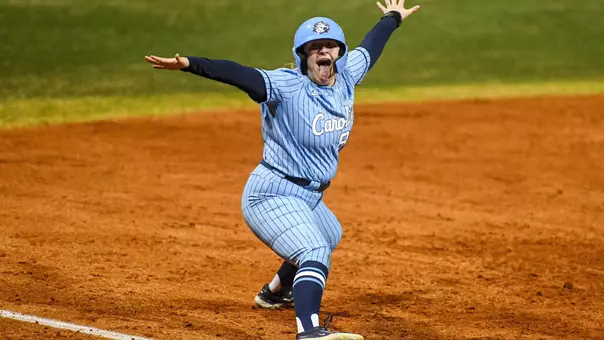
The softball project is shifting into a higher gear, adding a team building, some stands, a press box and concessions. We have the funding to do all of that.
We are reviewing a comprehensive plan for Boshamer Stadium. An outside sports architectural firm worked with a local firm and presented a proposal to renovate the stadium. We're assessing that to determine a short-term, medium-term, and long-term basis.
We also have a company coming in to look at the Smith Center to see how we can upgrade the sound system, video boards, and how signage might work together with all of that.
We are taking a major look at Carmichael. The women's basketball offices there are inadequate. The building has not had major renovations since it was built in the mid-1960s.
Finally, we're looking at construction of a building adjacent to Koury Natatorium that would include a new basketball museum, ticket office, and offices for the Rams Club and administration.
THM: How do you foresee paying for all those projects?
DB: One way is by including a facility fee on our tickets, which fans saw with football tickets this year. We didn't raise the actual ticket cost, and our season ticket package still ranks in the middle of the ACC, but we did include a facility fee. That money will be earmarked for a specific fund to pay off debt service as we borrow money to do some of these projects. Just through football tickets, that fee may generate $250,000 or $300,000. That means we could borrow $2.5 to $3 million if it is used for debt service.
We will not do the full-scale facility fee on basketball tickets, because we have an extra home game this year that will already add to the season ticket cost this year. The overall season ticket price will be higher, but that will be because of the additional game.
Facility projects typically interest a lot of our constituents and we can generate some funding there, but we need to be careful that it does not come at the expense of the scholarship program. Our primary focus right now is on making sure the scholarship program is stable for now and for the future.
THM: How will you assess improvement in the football program this season?
DB: There's no question everyone is looking for improvement, and that includes Coach Bunting, his staff and the student-athletes. We all want to win. Their offseason workouts have been spirited and with a strong sense of purpose, we've had two outstanding recruiting years and we have lots of experience on offense. The defense is a year older and more mature and Coach Bunting made significant changes in his defensive staff. We've instituted a leadership program, not only for the football team but for other sport programs, that has already paid dividends. Having said that, our schedule is so demanding. The ACC is one of the best leagues in the country and two of the non-conference teams we play this year were 10-game winners a year ago. But that demanding schedule also presents us with an opportunity to show our improved play. We need to measure how well this team plays, how hard they play, and how they represent what Coach Bunting and his staff are trying to accomplish. I'm excited about this season and the possibilities of where this team could take us.
THM: The ACC is integrating two new teams this year and one next year. How has that process gone?
DB: It's gone well. We're pleased with the financial data we've received from the ACC. The conference was able to negotiate an impressive football package, but it will be divided 12 ways instead of nine. But the important thing is we're not going backwards, and that was a concern. Relationships around the league are fine. The new schools have already attended several league meetings. They're outstanding institutions and are represented well by their athletic directors, faculty representatives and presidents.
I do think it's starting to sink in with our fans about not playing every school twice in a round-robin basketball schedule. I'm hearing disappointment from fans about some of the rivalries not continuing. That was an issue from the very beginning for us, but we have to learn to deal with that.
There are issues in other sports we still have to sort through. We've had ACC championships in all sports except football. But with 12 teams, there is some down side in sports like volleyball and soccer. We would have to add another day of competition to those tournaments, which could mean the winner would go into the NCAA Tournament the following weekend with a tired team. We don't want to put our teams at a disadvantage in the NCAA Tournament. The athletic directors have to look at whether we want to stay with the philosophy of having end-of-season ACC championships, and that's something I've already talked about with our coaches in all sports. I believe we need to do what's best for each individual sport, rather than having a blanket policy that might put programs at a disadvantage.
THM: Speaking of ACC championships, do you have any feelings on the location of the league championship football game that will begin after the 2005 season?
DB: I'm interested in seeing the proposals. It's important to play the game in a city that fans can reach easily. I also think you have to be careful not to create a situation where fans of one team would have to go back to the same location for the ACC title game and a bowl game. We want fan interest to remain high in the bowl.
THM: The 2003-04 athletics year was the first in which Carolina didn't win a men's conference title. Does that concern you and do you see progress in that area next year?
DB: We evaluate our programs in many areas and ACC championships is just one of them. We also had seven men's programs qualify for NCAA postseason competition. Combined with the women's programs, it looks like we'll be among the top schools in the Directors Cup (formerly the Sears Cup) standings. You have to look at how programs like baseball, lacrosse and tennis are developing. It's rare in today's world to find a school that dominates a men's program, as we did in men's tennis in the 1960s and 70s. But our men's programs are coming on, are competitive, and those coaches are doing a good job. The ACC is the strongest all-around league in the country and our men's teams were competitive in almost every sport. Yes, we want to win ACC championships, and when programs slide, we have to focus on rebuilding them, as is being done successfully in lacrosse. We are committed to being a broad-based program and being successful across the board.