University of North Carolina Athletics
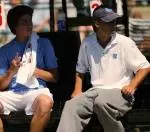
Carolina Spotlight Of The Week
May 10, 2007 | Men's Tennis
May 10, 2007
TarHeelBlue.com continues its Q&A sessions with members of the 2007 University of North Carolina men's tennis team. This week's featured Tar Heel is assistant coach Tripp Phillips. Phillips played at Carolina from 1996-2000. He was awarded the Patterson Medal in 2000, the first men's tennis player to receive the award since Vic Seixas in 1950. Since his matriculation from UNC, Phillips has gone on to play professionally. Last September, Phillips advanced to the semifinals of the U.S. Open with doubles partner Australia's Ashley Fisher.
THB: While you were a student here, what major lessons did you learn that you are trying to pass on to the current players?
Tripp Phillips: A lot of the lessons that I did learn from Coach Paul were about developing my game and growing up as a person, but also some of the realizations that I think you have after you leave, you really appreciate more so the opportunity that you have right now. It is sometimes hard to realize it at the time, but for me, it is easy now to look back and realize it was such an amazing opportunity that I had when I was here. I tried to take advantage of it, but I wish I had done even more.
THB: As a player, what was your favorite moment at Carolina?
TP: Probably my senior year, we beat VCU when they were top 10 in the country and I beat the No. 1 player in the country. It was a great team win and a great crowd. It was a lot of fun.
THB: In 2000, you were awarded the Patterson Medal. How did that feel for you to win such an admirable award?
TP: It meant a ton to me. I was extremely honored to be even mentioned in the same breath as some people who had won that before me. I really tried to do things the right way and work really hard. I took a lot of pride in what I had done. So to be recognized for that, especially on such a prestigious award is something that I will always remember. It really meant a lot.
It is the award they give for the best senior student-athlete. They give one man and one woman for all sports.
THB: How was the transition from collegiate tennis to professional tennis? What are the major differences, the environment and how did you adjust?
TP: It is a little bit of a different world. The travel first of all is something, on the road 35 weeks out of the year, all over the world, staying three people in the hotel room. Adapting to that lifestyle when you are starting out without any money and points is definitely tough. Every single match you play, if you don't bring you're A-game, you will lose. And so learning to bring the correct level everyday, it is something that you strive for in college, but it is something that is absolutely essential if you want to do well professionally.
THB: What is it like to walk into the tennis center, see your banner and realize that now you are coaching here?
TP: For me, I love Chapel Hill. Chapel Hill feels like home to me. It is a very family atmosphere around here, it always has been. I am very comfortable here and I am very excited to be back and be part of something that I believe so strongly in.
THB: What made you want to coach?
TP: I never assume that I would end up; it was never a goal of mine to be involved in college coaching originally. This is the only job in the country that I would have accepted, especially at this point in time because it coincides with a peak of my own in my individual career. But for me, I really believe in Coach Paul and what we are building here is something really special and something I was really excited to be a part of.
THB: What is the most fulfilling thing about being a coach for you at this point?
TP: I think that hopefully I am in a position to really help these guys achieve their dreams in tennis. I grew up wanting to play professional tennis and wanting to do this and that and fortunately have been able to achieve a lot of those dreams. As my career starts to wind down and be in a position to help other people accomplish the things they dreamed of since they were kids is probably the most fulfilling aspect of it.
THB: What was it like for you to reach the semifinals of the U.S. Open last September?
TP: It was great. Again, I've been at it for a long time. I feel like I've been knocking on the door of having big results like that a lot and to have it come together on such a big stage in that kind of atmosphere was amazing. I had friends and family and everyone that flew up; I played my quarterfinals and semifinals on national television on the biggest stadium in the world. To be in that environment, that was what I've been dreaming about doing since I was five years old when I started playing tennis. It obviously meant the world to me to live that out.
THB: Watching the U.S. Open as a kid and then playing in it, what was that like for you?
TP: I said to my dad when I was five years old that I wanted to play on center court at Wimbledon and I wanted to play on center court at the U.S. Open. At that point, I was so far away from it, but he just said, first you have to be the best in the city, then the state and who knows, maybe one day you can do it. And now I've gotten to play on both of those courts and some of the biggest stages. You play tennis to work to play on the big stage. It is certainly something that I will always remember.
THB: You mentioned a lot of people came to watch you. Did that make you nervous at all?
TP: I was more excited than nervous. There has always been two ways to look at situations where you can get nervous, you can either be nervous or you can love it and enjoy it. For me, I wanted to look back and remember the day and I did that as a day that I enjoyed it and left it all on the court and really soaked it up and made the most of it. I didn't want to look back and say, oh I got nervous because of it. And sometimes that is a little easier said than done when you walk out of the tunnel, but it has always been my nature to look at it like that.
THB: Since you've played under Coach Paul and now you're coaching with him, do you take any specific players under your wing, maybe the freshman, to teach them the ways around here?
TP: We have been fortunate to have great leadership on the team. They handle a lot of that. We work pretty hard to make sure they understand how they are going to develop their game. We stay on them and try to keep them outside of their comfort zone a little bit to make sure they are always getting better. I kind of think it is my job to make sure these guys reach their potential and between Coach Paul and I, we have a lot of experience on how that needs to happen. We just try to make sure they stay on the right path.
THB: How has this team progressed over the year?
TP: They have really mad a lot of improvement. Inside our locker room, I think the expectations have been there from the beginning, but probably for most other people looking at our team this year, realizing that we lost our one, two, three and six players from last year's team including two guys that were All-Americans, one was Senior National Player of the Year, I don't think most people would have assumed that we would be sitting here six in the country at the end of the regular season. I think it is a tribute to the guys for working very hard and believing in themselves and also, they have really improved over the course of the year and started to pick up some of the concepts and ideas that we are trying to implement into their game. They have been a great group to work with and they have really improved.
THB: How are you feeling about the upcoming NCAA Tournament?
TP: It is exciting. As far as college tennis goes, this is the big stage. You play the whole year to get ready for NCAAs and we're excited to compete. We feel fortunate to be hosting, it will be good to have some fans for the first couple rounds.
THB: Do you get any déjà vu when you're standing on these courts coaching?
TP: Yea, it is funny. I joke with some of the guys that they need to come up with new excuses because the ones they are giving me have been passed down through the teams, but if you trace the roots of them, I am the one who invented that excuse. It is definitely funny at times to be on the other side of it. I really enjoy working with the guys on the team and we have a lot of fun. We work very hard, but I think most of the guys would agree we have a lot of fun. It's definitely different being the one telling someone else to calm down or relax. I realize I owe Coach Paul a few thank you's for putting up with me when I was a player.
Players Mentioned