University of North Carolina Athletics
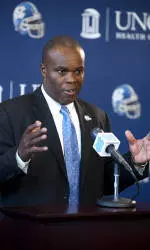
Jacobs: Moving To The Front
August 3, 2011 | General
Aug. 3, 2011

By Barry Jacobs
Everett Withers and wife Kara had crafted a career plan the Charlotte native followed through seven stops in the college ranks and two in the National Football League.
Since starting his coaching career in 1988 Withers was content to work for others, serving as a low-profile part of larger units, biding his time to reach for the ultimate decisionmaking reins. His resume included three years of service under Butch Davis at UNC.
"I think I was in places where I felt comfortable with the position that I was in," Withers said of his deferral of a head coaching role. Among the positions he filled were those of defensive coordinator at Louisville, Minnesota, and, most recently, at Chapel Hill.
All that changed the other day when North Carolina switched head coaches, advancing Withers and, in the process, scoring a little-noticed breakthrough for the school's athletic program.
Precedent suggests Withers can step in and quickly make a positive impact.
Directing a 4-3 alignment premised on taking the fight to opponents, particularly up front, Withers improved UNC's defensive prowess in a single year. The Heels leaped from 11th in yards allowed per game in 2008 (365.4), Withers' first season as coordinator, to first -- and sixth in the nation -- in 2009 (269.6). Carolina went from last to fourth in the ACC in overall time of possession in that span.
Last season, despite suspensions and dismissals that deprived the defense of several standouts, the Heels ranked fourth in the ACC in both total defense (an average of 338.5 yards allowed) and in time of possession.
Four North Carolina defenders were selected among the top 100 in the 2010 NFL draft - end Robert Quinn, linebacker Bruce Carter, tackle Marvin Austin, and safety Da'Norris Searcy. All played at least two seasons under Withers.
Meanwhile, in each of Withers' three seasons on the staff the Tar Heels made a bowl, won half their ACC games, and finished 8-5.
That track record, bolstered by familiarity with the program and university, and impressive personal attributes, won the coordinator the job as interim head coach after Davis was dismissed by chancellor Holden Thorp.
"We believe he has the leadership, the ability to take on this very, very difficult task," athletics director Dick Baddour said of Withers. "We firmly believe that he has the ability to stabilize this team and rally the players around each other."
Withers' promotion was applauded by colleagues within the Tar Heel coaching staff.
"He's extremely hard-working," said Art Kaufman, who stepped up to defensive coordinator as part of the coaching shuffle. "His people skills are great. He's a great leader. He's got the respect of players."
But Withers' ascent meant more than continuity within the UNC program, more than an affirmation of caring leadership and the internal "chemistry and staff cohesion" lauded by Kaufman, previously the linebackers coach.
By hiring Withers, North Carolina quietly moved toward the front ranks of racial diversity in intercollegiate sports. He became the first African American head football coach in school history and only the fourth at an ACC institution in the conference's 59 seasons. The only previous black head coach at UNC was Hubert West, who served as track coach in the early 1980s.
No one brought up the historic nature of Withers' promotion at his introductory press conference. The silence may be a satisfying sign of progress, color blindness at its best, or merely understandable hesitation to tread on awkward social ice. However, given the weak record of affirmative hiring in football among ACC schools in particular and major-college programs in general, UNC's decision probably merited exploration.
Certainly it is worthy of celebration.
"I think it means at least change has taken place and growth has taken place. That's a good thing," said UNC assistant coach Ken Browning, entering his 18th season on the Tar Heel coaching staff.
The Durham native, 65, has watched the ACC since its inception in 1953. "There was a long time when there were no black players in the ACC," Browning recalled. "You can see how far that's come."
The tide has shifted slowly toward diversity on Division 1-A sidelines. As recently as 2008, the year Withers arrived at Chapel Hill, there were but six black men serving as head football coaches at BCS schools. Last season there were 13.
Withers brings to 17 the number of African Americans running 1-A programs in 2011, with every power conference represented except the Big 10.
The ACC pioneer was Jim Caldwell, who served at Wake Forest from 1993 through 2000. Caldwell currently is head coach of the NFL's Indianapolis Colts, promoted from his position as an assistant.
Caldwell was followed in the ACC by Randy Shannon (2007-10), who moved up from an assistant's role at Miami (2007-2010). Next was Mike London, hired at Virginia last season after serving as head coach at Richmond in the Football Bowl Subdivision.
Now comes Withers, 48, the fourth-youngest coach in the league after London, Clemson's Dabo Sweeney, and Florida State's Jimbo Fisher. He joins Sweeney, Fisher, and Boston College's Frank Spaziani as the only ACC head coaches who had not run their own programs prior to taking their current positions.
Of course what ultimately matters are not the measures applied to a person, but how that person measures up. "I'm not naïve enough to know that winning games isn't important in this business," Withers acknowledged as he addressed media members and colleagues in a packed room overlooking the field at Kenan Stadium.
From all accounts, he has a chance to make that happen, too.