University of North Carolina Athletics
Turner's Take: Heartbreak and Hope
September 16, 2012 | Featured Writers, Turner Walston
It was one of the more exciting games in recent Carolina football history. The Tar Heels clawed and fought their way back into a game that had no business being as close as it was. Playing shorthanded in the early season yet valiantly marching on, the team came within a single dropped pass of pulling off a tremendous comeback.
Alas, on that September day two years ago in Atlanta, T.J. Yates couldn't quite hook up with Zack Pianalto, and the Tar Heels couldn't quite pull off the win against LSU. Saturday in Louisville, Carolina lost by five points on the scoreboard but will take lessons from the game that will carry throughout this season and beyond.
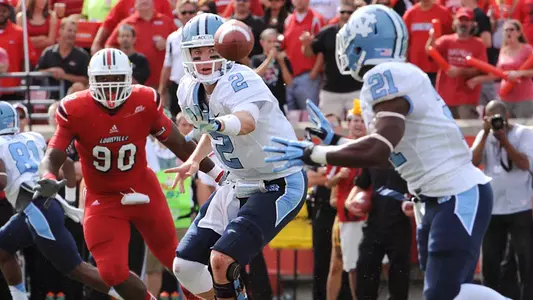
The Tar Heel offense couldn't get out of their own way when the game started. They faced 2nd and 20 on the opening possession. Meanwhile, the defense couldn't seem to get in Louisville's way. Despite kicking off to start the game, the Cardinals were up by two touchdowns less than seven minutes into the first quarter. The rout was on. Louisville reeled off 29 straight points to start the game, aided by botched snaps, an interception and a fumble from the Tar Heel offense. Carolina did not advance the ball past their own 36 until Sean Tapley returned a kick to the 40 early in the second quarter. They finally showed signs of life when Bryn Renner hit Romar Morris for a 44-yard scoring strike, but Louisville answered with a touchdown of their own. Carolina faced a 29-point deficit, at halftime. "It was lack of effort, lack of intensity, lack of passion, lack of enthusiasm, a lot of mental mistakes," Fedora said of his team's first-half performance. "You name it. Whatever could go wrong, went wrong in the first half."
And then something happened. The game had been decided, right? The fourth-largest crowd in Papa John's Cardinal Stadium history began to trickle back to their tailgates confident of easy victory. But Larry Fedora didn't like what he'd seen from his team; knew they had more to give and let them know it. "The challenge to them at halftime was to go out and give everything you had," Fedora said. "Fight, scratch, claw to do the best you could possibly do because the first half was gone and we totally threw it away."
"He challenged all of us. How hard are we going to play, and what kind of character do we have as a team?" Renner said. "Every time this team has had their character challenged by anybody, whether it's outside events or things that happen in the game, we've always stepped up. I think you can't say enough about what we did in the second half."
He's right. It started on Louisville's opening possession of the third quarter, when former walk-on Tommy Heffernan got a fourth-down stop at the Tar Heel 20. Renner then threw passes on 10 of the next 11 plays, completing seven and capping the drive with a touchdown toss to Eric Ebron. The Cardinals started the fourth quarter with a field goal, but Renner found Erik Highsmith, Morris blocked a punt, and Renner connected with Ebron again. Now it was 39-28. The swarming defense forced another punt, and Renner went to work again. He dinked and dunked to midfield before hitting Morris, who carved through the Cardinal defenders for a 50-yard score. 39-34. The two-point conversion failed, but Alex Dixon recovered a fumble on the ensuing kickoff. Carolina started at the Cardinal 23, used a pass interference penalty to get 1st and goal at the Louisville 9, then 3rd and goal at the 3 before a false start penalty backed the team up. Morris picked up four on the ground to set up a do-or-die 4th and goal from the 4-yard line. After a Tar Heel timeout, Renner looked for Highsmith in the end zone. The senior had the ball in his grasp for a fleeting moment before Andrew Johnson knocked it away. "Everything was going in our favor in the second half, and I've just got to make that play," Highsmith said. "I'll probably have nightmares about it. I've got to make that play."
Fedora said after the game that he'd need to do a better job preparing his team. It's true that the team came out flat. Morris said as much. They simply didn't look ready to play, on both sides of the ball, from the opening kickoff. "You've got to make something happen, and when something doesn't happen, you've still got to make it happen," Fedora said. "You can't sit back and wait for somebody else to do it. You've got to go out there and do it yourself." In the second half, they did make things happen. Renner was brilliant: 15-23 for 207 yards and four scores in the second half alone. Morris was lightning-quick with the ball in his hands. And Heffernan and Kevin Reddick were able to make plays in the Louisville backfield to keep their team in the game.
There are no moral victories, certainly, but there are games that give you something to build on. That 2010 team lost a close one to Georgia Tech the next week, then reeled off four straight wins and six in seven games. By the time they faced Tennessee in the Music City Bowl, they'd figured out how to win close games and pulled off one of the most improbable victories in Carolina football history. "I remember a lot from that game, and I remember how the team rallied around that game and fought through," said Renner, who'd been a redshirt freshman watching his roommate Yates direct the offense. "I think this could be a game like that, but we've got to see what happens and just keep moving forward and working hard."
The Tar Heels won't take a victory from Saturday, but they will take something intangible: belief in themselves. And in the long run, that's even more precious.
Turner Walston is the managing editor of Tar Heel Monthly.
Follow the THM staff on Twitter.
Players Mentioned