University of North Carolina Athletics
Training Days
August 28, 2014 | General, Featured Writers, Sports Medicine, Turner Walston
By Turner Walston
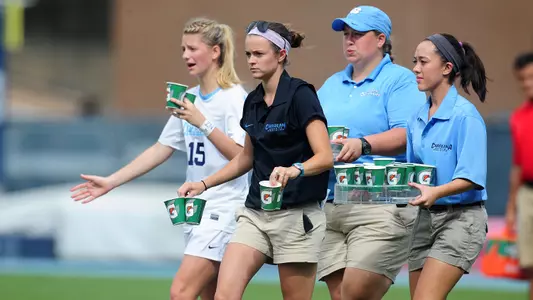
They're in the huddle. They're on the sideline. They're in the dugout, by the pool, or at the track. Athletic trainers are ready to attend to the medical needs of Tar Heel student-athletes. And though you might only see them on game days, the work of the athletic trainers at Carolina goes well beyond taping ankles and icing elbows.
Carolina has both undergraduate and graduate athletic training educational programs in the Department of Exercise and Sport Science, and students are active participants in the health and safety of athletic teams. Undergraduate athletic trainers assist and observe in the training room and on the field. Graduate assistants are students pursuing their master in arts degree in Exercise and Sport Science with a specialization in athletic training. They too assist in taking care of student-athletes in addition to taking classes, conducting research, teaching Lifetime Fitness classes and working in the student health clinic. “They are really the direct link between that education component and research component and what we do in practice in the clinical setting,” said Kenny Boyd, head athletic trainer for football. “So in a lot of ways, they're a huge asset for us because we're able to do some things on a research basis that a lot of other schools can't.”
Graduate assistants Alessa Lennon (second year) and David Mincberg (first year) work with football as well as fencing. Lennon is currently conducting research for her thesis, comparing two commercially-available head impact monitoring devices: the HITS system, in use for several years at UNC, and the xPatch system. The HITS encoders are worn as part of the helmet, whereas the xPatch device is placed behind an athlete's ear. “The thing that's really neat about the xPatch is that any athlete can wear it. It's a really small device that just goes behind the ear, so we're comparing the differences. Do they measure the same thing?” Lennon is gathering data to see if the xPatch might be more cost-efficient for athletic programs.
Carolina is somewhat unique among athletic training programs in that the research, education and clinical settings are so well linked. “Our grad students are really getting a wide education,” said Mario Ciocca, director of sports medicine. “They're teaching classes, they're working on their thesis and their research and coming out and taking care of a team and doing some work in clinic.”
Recent graduate Taryn Gilrein is three weeks into her new job as a staff athletic trainer at the University of Indiana, working with Hoosier field hockey and softball. In Chapel Hill, she enjoyed not only working with field hockey and baseball, but in clinic with non-athlete students. “You get so caught up in working with these motivated athletes who are trying to get back (to play), and you're trying to get them back as quickly as possible. So, to be in the campus health side of it, seeing one-on-one actual patients that see you with everyday issues, I think that gives you another piece of expertise and experience,” she said. “They don't have the same complaints and demands, so I think that that's really unique.”
And having a concussion clinic and a movement analysis lab in the heart of campus allows sports medicine staff to implement advancements directly with athletic teams. “We've got such a close relationship with Exercise and Sports Science,” Ciocca said. “That has made it easy for them to perform research that they need to perform in the clinical side, and it's also been beneficial for us, because it helps us out to in being able to take research that they've done and apply it clinically.”
So when you see athletic trainers rush out to carry water to a football huddle, know that you're seeing just the tip of the iceberg. Graduate assistants for football perform morning treatments early, then take classes, teach a lifetime fitness class. “Around 12:30 or 1, we'll go back down to Kenan to get ready for practice,” Lennon said. “More treatment, taping, pre-practice duties and then in addition we'll also have fencing treatments in the morning or afternoon.” The rest of the day involves clinic or research (or both), studying and homework. And then it all begins again.
“That was probably one of the best parts, when an athlete sees you on campus or has you in an LFIT class that you're teaching and they kind of wrap their heads around, 'Oh wait, you go to class 8 to 12, and teach 12 to 1, and then you're here?'” Gilrein said. “That's the cool part, when they realize it and appreciate it that much more.”
Many former Carolina students go on to become staff athletic trainers, or work in orthopedic clinics, pursue a Ph.D. or become physicians, Ciocca said. And as the Carolina athletic training family expands, so too does its influence. “We've got some real quality grad students that have come through here,” Ciocca said. “We see that at the national conferences. We see all the presentations and research that's done by not only our staff that's here, but then all the grad students and former students that are making an impact nationally.”
Boyd knew of Carolina's reputation well before he joined the staff this year. “In our profession, UNC is one of the leaders in educational advancement and just in the overall profession,” he said. They're a leader amongst athletic trainers and our group. Coming to Carolina as an athletic trainer into this program, it's kind of a honor to be a part of this staff.”
On her third day on the job in Bloomington, Gilrein sent text messages to both staff athletic trainer Terri Jo Rucinski and Scott Oliaro, associate director of sports medicine. “I just said 'Thank you,' because you don't notice it when you're in there. You're tired, they keep throwing things on to you. 'Now teach this class,' and 'now you have to finish this.' You appreciate it so much more. They set you up so that everything else will be a little bit easier. Nothing will feel as overwhelming as it did for those two years,” she said. “It's amazing, stepping into staff member shoes after being in grad assistant shoes or even undergrad shoes, the difference. After being at Carolina, it's incredible how comfortable I am, and I'm surprised at myself at how much I learned there and they taught me.”