University of North Carolina Athletics
Tar Heel Athletic Traditions 101
April 24, 2015 | General
by Fred Kiger
Everyone be seated, put away your crossword puzzles, stop twittering and thanks for being here. This little literary treatise is intended to be a primer to help all those who do know, instruct those that don't, and it appears there's still quite a few in the latter category.
One might call this Tar Heel Athletic Traditions 101. We'll launch this edition with the most frequent question, which is almost always, “What IS a Tar Heel?”
Well, there are several stories out there but all revolve around a common thread—pine trees. One fanciful story and, I emphasize “story,” relates to Cornwallis' British Army who, in early May of 1781, forded the Tar River and, thanks to tar dumped into the river to prevent its seizure, emerged with tar on their feet.
For my ear and predilection, I'll defer to the late, great William S. Powell who, as pre-eminent North Carolina historians go, is sculpted on our state's Mt. Rushmore. He wrote that we must return to North Carolina's colonial history and that creation of nature I mentioned earlier—pine trees. We have scrub in the mountains, loblolly in the Piedmont and, all through the coastal plain where our history began, we have tall, majestic long-leaf pines.
Those stately gifts of nature served as the basis for our colonial economy. They provided tar, pitch and turpentine, collectively known as naval stores, and they literally kept the English Navy and its merchant marine afloat.
Years before the American War for Independence, the colony of North Carolina shipped over 100,000 barrels of tar and pitch to Great Britain each year. The distillation process was one that attacked the senses. It was messy and smelled to high heaven. Pine logs were stacked, covered with earth then burned. Tar ran from channels excavated on the lower side of the pile.
Because of the product and the process, citizens of colonial North Carolina were nicknamed “Tarboilers.” Now, to the treasure chest of stories, we can add this spin-off. Visitors to our colony/state recorded the spectacle of seeing many barefooted North Carolinians who regularly walked through these long-leaf pine forests and, because they did, wore a badge of tarred resin on the bottom of their heels.
“Tarboilers” morphed to “Tar Heels” and, like tar, our nickname stuck—not only for our state but for its flagship university. Yes, we are “Tar Heels” and share that nickname with no one. It is uniquely ours.
Now, here's a historical note. For many years, being tagged a “Tarboiler” or “Tar Heel” was not complimentary. The term inferred a backward rube or uneducated clodhopper but, interestingly, the Civil War helped to begin a change in that thinking. One story goes back to a battle in the Old Dominion. After the fighting, a group of Virginians and North Carolinians began to bark and hoot at one another.
After being teased about whether there was any tar left down in the Old North State, one North Carolinian retorted that Jeff Davis had bought it all up. “Is that so?” one Virginian asked and then added, “What's he going to do with it?” A North Carolina wit shot back, “He's going to put it on you'uns heels to make you stick better in the next fight.”
The exchange was communicated to Robert E. Lee who, reportedly smiled and mused aloud, “God bless those Tar-Heeled boys.” Hence, the beginning of a positive spin on what before had been a verbal dig.
Now, we Tar Heels needed appropriate colors for our appropriately named athletic teams and, according to Archibald Henderson's The Campus of the First State University, UNC's first intercollegiate game was a baseball game with Bingham Military School in the spring of 1884.
A few years later when we got around to adopting colors, we needed distinctive hues to match our unique nickname. As strange as it may seem, our athletic colors can be traced back to two literary and debating societies first created in June of 1795—the Dialectic and Philanthropic Societies.
The Di-Phi, as the two were known on campus, were the oldest student societies in the South and, nationally, second only to those at Princeton. Students from the eastern part of the Old North State joined the Philanthropic and adopted the color white to represent their organization. Those from the west joined the Dialectic and chose light blue. Student officials, managers and marshals wore the color of their respective society to commencement, balls and other social events. So, when Carolina decided on colors, it was an easy and natural selection.
Well, with nickname and colors in place, we needed a logo and, today there are many. But the most distinctive and beloved is the interlocking “NC.” To track this one down is as difficult as agreeing on one version of the origin of “Tar Heel.” For this tradition, I looked for photographic evidence and that led me to UNC's General Alumni Association's library.
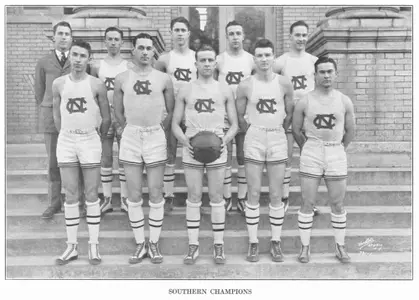
There I pulled volume after volume of Carolina's yearbook, The Hellenian, which pre-dates today's Yackety Yack. I found the first photograph of a UNC athletic team in the 1891 Hellenian. There, UNC's football team—which first fielded a squad in 1888—stared back at me in uniforms that read “UNIVERSITY” across their chests. In 1892, The Hellenian photographed UNC's football team members with jerseys that, either, featured the same “UNIVERSITY” across the chest or a “U” over the left breast.
Things clicked in the 1893 Hellenian. First, both football and baseball teams were photographed and, sure enough—for the first time—I found evidence of something new. Although the football team wore jerseys that sported “NC” across the chest, it was the “University Nine” (baseball team) that became fashion pioneers. They wore jerseys with not only “UNC,” but what appeared to be dark-colored “sweaters” with the interlocking “NC.” The “U. N. C. Base-Ball” team, even, went one step further as some team members brandished caps with the same distinctive logo.
In the same publication one year later, the football team caught up with their diamond mates and wore jerseys with the interlocking “NC” over their left breast and the same logo prominently displayed across the chest of their “sweaters.”
And, anticipating your next question, in a photograph from the 1898 The Hellenian, it was the baseball team who, again, would have made Alexander Julian proud. For the first time I spotted a Carolina athletic team wearing a jersey—though dark—that read “CAROLINA” across the chest.
By the turn of the 20th century, we had a nickname, colors and logo, but we were missing was a mascot. We had to wait until 1924 when UNC cheerleader Vic Huggins reasoned that if Georgia had a bulldog and NC State had a wolf—well, the Heels needed a mascot as well. Huggins persuaded UNC Athletic Business Manager Charlie Woollen to fork over $25 and the quest for a suitable mascot began.
Discovered and bought, our mascot was shipped from Texas to Chapel Hill and, at a pep rally before the VMI game, was introduced. Well, why a ram you ask? Two seasons earlier, a bruising fullback by the name of Jack Merritt led Carolina to a 9-1 record. So bruising, he was nicknamed “the battering ram,” thus, Huggins' inspiration. On November 8, 1924, Rameses was introduced at a pep rally, then, led over to old Emerson Field.
In the game that followed, the Heels were locked in a scoreless tie with a then-powerful VMI team. Late in the contest, Bunn Hackney was called upon to kick a field goal. Before going in, he rubbed Rameses' head and, trotted out onto the field, then, promptly drop-kicked a 30-yarder to win the game, 3-0. Rameses' storied presence began.
And, so, now suitably armed to refer and or answer questions from those that are unaware or curious, go forth and enlighten. Class dismissed…