University of North Carolina Athletics
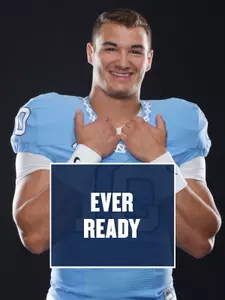
Tar Heel Tenure Prepared Trubisky for National Stage
April 26, 2017 | General

Mitch Trubisky had yet to start a single football game for the Tar Heels, had yet to carry the mantle as the Tar Heels' No. 1 quarterback back in January of 2016 when he gathered with the team's quarterbacks as spring semester opened in Chapel Hill. The coaching staff was on the road recruiting, so quarterback coach Keith Heckendorf put Trubisky in charge of running regular skull sessions.
Trubisky took control of the video and began queuing up tape from various Carolina games the previous year and/or defenses the Tar Heels would see in spring ball.
Where do your eyes go first? Which drop do you use? What clues are the linebackers giving? Watch the safety cheat down. What are your rules in one protection versus another? Go here in this coverage, go there in that coverage.
"Mitch knew our offense in and out,” says one of the quarterbacks in the room, Manny Miles. “When Coach Heck asked him to take the meeting over he didn't flinch because he knew what he was talking about. If you know all the nuances of your offense and what the defense is doing, you can play much more confidently. That definitely helped him once we got into the season.”
Trubisky leaves Carolina this spring to jump into the NFL Draft after four years on the roster—one as a red-shirt, two of seeing spot back-up duty to Marquise Williams and then one as the full-time starter. But the protocols and regimens he's been through certainly prepare him for the next level to a far greater degree than the surface facts might indicate.
"After I get through with football, I want to be a coach,” Trubisky says. “Running the meetings was a good stepping stone. It's a great test of how well you know the offense when you have to teach it to someone else. We'd go over every single detail. When you're in this situation, what do you do? If you get this blitz, what do you do? You make sure you know everyone else's job as well. It was really cool to sit down with those guys and teach the offense. “
Trubisky completed nearly 70 percent of his passes and had a 28:4 touchdown-to-interception ratio last season. He showed the ability to nail the deep ball or fire the ball on a rope on a boundary route. He has a quick release and anticipates receivers making their cuts, often delivering the ball conveniently to a receiver just as he's making his cut and looking back for the ball. And he was sharp getting the Tar Heels into the right call on the frequent run-pass option plays they run.
"What Mitch has done validates what we're doing, that you can come play here and we'll prepare you to be not only a great college player, but also prepare your game to translate to the next level,” says Heckendorf, a graduate assistant under John Shoop and Blake Anderson from 2011- 13 before assuming the QB coach role when Anderson left for Arkansas State in December 2013.
Heckendorf's perspective combines the pro-style passing game he learned coaching under Bill Callahan at Nebraska and Shoop at Carolina, both of them from the Jon Gruden family of offensive minds. Mix that with the spread formation that Fedora and Anderson brought to Chapel Hill in 2012, and quarterbacks on the Tar Heels' roster now have the opportunity to learn and execute the best of both worlds.
"What we've done here is taken the approach of teaching the quarterback just like they teach in the NFL,” Heckendorf says. “It's the same thought process on what is important— where to have your eyes and how you move your feet. I've worked with guys who've all coached in the pros, and I've taken that method of thinking and teaching and applied it to an offense that runs no-huddle and is spread out. It gives us the ability to utilize all the players' skills and talents in the run and pass game. It gives us the ability to have success in college that translates to the pros. Mitch is a product of that.”
The collegiate spread offense that utilizes a quarterback nearly exclusively in a shotgun formation is often roiled as not adequately preparing quarterbacks for the pros, where the default setting is quarterback under-center.
Former Tar Heel QB Bryn Renner, who's been on five NFL rosters over three years, and Heckendorf believe Trubisky's eventual performance in the majors will refute that.
"Look at the Patriots—they're in the gun the entire time they want to throw the ball, they're under center when they want to run it,” says Renner, now on Butch Davis's staff at Florida International. “You have to do both. The Packers are rarely under center nowadays. [Former Oregon QB] Marcus Mariota was never under center. Jameis Winston wasn't under center much at FSU. The game is evolving. Mitch won't have an issue.”
Renner hosted Trubisky on his official recruiting visit in 2012 and was the starting quarterback in 2013 when Trubisky was redshirting. They formed a close bond, and Trubisky sought Renner's counsel when weighing the pros and cons of leaving for the NFL. Renner suggested to Trubisky that his relative lack of starting time shouldn't be a problem.
"How many reps did you get in practice over four years?” Renner asked. “You got every single second-team rep for two years before you started. You played against the No. 1 defense all spring and fall camp. You prepared like a starter for three seasons.”
Heckendorf remembers Trubisky being the first one in the quarterbacks' meeting room during his early enrollee semester in the spring of 2013 and that his “big picture” view of his career helped accelerate his development—albeit behind the scenes at times. That motivation helped during the two years he was backing up Williams, as it's Heckendorf's protocol that the No. 2 quarterback during practice take “mental reps” on every snap by standing behind the play and mimicking the footwork and downfield reads on each first-team snap.
"Mitch had a vision of where he wanted to go with his career,” Heckendorf says. “We coached him in that manner to prepare him not only to have success in college, but also so his game would translate to the next level.”
The exposure and notoriety Trubisky has gotten will certainly pay dividends for the Tar Heel staff in signing future quarterbacks. Long a school known for producing tailbacks, defensive linemen and linebackers, the Tar Heels over the last decade have seen T.J. Yates, Renner, Marquise Williams and now Trubisky at least get to training camp, if not beyond, on NFL teams. A run like that has never happened before.
"The bar's been set pretty high now,” says Yates, who started for the Houston Texans and led them to a win over Cincinnati in 2012. “All four of us have gotten a good grounding in high-level quarterback play— whether it's drop-back, the spread, vertical, underneath. We've learned it all and played it all at Carolina. It's nice to see some tradition getting started at Carolina.”
The Tar Heels didn't sign a high school quarterback with the 2017 class because they signed two a year ago and didn't anticipate Trubisky leaving early. Trubisky's name, image and accomplishments are providing an arsenal of sales mojo as Heckendorf now casts the Carolina line into the recruiting pool.
"Everyone knows who Mitch is right now,” Heckendorf says. “People see the North Carolina name and associate it with Mitch. It changes your profile: 'Hey, this is a place you can come to, and one, get a great education, and two, you'll be prepared to play on Sunday.'”
The Tar Heel staff was selling that concept a year ago. Now they have proof.
"What is awesome is that a lot of quarterbacks in the 2018 class, we started the process last year,” Heckendorf says. “What's fun for me is I told everyone last spring and summer that by the end of '17, everyone in the country would know who Mitch Trubisky is. At the time, no one knew who he was. For us to say that to coaches and prospects across the country and then watch it unfold was a lot of fun. Now everyone looks at us and says, "Okay, they know what they're talking about."
This story appeared in the April 2017 issue of Born & Bred magazine.