
University of North Carolina Athletics
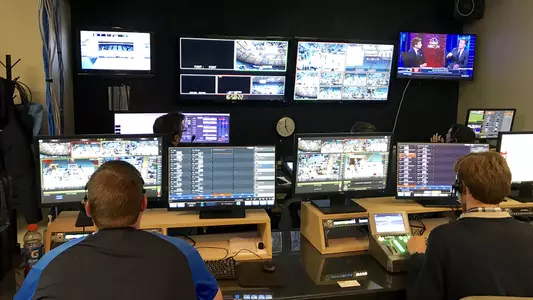
The GoHeels Productions Smith Center control room
Photo by: UNC Athletic Communications
GoHeels Exclusive: Keeping The Viewer Engaged
December 14, 2018 | General, Featured Writers
By Pat James, GoHeels.com
It's eight minutes to game time in Carmichael Arena, and Evan Badler's as prepared as he can be.
Over the next two hours this Wednesday afternoon, the producer of GoHeels Productions' coverage of North Carolina athletics on ACC Network Extra will make countless decisions that'll impact how viewers experience the women's basketball team's 82-55 win over UNC Wilmington. All will be made from his front-row seat in the Smith Center control room, with the assistance of four camera angles, several graphics and replays, and a team of 11 people.
Badler will be in control of everything. Everything except the actual game. He understands that's what people are tuning in for, not for anything specific he or his team does. He also knows that despite all the information that's been gathered for this broadcast, not all of it's guaranteed to be used after tipoff.
"We are seven minutes out, everybody," Badler exclaims once the clock strikes 3:23 p.m. It's the last time update he'll give before his 10-second countdown.
One hundred and thirty seconds pass from going on air to the tipoff. In that span, Badler uses eight camera switches and five graphics to set the story. He started planning this open, one primarily focused on Stephanie Watts, UNCW leading scorer Shrita Parker and the two head coaches, two days in advance.
"You don't want to abandon anything if you've brought it up, especially early on," Badler said. "But I definitely don't get caught in the sunk costs. If it's not it, it's not it. … So you go in with a plan, but you have to be ready to kind of adjust or just totally dump it at any time."
Finally, at 3:30 p.m., the broadcast comes on air.
Play-by-play announcer Dean Linke sets the scene with a wide-angle shot of Carmichael. Color commentator Kyle Straub then puts Badler's pre-planned narrative into motion by referencing Watts' recent offensive success. Every talking point is accompanied by a graphic. Dylan Field, the assistant director of live broadcasts for GoHeels Productions, runs those. He also readied the equipment in the arena earlier in the day and organized the crew.
The 130 seconds before tipoff go by without any mishaps, at least none noticeable to the viewer at home.
"All right," Badler says when Taylor Koenen wins the tipoff, "we're off and running."
The game's in control now.
It's eight minutes to game time in Carmichael Arena, and Evan Badler's as prepared as he can be.
Over the next two hours this Wednesday afternoon, the producer of GoHeels Productions' coverage of North Carolina athletics on ACC Network Extra will make countless decisions that'll impact how viewers experience the women's basketball team's 82-55 win over UNC Wilmington. All will be made from his front-row seat in the Smith Center control room, with the assistance of four camera angles, several graphics and replays, and a team of 11 people.
Badler will be in control of everything. Everything except the actual game. He understands that's what people are tuning in for, not for anything specific he or his team does. He also knows that despite all the information that's been gathered for this broadcast, not all of it's guaranteed to be used after tipoff.
"We are seven minutes out, everybody," Badler exclaims once the clock strikes 3:23 p.m. It's the last time update he'll give before his 10-second countdown.
One hundred and thirty seconds pass from going on air to the tipoff. In that span, Badler uses eight camera switches and five graphics to set the story. He started planning this open, one primarily focused on Stephanie Watts, UNCW leading scorer Shrita Parker and the two head coaches, two days in advance.
"You don't want to abandon anything if you've brought it up, especially early on," Badler said. "But I definitely don't get caught in the sunk costs. If it's not it, it's not it. … So you go in with a plan, but you have to be ready to kind of adjust or just totally dump it at any time."
Finally, at 3:30 p.m., the broadcast comes on air.
Play-by-play announcer Dean Linke sets the scene with a wide-angle shot of Carmichael. Color commentator Kyle Straub then puts Badler's pre-planned narrative into motion by referencing Watts' recent offensive success. Every talking point is accompanied by a graphic. Dylan Field, the assistant director of live broadcasts for GoHeels Productions, runs those. He also readied the equipment in the arena earlier in the day and organized the crew.
The 130 seconds before tipoff go by without any mishaps, at least none noticeable to the viewer at home.
"All right," Badler says when Taylor Koenen wins the tipoff, "we're off and running."
The game's in control now.
Preparing for imperfection
Badler said there's no such thing as a perfect broadcast. There are too many variables involved in the game itself, let alone the production. His recognition of that hints at how understanding he and his team are of the little influence they have over the event they're covering.
"Ideally, you get a game that's about 10-15 points the whole time, close enough to where there's something to talk about for both teams and not too close that you're worried about extra timeouts and overtime," he said. "That's your perfect idea.
"But you can't really go in looking for that. You sort of just have to roll with it as you go."
That ideal broadcast becomes unattainable when UNC seizes a 34-point lead late in the second quarter, if not earlier. Much of the information Badler researched and told his team to monitor during the pregame run-through – such as the Tar Heels' free-throw proficiency and the play of UNCW's Paige Powell in the post – won't be integral to the broadcast. But it's still valuable.
How far in advance Badler begins preparing for a broadcast depends on numerous factors. Mostly, it's determined by how many games he's producing before that one. For the UNCW contest, he hadn't produced any game since the volleyball match against Florida State on Nov. 21, two weeks earlier. So he had an idea of what he wanted to feature during the UNCW broadcast, specifically in the open, well in advance.
Badler said ESPN encourages his team to sell Carolina's stars. That made Watts, averaging 19.2 points over her previous five games, a prime player for Badler to highlight in the open, even before he learned Paris Kea would be sidelined against the Seahawks because of an injury.
"So the big thing is, 'OK, who steps up when your primary ball-handler is down?'" Badler said. "That kind of writes your story for you."
The same logic can be applied for his decision to include Parker in the open.
To defeat the Tar Heels, UNCW likely needed a strong effort from Parker, who entered the game averaging 20.6 points. But she scored eight on 3-for-10 shooting in the first half, a major reason why the Seahawks entered the break down 55-23. Still, she remained part of the narrative.
During halftime, Badler and his team compiled a package showing Parker's poor shot selection. It ran just before the third quarter began.
"Even when it doesn't necessarily go your way," Badler said, "you never want to just abandon your storyline."
Badler said there's no such thing as a perfect broadcast. There are too many variables involved in the game itself, let alone the production. His recognition of that hints at how understanding he and his team are of the little influence they have over the event they're covering.
"Ideally, you get a game that's about 10-15 points the whole time, close enough to where there's something to talk about for both teams and not too close that you're worried about extra timeouts and overtime," he said. "That's your perfect idea.
"But you can't really go in looking for that. You sort of just have to roll with it as you go."
That ideal broadcast becomes unattainable when UNC seizes a 34-point lead late in the second quarter, if not earlier. Much of the information Badler researched and told his team to monitor during the pregame run-through – such as the Tar Heels' free-throw proficiency and the play of UNCW's Paige Powell in the post – won't be integral to the broadcast. But it's still valuable.
How far in advance Badler begins preparing for a broadcast depends on numerous factors. Mostly, it's determined by how many games he's producing before that one. For the UNCW contest, he hadn't produced any game since the volleyball match against Florida State on Nov. 21, two weeks earlier. So he had an idea of what he wanted to feature during the UNCW broadcast, specifically in the open, well in advance.
Badler said ESPN encourages his team to sell Carolina's stars. That made Watts, averaging 19.2 points over her previous five games, a prime player for Badler to highlight in the open, even before he learned Paris Kea would be sidelined against the Seahawks because of an injury.
"So the big thing is, 'OK, who steps up when your primary ball-handler is down?'" Badler said. "That kind of writes your story for you."
The same logic can be applied for his decision to include Parker in the open.
To defeat the Tar Heels, UNCW likely needed a strong effort from Parker, who entered the game averaging 20.6 points. But she scored eight on 3-for-10 shooting in the first half, a major reason why the Seahawks entered the break down 55-23. Still, she remained part of the narrative.
During halftime, Badler and his team compiled a package showing Parker's poor shot selection. It ran just before the third quarter began.
"Even when it doesn't necessarily go your way," Badler said, "you never want to just abandon your storyline."
Keeping the viewer engaged
Badler believes including more narrative elements in the broadcasts in recent years has appealed to viewers. And the numbers seem to suggest that's true.
According to Badler, the viewership for most sports that GoHeels Productions broadcasts was at or above the ACC average during the 2017-18 athletic year. But he's also quick to mention that it's difficult to determine how much of what he does drives viewership.
"All you can do," he said, "is try to make (the broadcast) clean and give people the tools they need to succeed."
On both fronts, the UNCW broadcast delivered.
The most important replays were shown, including Watts' 3-pointer that accounted for the game's first points and a hard foul she absorbed late in the first quarter. When Parker requested to be subbed out late in the second period, Badler immediately wanted to know if Parker had sustained an injury. A baseline camera provided a replay of the layup she made seconds earlier. Just before then, Badler had a shot of UNCW men's basketball coach C.B. McGrath, a former Carolina assistant, sitting in the crowd, and seamlessly promoted the men's game that night.
The rest of the broadcast went on without a hitch. Although the Tar Heels led the game from beginning to end, Watts gave Linke and Straub plenty to talk about, scoring 35 points and making nine 3-pointers, one off her ACC record.
Everything predominantly goes to plan. The viewer has no reason to think otherwise.
"You're trying to tell a good story, you're trying to sell the game," Badler said. "There's no commercial we're running for the game anywhere. … You know, you can bring a horse to water, but you can't make them drink. In this case, it's the opposite. You can't get them there. But once you get them there, it's your job to keep them."
Badler believes including more narrative elements in the broadcasts in recent years has appealed to viewers. And the numbers seem to suggest that's true.
According to Badler, the viewership for most sports that GoHeels Productions broadcasts was at or above the ACC average during the 2017-18 athletic year. But he's also quick to mention that it's difficult to determine how much of what he does drives viewership.
"All you can do," he said, "is try to make (the broadcast) clean and give people the tools they need to succeed."
On both fronts, the UNCW broadcast delivered.
The most important replays were shown, including Watts' 3-pointer that accounted for the game's first points and a hard foul she absorbed late in the first quarter. When Parker requested to be subbed out late in the second period, Badler immediately wanted to know if Parker had sustained an injury. A baseline camera provided a replay of the layup she made seconds earlier. Just before then, Badler had a shot of UNCW men's basketball coach C.B. McGrath, a former Carolina assistant, sitting in the crowd, and seamlessly promoted the men's game that night.
The rest of the broadcast went on without a hitch. Although the Tar Heels led the game from beginning to end, Watts gave Linke and Straub plenty to talk about, scoring 35 points and making nine 3-pointers, one off her ACC record.
Everything predominantly goes to plan. The viewer has no reason to think otherwise.
"You're trying to tell a good story, you're trying to sell the game," Badler said. "There's no commercial we're running for the game anywhere. … You know, you can bring a horse to water, but you can't make them drink. In this case, it's the opposite. You can't get them there. But once you get them there, it's your job to keep them."

Sunday, October 18
Sunday, October 18
Sunday, October 18
Sunday, October 18