


University of North Carolina Athletics
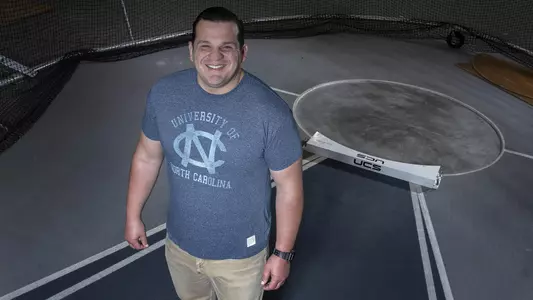
Photo by: Jeffrey A. Camarati
Coached: Amin Nikfar
January 4, 2020 | Track & Field
With a new decade on the horizon, the Carolina track & field and cross country teams ushered in a new era with the hiring of program director Chris Miltenberg in June. Since then, Miltenberg has assembled one of the most promising coaching staffs in the nation.
Associate head coach and recruiting coordinator Michael Eskind, throws coach Amin Nikfar and distance coach Dylan Sorensen joined Miltenberg on his cross-country journey to Carolina. Sprints and relays coach Adrian Wheatley hopped on the Tar Heel train in August and distance coach Sam Nadel reunited with her former Georgetown teammate in September, this time in Carolina blue.
In this series, Tar Heel track & field fans get an inside look this decorated coaching staff. For part three of Coached, GoHeels spoke with assistant coach Amin Nikfar who oversees the development of student-athletes competing in throws events.
In his one season at Stanford, Nikfar earned the honor of the 2019 USTFCCCA West Region's Women's Assistant Coach of the Year for his work with his four women's NCAA Outdoor Championship competitors. Nikfar coached three women to top-five finishes in the NCAA Indoor and NCAA Outdoor Championships including one NCAA title for Mackenzie Little in the women's javelin. In the men's event, Nikfar helped then-freshman Liam Christensen set Stanford's Big Meet, school and freshman records with a javelin throw of 245-4 (74.78 meters).
Before Miltenberg brought Nikfar back to his home state, Nikfar spent three seasons — one as associate head coach and two as an assistant — at Southeastern Louisiana University where he coached throws and the high jump from 2015-18. Nikfar's athletes at Southeastern Louisiana earned four All-America honors. He coached 11 NCAA East Prelims qualifiers, nine Southland Conference champions and 15 conference podium finishers. Nikfar also coached the Lions' Alex Young to an NCAA Indoor Championship weight throw title in 2016 before guiding him to USATF titles in the weight throw and hammer throw during the 2017 indoor and outdoor seasons. Young was also an IAAF World Championships qualifier and the 2017 NCAA hammer runner-up and continues to work with Nikfar in his professional career training.
A two-time Olympian, Nikfar competed in the 2008 Beijing and 2012 London Olympic Games and appeared in two IAAF World Championships. He was a nine-time Iranian champion and broke national records six times. He was also the 2004 Asian indoor champion and his collegiate-best mark still ranks No. 7 on the University of California Berkeley's all-time list in the shot. His lifetime best of 65-9 ½ (20.05 meters) from 2011 remains an Iranian record.
Read below what Nikfar had to say about Carolina, his coaching career and his Olympic experience.
–––––––––––––––––––––––––––––––––––––––––––––––––––––––––––––––––––––––––––
Q: How did you get to Carolina?
A: "My story is probably pretty similar to Coach Eskind's and Coach Sorensen's since we all followed Coach Milt from Stanford, but working for Milt last year was fantastic. He's a wonderful head coach. I really love his vision and his drive, and I wanted to keep being a part of it. When he took the job at Carolina and asked me to come, it was an absolute no brainer because I love working for the guy and I know the potential that Carolina track & field has. I just wanted to be a part of building and rebuilding something that can be truly great."
Q: How would you describe your coaching style?
A: "I think I'm a relationship coach. The secret is not the programming; it's not the training; it's not any of that stuff. The secret is the day-to-day interaction with the student-athletes — building relationships with them, getting to know them, finding out what they want, identifying the challenges they face and just building them up as humans to be the best versions of themselves. Those things are really difficult to replicate. You meet them where they are and then hold them to the expectation that they will meet you where you want them to be at some point. The part that others get to see is a track result, but there's also going to be a positive spillover into their life as a whole."
Q: Why did you take a five-year hiatus from coaching?
A: "I was competing during that time. At the end of my last professional season in 2014, I knew I wasn't going to throw anymore, and by then I'd realized I didn't like working in a classroom. I needed to be outside and coaching was a way to do that. So, I started looking for a job in coaching and got an opportunity to coach at the University of New Orleans. That was a fantastic first job — a lot of challenges and a lot of learning. It was a good place to figure out if I really wanted to coach because it was hard. If it had been easy, maybe I would have come to the same conclusion, but that's not what happened. Just getting a taste of Division I track coaching at UNO really shored it up for me. I kept with it because I love the educational process and I love seeing the student-athletes grow. The results of championships or national don't tell the story. The student-athletes get to know their stories and I get to know their stories, but the results are just a snapshot of what they've been doing. Others get to know those stories, too, if they ask."
Q: Let's transition from your coaching days to your competition days. Obviously, the Olympics are a dream for some people, so it has to be hard to sum up your experiences in a short quote especially since you competed on that stage not once but twice. Tell us a little bit about your experience at the Olympics.
A: "It's incredible to be able to compete at the top of your sport no matter what it is, and I can say that the Olympic Games are exactly what people think they are. It's an amazing experience and it's a place where you figure out a little bit about yourself, too. I think it's easy for me to be the way I am about the Olympics because I was fortunate enough to compete at them twice. It's easy for me to talk about competing, about how tough it was and all that stuff. But in my mind, the story isn't the Olympic Games. The real story is the story of struggle to get there, all the years of work and the season leading up to it. people just get to see the finished product and that's good, but I wish that there was a way for them to see how you did it.
"I think this goes for any Olympian, but we're not in a cocoon for four years. We don't all of a sudden compete at the Olympic Games. Everybody who makes it to that level has a story about the struggle. The periods leading up to that is hard — there were times when I was working at the high school and I wouldn't be getting the proper recovery, I wouldn't sleep great, but I was still trying to train while taking care of family stuff. Now, maybe if I would have done better, it'd be different. I'm not sure if I was dead last, but I was pretty close. Sometimes I think the people who don't make it to the Olympics, the people who place fourth at trials, those are some of the most interesting stories you'll ever hear. But again, it's an incredible experience and I think that the street cred you get is pretty cool, but I don't think me competing at the Olympic Games is the reason I can coach."
Q: You're no stranger to working with national champions and now you're working with some of greatest throwers in Carolina's program history. However, they've also faced some pretty low moments in their careers. Do you find having that kind of experience — one where you made it to the top of the sport but didn't have the success you wanted — helps you relate to your student-athletes on their bad days?
A: "Absolutely. If you look at the peaks and valleys in people's careers — PRs, big meets — that's not the majority of what happened. Having been through an incredible amount of disappoint in my career, I think that it's very easy to relate to people like Daniel and Jill who don't make the national meet coming off of big performances because I've been there. I don't want them to go through that at all — it's not fun. Not that much of my throwing career is the reason behind my coaching mindset, but I try to be a very positive coach. Doesn't mean that things are happy all the time, but I want to frame things in a positive way. I want to find the silver lining no matter how small it is and try to build off of it. Knowing what the dark clouds look like, it's a bit easier for me to navigate the bad days and find those silver linings."
Q: For you, would you say your silver lining was the fact that you won nine Iranian championships and set national records six times?
A: "It was good. I just believe the bigger picture with that is I got to experience the sport for almost a decade after college. That's something most people don't get to do. I got to travel the world, get some perspective — not just in track but in life — and experienced a sport at a high level in different places. I saw the different approaches to competition and the different approaches to events in the Middle East, Asia and Europe. Just seeing how people operate in different environments and their struggles, I had no idea what I was going to use those experience for, but I knew having them in my toolbox for later would be important."
Q: At larger meets, most other events can have multiple people competing at once –– two pole vault mats, two jumping pits, eight lanes. Throws seem to be a bit more isolating, especially in a cage or on the javelin runway. How did you manage the pressure of all eyes on you as a student-athlete and professional competitor? What advice do you give current student-athletes to help manage them that same feeling?
A: "It comes comes down to being able to operate in any environment. If we can operate in practice the way we want to operate in a meet, then we operate at the small meets and then we operate at the bigger meets. I think I acknowledge the pressure is there, but that's only a factor for better performance in my mind. I don't ever view pressure as a reason to do poorly — you take the butterflies in your stomach and you make them help you fly."
Q: What's the most important piece of advice you've ever received from a coach?
A: "When I first started coaching, I called my old coach throws coach as Cal, Mohamad Saatara. It was before my first real college job at UNO, but I called up Mo and said, 'How do I do this?' He asked, 'What are you talking about?' Again, 'How do I do this?' He told me, 'You really only have to ask yourself two questions. Number one, what do you want them to learn? And number two, is that what you're teaching them? If you can answer those two questions the way you want, you're doing it right. If you can't, you're doing it wrong.' It's the most simple, pragmatic approach to coaching that I've ever heard. More recently, I'm actually a big Mack Brown fan. I watch all of his postgame media events and after one of the early games in the season, he was talking about how as coaches you're either teaching things or allowing them. He used the example of a position coach saying a kid ran the wrong route. Mack said, 'No, you taught him the wrong route.' I think that's something many of us in life and in coaching know, but Mack was the first one I heard verbalize it — you're either teaching it or you're allowing it. I love Mack Brown for that."
Q: If you could only give one piece of advice to every future student-athlete, what would it be?
A: "Figure out what you want and commit to it. Embrace the struggle because at the end of the day, the long, windy, bumpy road you travel will be worth it and you'll be better for it – in sport and in life."
Associate head coach and recruiting coordinator Michael Eskind, throws coach Amin Nikfar and distance coach Dylan Sorensen joined Miltenberg on his cross-country journey to Carolina. Sprints and relays coach Adrian Wheatley hopped on the Tar Heel train in August and distance coach Sam Nadel reunited with her former Georgetown teammate in September, this time in Carolina blue.
In this series, Tar Heel track & field fans get an inside look this decorated coaching staff. For part three of Coached, GoHeels spoke with assistant coach Amin Nikfar who oversees the development of student-athletes competing in throws events.
In his one season at Stanford, Nikfar earned the honor of the 2019 USTFCCCA West Region's Women's Assistant Coach of the Year for his work with his four women's NCAA Outdoor Championship competitors. Nikfar coached three women to top-five finishes in the NCAA Indoor and NCAA Outdoor Championships including one NCAA title for Mackenzie Little in the women's javelin. In the men's event, Nikfar helped then-freshman Liam Christensen set Stanford's Big Meet, school and freshman records with a javelin throw of 245-4 (74.78 meters).
Before Miltenberg brought Nikfar back to his home state, Nikfar spent three seasons — one as associate head coach and two as an assistant — at Southeastern Louisiana University where he coached throws and the high jump from 2015-18. Nikfar's athletes at Southeastern Louisiana earned four All-America honors. He coached 11 NCAA East Prelims qualifiers, nine Southland Conference champions and 15 conference podium finishers. Nikfar also coached the Lions' Alex Young to an NCAA Indoor Championship weight throw title in 2016 before guiding him to USATF titles in the weight throw and hammer throw during the 2017 indoor and outdoor seasons. Young was also an IAAF World Championships qualifier and the 2017 NCAA hammer runner-up and continues to work with Nikfar in his professional career training.
A two-time Olympian, Nikfar competed in the 2008 Beijing and 2012 London Olympic Games and appeared in two IAAF World Championships. He was a nine-time Iranian champion and broke national records six times. He was also the 2004 Asian indoor champion and his collegiate-best mark still ranks No. 7 on the University of California Berkeley's all-time list in the shot. His lifetime best of 65-9 ½ (20.05 meters) from 2011 remains an Iranian record.
Read below what Nikfar had to say about Carolina, his coaching career and his Olympic experience.
–––––––––––––––––––––––––––––––––––––––––––––––––––––––––––––––––––––––––––
Q: How did you get to Carolina?
A: "My story is probably pretty similar to Coach Eskind's and Coach Sorensen's since we all followed Coach Milt from Stanford, but working for Milt last year was fantastic. He's a wonderful head coach. I really love his vision and his drive, and I wanted to keep being a part of it. When he took the job at Carolina and asked me to come, it was an absolute no brainer because I love working for the guy and I know the potential that Carolina track & field has. I just wanted to be a part of building and rebuilding something that can be truly great."
Q: How would you describe your coaching style?
A: "I think I'm a relationship coach. The secret is not the programming; it's not the training; it's not any of that stuff. The secret is the day-to-day interaction with the student-athletes — building relationships with them, getting to know them, finding out what they want, identifying the challenges they face and just building them up as humans to be the best versions of themselves. Those things are really difficult to replicate. You meet them where they are and then hold them to the expectation that they will meet you where you want them to be at some point. The part that others get to see is a track result, but there's also going to be a positive spillover into their life as a whole."
Q: Why did you take a five-year hiatus from coaching?
A: "I was competing during that time. At the end of my last professional season in 2014, I knew I wasn't going to throw anymore, and by then I'd realized I didn't like working in a classroom. I needed to be outside and coaching was a way to do that. So, I started looking for a job in coaching and got an opportunity to coach at the University of New Orleans. That was a fantastic first job — a lot of challenges and a lot of learning. It was a good place to figure out if I really wanted to coach because it was hard. If it had been easy, maybe I would have come to the same conclusion, but that's not what happened. Just getting a taste of Division I track coaching at UNO really shored it up for me. I kept with it because I love the educational process and I love seeing the student-athletes grow. The results of championships or national don't tell the story. The student-athletes get to know their stories and I get to know their stories, but the results are just a snapshot of what they've been doing. Others get to know those stories, too, if they ask."
Q: Let's transition from your coaching days to your competition days. Obviously, the Olympics are a dream for some people, so it has to be hard to sum up your experiences in a short quote especially since you competed on that stage not once but twice. Tell us a little bit about your experience at the Olympics.
A: "It's incredible to be able to compete at the top of your sport no matter what it is, and I can say that the Olympic Games are exactly what people think they are. It's an amazing experience and it's a place where you figure out a little bit about yourself, too. I think it's easy for me to be the way I am about the Olympics because I was fortunate enough to compete at them twice. It's easy for me to talk about competing, about how tough it was and all that stuff. But in my mind, the story isn't the Olympic Games. The real story is the story of struggle to get there, all the years of work and the season leading up to it. people just get to see the finished product and that's good, but I wish that there was a way for them to see how you did it.
"I think this goes for any Olympian, but we're not in a cocoon for four years. We don't all of a sudden compete at the Olympic Games. Everybody who makes it to that level has a story about the struggle. The periods leading up to that is hard — there were times when I was working at the high school and I wouldn't be getting the proper recovery, I wouldn't sleep great, but I was still trying to train while taking care of family stuff. Now, maybe if I would have done better, it'd be different. I'm not sure if I was dead last, but I was pretty close. Sometimes I think the people who don't make it to the Olympics, the people who place fourth at trials, those are some of the most interesting stories you'll ever hear. But again, it's an incredible experience and I think that the street cred you get is pretty cool, but I don't think me competing at the Olympic Games is the reason I can coach."
Q: You're no stranger to working with national champions and now you're working with some of greatest throwers in Carolina's program history. However, they've also faced some pretty low moments in their careers. Do you find having that kind of experience — one where you made it to the top of the sport but didn't have the success you wanted — helps you relate to your student-athletes on their bad days?
A: "Absolutely. If you look at the peaks and valleys in people's careers — PRs, big meets — that's not the majority of what happened. Having been through an incredible amount of disappoint in my career, I think that it's very easy to relate to people like Daniel and Jill who don't make the national meet coming off of big performances because I've been there. I don't want them to go through that at all — it's not fun. Not that much of my throwing career is the reason behind my coaching mindset, but I try to be a very positive coach. Doesn't mean that things are happy all the time, but I want to frame things in a positive way. I want to find the silver lining no matter how small it is and try to build off of it. Knowing what the dark clouds look like, it's a bit easier for me to navigate the bad days and find those silver linings."
Q: For you, would you say your silver lining was the fact that you won nine Iranian championships and set national records six times?
A: "It was good. I just believe the bigger picture with that is I got to experience the sport for almost a decade after college. That's something most people don't get to do. I got to travel the world, get some perspective — not just in track but in life — and experienced a sport at a high level in different places. I saw the different approaches to competition and the different approaches to events in the Middle East, Asia and Europe. Just seeing how people operate in different environments and their struggles, I had no idea what I was going to use those experience for, but I knew having them in my toolbox for later would be important."
Q: At larger meets, most other events can have multiple people competing at once –– two pole vault mats, two jumping pits, eight lanes. Throws seem to be a bit more isolating, especially in a cage or on the javelin runway. How did you manage the pressure of all eyes on you as a student-athlete and professional competitor? What advice do you give current student-athletes to help manage them that same feeling?
A: "It comes comes down to being able to operate in any environment. If we can operate in practice the way we want to operate in a meet, then we operate at the small meets and then we operate at the bigger meets. I think I acknowledge the pressure is there, but that's only a factor for better performance in my mind. I don't ever view pressure as a reason to do poorly — you take the butterflies in your stomach and you make them help you fly."
Q: What's the most important piece of advice you've ever received from a coach?
A: "When I first started coaching, I called my old coach throws coach as Cal, Mohamad Saatara. It was before my first real college job at UNO, but I called up Mo and said, 'How do I do this?' He asked, 'What are you talking about?' Again, 'How do I do this?' He told me, 'You really only have to ask yourself two questions. Number one, what do you want them to learn? And number two, is that what you're teaching them? If you can answer those two questions the way you want, you're doing it right. If you can't, you're doing it wrong.' It's the most simple, pragmatic approach to coaching that I've ever heard. More recently, I'm actually a big Mack Brown fan. I watch all of his postgame media events and after one of the early games in the season, he was talking about how as coaches you're either teaching things or allowing them. He used the example of a position coach saying a kid ran the wrong route. Mack said, 'No, you taught him the wrong route.' I think that's something many of us in life and in coaching know, but Mack was the first one I heard verbalize it — you're either teaching it or you're allowing it. I love Mack Brown for that."
Q: If you could only give one piece of advice to every future student-athlete, what would it be?
A: "Figure out what you want and commit to it. Embrace the struggle because at the end of the day, the long, windy, bumpy road you travel will be worth it and you'll be better for it – in sport and in life."

Sunday, June 07
Sunday, June 07
Sunday, June 07
Saturday, June 06