


University of North Carolina Athletics
THE CAROLINA FAMILY - Rams Club
by Adam Lucas

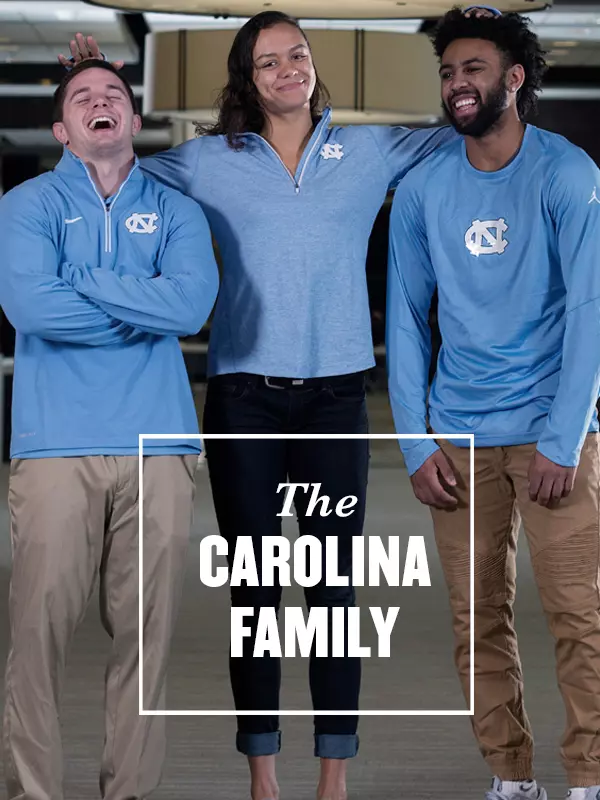
The Carolina Family isn't limited to just one sport. It binds together the athletic department, from the Smith Center to Carmichael to Kenan and beyond. We gathered Ryan Switzer (senior, football), Taylor Treacy (senior, volleyball) and Joel Berry (junior, basketball) to describe why the Carolina Family matters in their daily lives, and the impact they think it will have on their lives beyond Chapel Hill.
ADAM LUCAS: Do you remember the first time you were aware of Carolina athletics?
RYAN SWITZER: My aunt graduated from here. Anytime Carolina and Duke were playing basketball, I was always told to cheer for Carolina. I was in Chapel Hill when she graduated. So, I've been aware of Carolina for the majority of my life.
TAYLOR TREACY: I had no idea about Carolina until I started playing club volleyball. College coaches would come scout on the court, and I saw that Carolina blue for the first time when I was in ninth grade. That's when I first made the association.
JOEL BERRY: I didn't really have a family connection to Carolina. I liked watching Ty Lawson and Raymond Felton play, and my mom was a big fan of Sean May. I liked watching Carolina play, and I loved the color. That's how it became my dream school.
AL: A couple of you mentioned Carolina blue. What is it about that color?
RS: I just look good in blue (laughs).
TT: Everybody does.
RS: When you see that blue, you immediately know it's North Carolina.
TT: I think it was meant to be for me. Before I even knew what Carolina was, I painted my room Carolina blue. A couple months later, I started hearing from Carolina.
RS: It's like the sky. You see it every day without realizing it. It has an impact on you.
AL: This is the time of year when we start to see all the social media videos of Carolina teams cheering on other teams. What creates that bond across the athletic department?
JB: We see each other all the time in Loudermilk (Center for Excellence). When you're around each other that much, you get interested in those other sports and what everyone else is doing.
RS: The student tickets I had were up high, so I bought lower level tickets to a basketball game last month. I know what they go through on a daily basis, because I go through the same thing. I know about their class schedule and academic schedule and I know what it means to have that support from people who understand what it's like.
AL: What is it about that schedule that connects you?
JB: Your schedule is set all the time. You get up, go to class, go to the gym or the field. It's the same continuous schedule all the time. It's what we do, and it can be tough sometimes, but it's what we know we have to do in order to play the sport we love.
TT: As an athlete, you gain a respect for other athletes. You understand the discipline it takes to follow that schedule each day. You know that even though they're playing a different sport, they're working as hard as you. That's where that support comes from.
RS: What people don't fully understand is that not only do you have to perform on and off the field, but in each sport that we play, you can be humbled very quickly if your head isn't in it. It doesn't take much for a team that's less talented to make you look bad. In order to succeed on the court or on the field, you have to bring that focus every day. It's very tough to have that level of focus and attention both physically and mentally every day.
AL: What's the most memorable UNC sporting event you've seen that didn't involve your team?
TT: The Gio game (football vs. NC State, 2012). I was a true freshman and I was at the mall. I was watching the game in the fourth quarter on a screen at this kiosk. I saw the entire thing, and everyone in the mall was screaming. It was awesome.
RS: When the basketball team beat Duke my freshman year. I was in the stands during the game, on the court after the game, and on Franklin Street after the game. We had 6 a.m. workouts the next day and I was out on Franklin until about 4. I went home, took a 45-minute nap, and then made it to workouts.
AL: Everyone across athletics seems to agree that this family feeling is a good thing. If that's the case, then why don't other schools have it?
RS: There's a sense of community here you don't get elsewhere. Not many schools have a Loudermilk, I know that for a fact. Because of that, the interactions between sports are limited. We get to see each other all the time here. Plus, the proximity of all the arenas is important. The Dean Dome is a five-minute walk from Loudermilk. Carmichael is two minutes down the road. You don't have to go off campus or make a 10-15-minute walk. That makes supporting each other so much easier.
TT: Everything is very condensed in this two-mile radius. There's always opportunities to meet each other and build relationships with each other.
JB: Our coaches do a great job of trying to get us to support other teams. We go to every home football game and tailgate. I go to the volleyball games all the time, because I played volleyball when I was younger. I like the action, and they have girls on the team who can really jump. I played football, so I like to see football, and our coaches are always encouraging us to do that.
TT: There's also a lot of investment from the athletic department into marketing the sports. Social media is huge, because everyone is so into their phones. We can see anything at any time and it's easy to figure out what is going on.
AL: Since enrolling at Carolina, who has had the most impact on you?
JB: I have to go with Coach Williams. He saw the talent I had. I went through a rough freshman year, but he stuck with me and believed in me. That's why I am where I am today. At one point, I felt like basketball wasn't for me anymore. He kept on believing in me, and that's why I'm the player I am today.
TT: I would say the same thing about my coaches. It was a completely out of body experience my freshman and sophomore years. I redshirted, so that was an added obstacle. My coaches never quit believing in me. They saw the potential, and they invested in my development. That meant a lot to me, and I owe everything to them.
RS: I would say Coach (Larry) Fedora and Coach (Gunter) Brewer. I struggled my freshman year. People didn't see it, because they only saw punt returns and special teams. But offensively, I was going from playing running back in high school to learning how to play wide receiver in college. It was overwhelming, and I struggled heavily. If it wasn't for special teams, I should've redshirted. But my coaches stuck with me. They worked with me, and I'm where I am today because they didn't just toss me aside. They helped me get better.
AL: Each of you talked about struggles as a freshman. Is that another element of the mutual appreciation you have for each other?
RS: It's actually kind of nice to hear they struggled. It's nice to hear I wasn't the only one. I feel a little better now (laughs). It makes it sweeter today. You see them excelling at what they do, and you know that's because of what they went through. It enables you to enjoy it more now.
JB: You appreciate it so much more because of the struggle. If it came easy, everyone would be doing it. Making that transition from high school to college is tough. That's why I enjoy it now. I'm a junior, and I look at these two, and they're about to graduate. It goes so fast, and you really have to enjoy your time.
AL: If you only had one more week in Chapel Hill before going out into the real world, what would you do?
TT: I'm actually in that position right now. I'm hitting up all my favorite food places on Franklin, visiting friends, trying to make sure I say everything I want to say to everyone . . . it's kind of crazy. It's also sad.
RS: I'm trying to get Coach (Roy) Williams to let me sit on the bench for a game. I've played basketball my whole life. I was good, but obviously not at the Division I level. But if I could just go through layups in warmups my life would be made.
JB: Through the years, I've met so many different people here. I'd like to get the chance to say goodbye to everybody. This is such a welcoming place.
AL: What's something you didn't expect when you came here that now you can't imagine being without?
JB: I had never seen snow before I got here. I had never been around cold weather. So, that's one thing that was completely new. Beyond that, what I've found is that when I go home, I don't really know what home is anymore other than my house. I call Chapel Hill home now. When I graduate, it's going to be so hard to leave. When I go home, I don't know who to talk to or who to hang out with. Everyone I've spent so much time with over the last three years is here. That's why when people leave, they still call Carolina home.
RS: I can't imagine being without some of the people I've met. With 105 guys on the football team, you're not going to be personally close with everyone. But there are 10 or 15 guys I've formed relationships with who I know will be in my life for the next 40 or 50 years.
TT: You learn a lot in college, but the intangibles are what you take away the most. You learn a lot of discipline here. That's so important for later in life. You learn how to communicate with people and how to get things done in time, and how to be a responsible, mature adult. Those are the most important lessons I'll take away.
AL: How often when you are out in the world beyond Carolina do you find a connection with someone who knows you not as an athlete but as a Tar Heel?
RS: It's a worldwide brand. You see the blue and the logo everywhere you go, no matter where you are.
JB: You can be on the other side of the country and you know you will see someone wearing Carolina blue.
RS: It has to be among the most recognizable brands in the world. You've got the greatest ever, Michael Jordan. You've got Mia Hamm. Some of the best athletes to ever play their sports have gone here, and it goes beyond sports. No matter where you go, you always see that Carolina blue, and you know you immediately have an instant connection with that person.
This story appeared in the February 2017 issue of Born & Bred magazine.