University of North Carolina Athletics
LEE PACE'S EXTRA POINTS: Tar Heels' 2001 Charge: Answer The Bell.
August 16, 2001 | Extra Points
Aug. 16, 2001
Extra Points in PDF Format
 Download Free Acrobat Reader
It's third-and-one late in the game and Joe Burns of Georgia Tech must be stopped so the Tar Heels can get the football back with a chance to score ...
Answer The Bell.
It's early in the third quarter and Clemson has seized momentum and is rallying from a 17-0 deficit. Rod Gardner sprints out on another fade route and is reaching toward the sky to snag the football ...
Answer The Bell.
The clock is running down in the fourth quarter and the Tar Heel offense is pecking away at the Virginia goal line. There's a blitzing linebacker for the tailback to pick up. There's one more second for the guard to control his man, there's a decision and a throw waiting for the quarterback to execute with 100 percent precision ...
Answer The Bell.
"'Answer the bell' is our call to step up to the plate," senior receiver Kory Bailey says. "It's time to make a play, in a game or practice, to do whatever is called for. Every player has to answer the question: Are you ready to answer the bell? Are you prepared to step in and perform your role?"
"It means stepping up to the platform," adds senior center Adam Metts. "We have a real tough schedule, a lot of challenges to face this season. It's stepping up and taking them head-on and overcoming the obstacles."
Carolina's football team concluded each day during preseason camp this August with its evening snack around 10 p.m. and a viewing session of one or two rounds of "The Thrilla in Manila," the epic heavyweight boxing match between Muhammad Ali and Joe Frazier in 1975. It's been called the greatest fight in boxing history. Ali absorbed 440 blows from Smokin' Joe that night, many of them murderous left hooks. The brown skin around his eyes was purple halfway into the fight. After 14 rounds, Frazier's left eye was closed. The fighters staggered and stumbled and wailed with their arms long after their energy supplies were spent. Their fuel by then was simply pride and courage and heart alone.
"What you saw," Ali whispered afterward, "was next to death."
Round after round after round, the fighters answered the bell.
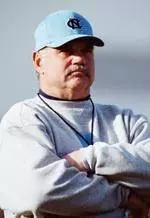
"That's what this football team has to do," John Bunting says on the eve of his first season as Carolina's head coach. "It has to answer the bell like a prize fighter. We've got 12 rounds. We may not win 'em all. But we'll win a bunch of rounds, we'll win the war."
Answer The Bell.
"This has been the hardest training camp I've had, mentally and physically," senior Quincy Monk says. "We've got 12 rounds and we have to show up, no matter what, no matter how tired we are. You've got to stick it out and fight through the pain and the grind. That's what we've done in camp."
Team mottoes and catch phrases are parts motivational ploys, parts marketing tools, parts malarkey if they're too contrived and don't fit. One of the best ones in Chapel Hill was the 1990 mantra of a team coming off consecutive 1-10 seasons. "One, one, ninety-one" was the rallying cry of those ambitious Tar Heels, signifying their goal of landing a January 1 bowl berth. The talent wasn't there, but the heart was and the Tar Heels posted a 6-4-1 record, including a tie against eventual national champion Georgia Tech.
Dawn Bunting, wife of then-St. Louis Rams assistant John, joined with a strength coach named Billy Long to coin the motto for the 1999 Rams, Gotta Go To Work. It caught like a match in a haystack as the Rams rolled to the 2000 Super Bowl championship over Tennessee, appearing on T-shirts, billboards, TV newscasts, videos and banners. Dawn and Long licensed the phrase and retain the rights today.
"We had T-shirts printed for the defense with `Gotta Go To Work' on them," says John, linebackers coach and co-coordinator on defense. "Our guys wore them the first time one Saturday for practice, and the offense goes to Dick Vermeil, `Where are our shirts?' Dick stammers for a minute and says,'They got lost in the mail. They'll be here next week.' So next week we've got a set for the offense and a set for special teams guys."
After talking at length with the team captains and seniors this summer at Carolina, Bunting asked his wife for her ideas and thus came Answer The Bell.
"Carolina has the Bell Tower, it has the Victory Bell," Dawn says. "Answer the bell--that's what this team has to do."
Round one comes in just a few days when Carolina travels to Norman, Okla., to challenge the defending national champions.
"It's time to reset the bar where this great team sport of football is concerned on this campus," says Bunting. "I've worn that blue helmet. I've worn that blue jersey. I've cried as a Tar Heel. For 30 years there've been ups and downs in this program. It's time it realized its full potential."
John Bunting without question is applying his thumbprint to this Carolina football program, just over eight months into his tenure.
He took on this Oklahoma game when everyone--from conference officials to Carolina athletic department executives--assumed he would want no part of it when the offer came last winter.
"What an incredible show of respect that was for us, and he didn't even know us at the time," says Metts. "It set the tone for the off-season. If you want to be the best, you've got to play the best."
"When he offered that game to the seniors, everyone lit up," says defensive tackle Ryan Sims. "It shows how much pride he has in this program, that we won't back down from anyone."
Dismissing previous strength coach George Smith and replacing him with long-time East Carolina coach Jeff Connors was another significant move. Most around the Tar Heel program were pulling for Smith to be a success in his role as successor to Jeff Madden, who went with Mack Brown to Texas after the 1997 season, because Smith is a decent man and genuinely likeable fellow. Smith played something of the "good cop's" role in a bad cop/good cop tandem with Madden, and for whatever reasons wasn't able to make a completely successful transition to the No. 1 guy under new head coach Carl Torbush.
"The perception was, this program had gotten soft," says Connors, who, to fight that very perception, outfitted players for summer workouts with T-shirts emblazoned with the word HARD. "I'm not saying that's the case. The University of North Carolina had a lot of success in the last decade. I can't say what was done here before. All I know is that we will ask our players to trust us, and if they'll do that, we'll take them places they've never been before."
There is no doubt that the Tar Heels have taken to Connors' mindset and methods--despite the added difficulty of winter, spring and summer workouts.
"Coach Connors is kind of like a military guy," says Sims. "He says things one time. Either you do it or you don't. It's what we needed. It makes you develop self-discipline more than anything."
Actually, there is definitely a military connection to Connors' regimen. He pegs the Marines as the "greatest organization in the history of mankind" and says their principles of training and discipline are perfect for his strength and conditioning program.
"There's fantastic correlation between how Marines are trained and how we train football players," says Connors. "There are elements of courage, humility and character-building that apply to both. The essence is that discipline cannot be obtained on the battlefield. It has to come from training."
Connors' program has a number of keystone elements. Running series of 300-yard sprints with target times and designated rest periods is a bedrock. Improved leg strength through squats is another. He had 20 players at ECU squat 500 pounds or more last fall, he found five in Chapel Hill who could move that amount. He conducted at 5 a.m. one March morning his War Games competition, a multi-faceted event comprised of a variety of quirky exercises. Linemen threw empty beer kegs over their heads backwards and pushed wheelbarrows loaded with weights. Backs ran obstacle courses littered with tires, ladder steps, "barbed wire" and tackling dummies. Linemen participated in grueling wrestling sessions on winter afternoons.
"The whole idea is to not only be in great shape, but do it in a group so you have to encourage each other while doing something difficult," Connors says. "Seeing your teammates pay the price to become a winner can lift you to greater heights. We try to put the players into situations that will be more difficult than anything they'll face in a game. You lose concentration when you're fatigued. That translates to the fourth quarter."
Personnel attrition is normal when a new coach takes over, and there's no question this transition has created some defections.
Receiver Jamal Jones and defensive back JoVon Lewis were dismissed from the squad for various infractions. Offensive lineman David Stevenson was suspended indefinitely for "conduct detrimental to the team," which essentially meant a lack of concerted effort on and off the field. Quarterback Luke Huard was suspended for coming into camp overweight. Cornerback Justin Browne has left the team because of his depth-chart position, offensive lineman Chris Kocaj left last winter. Punter Blake Ferguson told Bunting he was homesick and wanted to go back to Oklahoma, but Bunting suspected that a dislike for competition with John Lafferty was part of the equation. In addition, rising seniors Anthony Anderson, Rufus Brown, Anthony Saunders and Nathan Sutton are no longer on the team for medical reasons.
The result is a lack of depth across the board.
Dick Vermeil, in an exclusive foreword to a forthcoming book on Bunting, writes: "You win with outstanding players, and John will have to get John Bunting-type players in the program. Some already in the program will become those kinds of players. John and his staff will have to recruit more."
Bunting put the Tar Heels through an NFL-style training camp, housing them under the one roof of Avery Dormitory for 10 days. He even confiscated their car keys. He admits to being somewhat vexed between the old ways of housing football players permanently in one dormitory versus letting them be a part of the student body and escape the jock persona. A compromise for the moment is sequestering the team together for training camp.
"Does it make a guy who runs 4.8 improve to 4.6?" Bunting asks. "No. Does it turn an average tackler into a tremendous, Dick Butkus-type tackler? No. But does it help bring some guys together and appreciate and respect each other a little better? Maybe. I hope so."
There are dozens of questions to ask about this 2001 Carolina team in figuring its shots for some success in Bunting's first year. The two most crucial are these:
Can Ronald Curry harness his immense physical skills into becoming a quality quarterback (i.e., lead the offense, make good decisions before and after the snap of the football, throttle the ball downfield and ease up for little tosses)?
And will the offensive line give him and the rest of the Tar Heel backs enough room and time to complete their appointed chores?
Carolina has a good defense and should be strong as long as it's not decimated by injuries. Overall special-teams play should be very solid. Jeff Reed is an outstanding place-kicker, though admittedly the Heels' punting fortunes took a blow when Ferguson left campus. Fullback and tight end are green and that's a concern, but Bunting and offensive coordinator Gary Tranquill say they'll go with four-wides often if necessary.
Curry has spent the entire off-season with the football team instead of trying to keep pace with the NBA farm club over at the Smith Center. He's thrown balls several times a week to his receivers. He's altered his throwing motion somewhat under the tutelage of Tranquill and has spent countless hours with Tranquill in the film room. He knows that if he's going to impress anyone in the NFL, this is his last chance.
Bunting has gone to great lengths to get Curry some help. One of the reasons he liked Tranquill so much in interviewing offensive coordinator candidates in December and January was Tranquill's array of schemes to protect the quarterback. When new running backs coach Andr? Powell was finishing his interview with Bunting, he asked the new boss what, if he got the job, he would have to do to make Bunting happy. Bunting answered: "Protect the quarterback. Ball security. Big plays."
"I get sick watching tape from last year," says Bunting, who's watched a lot of Carolina's 2000 offense but not as much defense. "They'd max protect and Ronald would still get hit. The kid's confidence has got to pick up. He needs to be able to zero in on a receiver and not start ducking the second he gets the ball.
"We've talked and worked at length with Ronald on the art of scrambling. If everyone's covered, you've got to tuck the ball and run. Go make a play. You're a great athlete. Make something happen. But don't, don't, don't run backward. And don't throw it down the middle of the field."
The Tar Heels have only one experienced player on their starting offensive line, that being senior center Adam Metts. Flanking him at guard are two red-shirt sophomores, Jupiter Wilson and Marcus Wilson. Another member of the 1999 signing class, Greg Woofter, will start at one tackle. Jeb Terry, a fourth member of that class, has been slow to recover from a broken ankle, and red-shirt freshman Willie McNeill has been running first team at left tackle. Red-shirt freshman Skip Seagraves has also run with the first team at right tackle.
The offensive line has talent and potential, but it's a complicated position to learn as young players--particularly if you have four of them starting. Mistakes will be made, forcing Tranquill to use every ounce of his brainpower to help the Tar Heels move the football. If that means going with four-wides and throwing the ball quickly while the offensive line matures, so be it.
"Gary Tranquill is an expert at taking whatever talent he has and getting the most from it," says Terry Lewis, Carolina's tight ends coach on Torbush's staff who worked for Tranquill at the Naval Academy in the 1970s. "At Navy we had one offensive threat--Napoleon McCallum. Gary was a master at figuring ways to get him the football. Look what he did at Virginia--they threw it like crazy with Shawn Moore 10 years ago and ran it like crazy two years ago with Thomas Jones. He'll get the most out of whatever talent he has, I'll guarantee you that."
Darian Durant appears to have moved into the No. 2 QB slot following a good performance in a scrimmage Wednesday night, throwing for 182 yards and two TDs.
"I feel good about what Ronald has accomplished this off-season," Bunting says. "He's asserting himself more in the huddle. His teammates are looking to him for direction. Your quarterback has to be a leader."
And thus the saga continues as yet another autumn rolls around in Kenan Stadium. Ever since that tick in the Canadian woods snatched Jim Tatum from his resurrection job at Carolina in the late-1950s, coaches have come and gone. Jim Hickey and Carl Torbush were excellent lieutenants who couldn't seem to marshall enough wins as head man. Bill Dooley won but wanted to be an athletic director as well as football coach and left for Virginia Tech. Dick Crum was never comfortable in the fishbowl of a major Southern university. The lure of a job at a true national football powerhouse was too much for Mack Brown.
Now it's John Bunting's turn in a job he considers the fulfillment of a 30-year dream. Now it's his time to answer the bell.
SQUIB-KICKS -- Just as some players leave with a new staff, others find opportunity and move in. Three new ones at Carolina are Carl Smalls, a 6-2, 270-pound defensive tackle who's transferring from South Carolina, Bobby Blizzard, a 6-7, 250-pound tight end transferring from Kentucky, and C.J. Stephens, a 6-2, 215-pound quarterback transferring from Florida. Blizzard and Stephens will have two years of eligibility and Smalls three after each sits out the 2001 schedule. Blizzard and Smalls were heavily recruited by the Tar Heels out of their respective high schools--Blizzard in Hampton, Va., and Smalls in Charleston, S.C. Stephens is the son of Florida assistant coach Jimmy Ray Stephens ... Brandon Russell has moved from tailback to wide receiver and has been very impressive. He should get ample playing time in three and four-wide sets.
Many Tar Heel fans enjoyed Lee Pace's six-part series chronicling the playing and coaching careers of coach John Bunting that appeared at TarHeelBlue.com last spring. Now those same stories are available with new material in a book that promises to be a collector's item in the future.
Born & Bred is scheduled to be available the week of Carolina's home opener against SMU on Sept. 15th. It will be on sale at a variety of venues around campus and Chapel Hill, as well as on TarHeelBlue.com and by mail order.
New chapters cover Bunting's coaching staff, his visit in May to Tar Heel legend Charlie "Choo Choo" Justice, and efforts to improve the game-day experience in Kenan Stadium. In addition, there are sidebars on the 1980 Carolina championship team, led by Kelvin Bryant, and Bunting's key role in the 1982 NFL players' strike. Watch for details.
Extra Points, now in its 12th year, is published 15 times a year, once following all Carolina football games as well as at the beginning of the season, the end of the season and at the end of recruiting and spring practice. Subscriptions $30 per year, payable by check or MC/Visa to:
Extra Points Publishing Co.
101-A Aberdeen St.
Chapel Hill, NC 27516
Lee Pace, Editor & Publisher
919/933-2082, leepace@earthlink.net
|