University of North Carolina Athletics
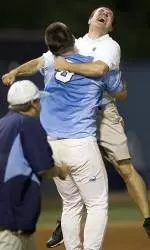
Lucas: Dressed For Success
June 14, 2007 | Baseball
June 14, 2007
By Adam Lucas
Carolina blue is the most recognizable color on the college sports palette. To find all the different ways to utilize the distinctive hue, just walk through the Boshamer Stadium equipment room.
The Tar Heels have worn nine different uniform combinations this year: navy tops with white pants, sleeveless gray tops with gray pants, black jerseys and white pants, short-sleeved gray jerseys with gray pants, white with blue pinstripes, white sleeveless jerseys with blue undershirts and white pants, short-sleeved white jerseys with white pants, and Carolina blue jerseys with both white and gray pants.
Although Carolina could play as many as eight games in Omaha, equipment manager Nate Yarbrough packed just four different uniforms--the sleeveless white jerseys with blue undershirts, the short-sleeved white jerseys with "Tar Heels" across the chest, the Carolina blue mesh tops that can be worn with gray or white pants, and the black tops--among the dozen giant bags of equipment he loaded onto the team charter yesterday (one of the College World Series perks is that although equipment managers are usually responsible for laundering all the uniforms, there's an Omaha local who handles all those details and returns everything spotless the same day).
As teams advance deeper into the postseason, therefore earning more television time, their equipment sponsor often delivers new items in the hopes of earning valuable camera time. Last year, Nike shipped white jerseys with Carolina blue inserts that received mixed reviews. This year's addition is a black jersey that follows a new Nike strategy of trying to emphasize black in their baseball lines--the company is also pushing all-black bats, gloves, and batting gloves to their most elite programs.
Black isn't going to become a new element of the UNC color scheme. But although players have conflicting feelings about the black jerseys, they're unanimous on one aspect of the new shirts.
"No matter what you think about the color, the material those jerseys are made of is great," senior Matt Danford says. "It's really soft and it's a lot cooler than you would think."
When the black jerseys--made of Nike's newest Dri-Fit material--arrived late in the regular season, the most glaring defect was a large blank space at the top of the backs. That space was intended for names, but the Tar Heels have never worn individual names on the backs of their jerseys (although they did have "Tar Heels" on the back at one point several years ago).
But after the blank area became too glaring in the jerseys' pre-NCAA appearances, names were added. For the first time ever, Carolina took the field with player names in the two-inning resumption of Game 2 of the super-regional.
The black shirts are unlikely to unseat the blue mesh tops that every player surveyed singled out as their favorite. Not coincidentally, those also happen to be the longest-running jerseys in the Tar Heel arsenal. Midweek regular-season games are open to input from the day's starting pitcher and Yarbrough, with Mike Fox having the final call, but the blues are a staple of the team's standard weekend rotation (Home: sleeveless white on Friday, short-sleeved white on Saturday, blue on Sunday; Away: Navy on Friday, Gray short-sleeved Saturday, blue Sunday).
Each jersey has their quirks. The white short-sleeved tops will be replaced for 2008, which will make at least one Tar Heel very happy. Throughout 2007 Garrett Gore has lamented that every jersey in the white short-sleeved set is identical--except his, which inexplicably has extra piping.
Yarbrough, an award-winning equipment manager who is in his second year with the Tar Heels, is responsible for more than just Carolina's color scheme in Omaha. Baseball players, perhaps more than any other sport, are very finicky about their equipment. Combined with the healthy streak of superstition that runs through the sport, it can be a volatile combination.
"We got a new shipment of cleats from Nike right before the super-regional," Yarbrough says. "They were black with blue bottoms and they had the College World Series emblem on the tongue. That box had to get out of here as quickly as possible, because last year in Alabama we had an incident where we were winning Game 2 in the ninth inning (three outs from Omaha) and one of Alabama's equipment guys handed me a bunch of College World Series t-shirts. As soon as he did that, we gave up the lead. So all I could think about with the shoes was making sure they didn't jinx us like what happened last year."
Not every Tar Heel will sport the new spikes, as many are too accustomed to their normal game shoes to switch this late in the season. They're usually more willing to try peripheral items such as new batting gloves.
"When they get something they like, they want to stick with it," Yarbrough says. "It might be a cliché, but when you look good, you play good."
Players are clear--as long as that most familiar color is part of whatever uniform combination the Tar Heels sport in the College World Series, they know they're going to look good.
"Carolina blue is unique to this University and it has special meaning to all of us," Danford says. "Any jersey with that color is going to be classic."
Adam Lucas's third book on Carolina basketball, The Best Game Ever, chronicles the 1957 national championship season and is available now. His previous books include Going Home Again, focusing on Roy Williams's return to Carolina, and Led By Their Dreams, a collaboration with Steve Kirschner and Matt Bowers on the 2005 championship team.