University of North Carolina Athletics
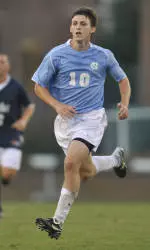
From Fetzer To Finley: Men's Soccer's Decade End Drive To The Top
January 16, 2010 | Men's Soccer
Jan. 16, 2010
By Dave Lohse
Associate Athletic Communications Director
When a pair of Tar Heel senior defenders were chosen in the 2010 Major League Soccer SuperDraft January 14 it should have come as no surprise. During the 2009 season, seniors Zach Loyd and Jordan Graye were the key starters on a depleted Carolina defensive unit which allowed only 12 goals as head coach Elmar Bolowich's team made a successful run to a second straight College Cup appearance. At the end of the first decade of the 21st century, Bolowich has built a program that is among the elite in the college ranks and this past year Carolina's smothering defense led the way.
Carolina has now been to back-to-back College Cups. That is the first time UNC has accomplished that feat since the program's inception in 1947. The Tar Heels were terrific throughout the first decade of the Millennium, going to nine NCAA Tournaments from 2000-09, reaching the NCAA quarterfinals five times in that era, attaining three trips to the treasured venue of the NCAA College Cup and winning the national title in 2001. Entering the 2010 campaign, when the Carolina roster should be loaded with both talent and depth, UNC will be joined only by Wake Forest as teams with back-to-back College Cup appearances on their resumes.
Bolowich says the formula for the success the Tar Heels have enjoyed in the past decade isn't really all that complicated. "First of all, we began getting a lot more support from the athletic administration in terms of staffing, financial resources and recruiting resources," said Bolowich, who came to UNC in 1987 as an assistant coach to Anson Dorrance and then took over the men's program in 1989. "My assistant coaches, Carlos Somoano and Jeff Negalha, just completed their eighth and fifth years with the program. You can't put a price tag on having continuity in your staff.
"Overall, I think the administration's commitment to building a nationally-respected soccer program has been the biggest factor. We've been able to recruit nationally and we've done a great job of getting kids from North Carolina to stay in state and play here. Seven of the starters on our national championship team in 2001 were native Tar Heels."
ACC regular-season and tournament championships and an NCAA quarterfinal appearance in 2000 foreshadowed UNC's national crown in 2001. UNC went to reach the NCAA quarterfinals again in 2005. But it was after compiling a losing record in 2007 and missing the NCAA Tournament for the first time since 1998, that the Tar Heels really stepped up their game.
Back-to-back College Cup appearances have been the reward but each of those teams has gotten there in its own way. The 2008 team actually finished with a losing record in the ACC at 3-5. At 15-8-1 overall, the '08 Tar Heels were offensively potent, scoring 47 goals, but they also gave up 29. However, when the season was on the line, the Tar Heels picked it up on the defensive end and allowed only three goals in five NCAA Tournament games while reaching the national championship game against Maryland.
A year ago, the Tar Heels entered the NCAA Tournament on a five-match losing streak. The stretch began with a crushing 3-2 double overtime loss at Clemson and a road loss at always pesky Campbell. Carolina then had to play three successive games against the No. 1 and No. 2 teams in the nation, losing to top-ranked Wake Forest 4-2 at home, falling at No. 2 Maryland 2-1 in the regular-season finale and then drawing the Terps again just a few days later, losing 1-0 in the ACC Tournament quarterfinals.
"We couldn't catch a break in getting a result. It was that kind of year," Bolowich recalls. "But we knew we could put it together. We got an opportunity as the No. 13 seed in the NCAA Tournament and with that a bye and eventually the chance to host some games."
The Tar Heels got hot at the right time. Three one-goal home wins against Jacksonville (1-0), University of Illinois-Chicago (3-2 in overtime) and Northwestern (1-0) earned the Heels a spot in Frisco, Texas for the College Cup. In the semifinals, the Tar Heels were not given much of a chance against top-seeded Wake Forest. But a goal in the fourth minute by Brian Shriver held up for a 1-0 separation despite the Demon Deacons' relentless offensive onslaught in the second half. After No. 2 Maryland escaped No. 3 St. John's in overtime in the other semifinal, Carolina's good fortune ran out. In an evenly played national championship game, the Terps were the ones to emerge with the finishing touch on the single goal it took to decide who wore the crown.
Carolina returned to the pitch in 2009 with a preseason No. 1 ranking from Soccer America magazine. Of course, that and a $5 bill can get you a cup of coffee from Starbucks. Nevertheless, a return trip to the College Cup was in store but the road there was no easier.
"One of the keys to the consistency of this year's team was the fact the majority of players had been to the College Cup last year and they knew what it took to get back there," Bolowich explains.
The route taken was different, especially after three veteran players who were projected as starters saw their seasons end early with injuries. Fortunately, the Tar Heels had quality depth on their side and the players who eventually stepped in knew what was expected of them and they did an excellent job fitting into the starting 11.
Missing from the lineup were senior defender Eddie Ababio, a two-year starter; senior transfer Stephen McCarthy, a midfielder who had joined the program from Santa Clara; and redshirt junior defender David Rodriguez. In January 2010, the good news is that all three have applied for medical hardships and there is an excellent chance they will all return to the pitch next season for Carolina, which loses only four seniors off its roster. The bad news in August 2009 was the fact Rodriguez and McCarthy are both 6-4 and when they got hurt, the Heels essentially lost most of the height they possessed among their field player allotment. And you just don't lose a player with Ababio's experience and not be affected by it.
En route to finishing 16-2-4 overall and 5-2-1 in the ACC, the Tar Heels reinvented themselves. Zach Loyd, who helped lead the 2008 postseason run after his switch to midfield, moved into the center of the back line to take Rodriguez's spot. Loyd would go on to become a consensus first-team All-America, leading a defense which allowed only 12 goals, down from 29 the year before. Meanwhile, the offense was as almost as productive as the year before, scoring 43 goals. First-team All-ACC players Billy Schuler (9 goals, 5 assists) and Michael Farfan (5 goals, 4 assists), the latter a junior transfer from Cal State Fullerton, second-team All-ACC selection Cameron Brown (5 goals, 3 assists), and ACC All-Freshman choice Enzo Martinez (3 goals, 4 assists) led a balanced offensive scheme. Sophomore forward Alex Dixon (8 goals, 1 assist) and sophomore midfielder Kirk Urso (4 goals, 6 assists) also had breakthrough years for the Tar Heels.
When push came to shove, however, it was Loyd leading a stellar defense that allowed this team to be as good as it was. Graye joined Loyd on the starting back line along with sophomores Drew McKinney and Brett King. Senior Brooks Haggerty became the full-time starter in goal for the Heels and allowed only 0.55 goals per game while saving .831 percent of the shots he faced.
"Zach became a first-team All-America even though we were asking him to play a new position for us," Bolowich said. "For Zach, playing in the back became second nature. He always knew how to pursue the ball and put pressure on his opponents. He's athletic and competitive and knows how to keep his focus."
When Loyd was injured halfway through the year the Tar Heels clearly missed him, going 3-1-1 in that stretch, including a 2-1 home loss to Boston College and a 2-2 draw at Wake Forest.
The Tar Heels saw their season end in the NCAA semifinals as they played undefeated and untied and No. 1-ranked Akron to a scoreless draw. Despite playing a man down for the final 40 minutes of the game, the Tar Heels were arguably the better team than the much-publicized Zips on that particular Friday night in Cary. The monstrosity that is called the penalty kick shootout was the only thing that denied UNC a second straight trip to the national championship match. While the game ended in a highly entertaining 0-0 draw, the penalty kick shootout favored Akron 5-4. It marked the first time all season Akron had failed to score in a game as the Tar Heel defense, despite playing with only 10 men for nearly 40 percent of the game stood tall on college soccer's biggest stage.
The 2009 side accomplished much. The Tar Heels shared the league's regular-season championship with Wake Forest as the '09 unit joined the teams from 1966 and 2000 as the only squads to finish atop the ACC standings. The two losses were the second fewest in a season in Carolina history. This team played 22 matches. No previous UNC squad that had lost as few as two matches took to the pitch more than 12 times.
While the Tar Heels will have to do some rebuilding on the defensive end, Carolina returns the bulk of its starting unit, welcomes back the aforementioned key players from injuries and adds another bountoful recruiting class as it prepares for battle in 2010.
As Bolowich put it succinctly, "We have a chance to be very strong again in 2010."
With the program on the most solid footing it has ever enjoyed, the 2010 Tar Heel season could well be another in which we see more fantastic finishes at Fetzer Field. In the meantime, hats off to the cast that provided so many thrills the past two years. It's wise to savor those accomplishments while still keeping the clear focus on the future.