University of North Carolina Athletics
CAROLINA: At Home on the Water
March 5, 2014 | Women's Rowing
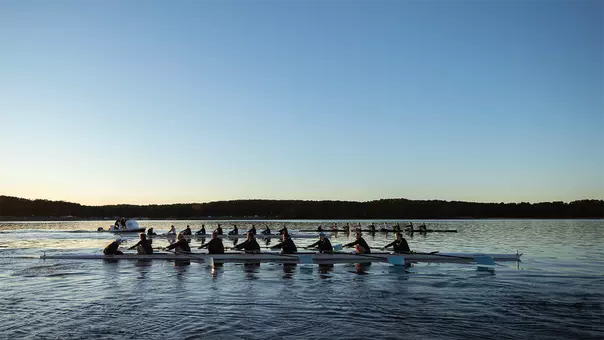
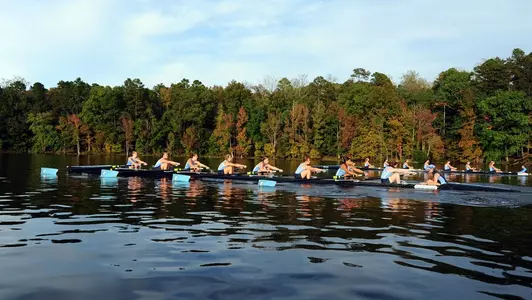
"You picked a good day to come out here," Carolina rowing coach Sarah Haney says. And she's right. It's a beautiful day at University Lake on Monday, January 27. Temperatures are unseasonably mild (in the 50s and 60s), the sun is shining and the water is calm. Tomorrow will bring snow to Chapel Hill and record-low temperatures to central North Carolina. But today is a good day to begin the spring rowing season.
Relatively speaking, Carolina rowing is in its infancy as a varsity sport. The women's team went from competitive club to varsity status in 1997-98, Haney's senior season, after she helped lobby for the transition. In 2002, she became the program's second-ever head coach.
Despite that varsity status, Carolina rowing has not gotten away from its club roots. Like many Division I programs, the Tar Heels use a novice program to bring walk-ons into the sport, taking students who may or may not have rowing experience and turning them into student-athletes.
Because Carolina rowing uses fewer scholarships than are allowed by the NCAA (the NCAA allows 20, Carolina has four), the Tar Heel program perhaps relies on walk-ons and its novice program more heavily than other schools. "We have an athletic campus," Haney says. "Some of our kids who are walk-ons are beating our recruited athletes. We don't care how you get here, if you're fast, you're fast. That's kind of our motto."
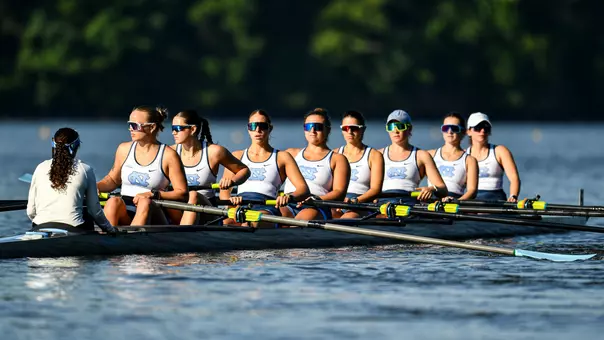
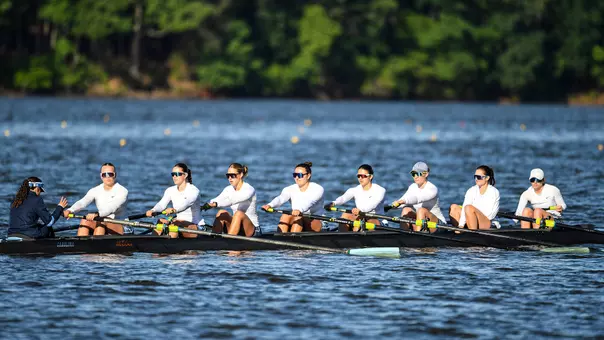
Carolina has about 30 rowers on the varsity roster, each competing for a spot in the varsity eight, the number one hull in competition. That's eight rowers plus a coxswain to call commands and steer the boat. Typically, schools field a varsity eight, a second varsity eight, and a varsity four, each with a coxswain, for a total of 23 from the varsity squad in competition. Likewise, the novice team, beginning with a roster of 40, will put 23 in boats for races.
Typically, it's the varsity athletes competing for the varsity eight spots, but the fastest rowers will be in that boat regardless of where they've come from. "Our job is to take the fastest eight rowers and the fastest coxswain and make our top boat," Haney says. "If they just picked up an oar in September, great. They're a phenomenon."
The Tar Heel roster is made up of both recruited athletes and walk-ons, with no set parameters guiding the makeup of the team (Carolina signed three recruits for the fall of 2014). Though the roster is blended with experienced rowers and newcomers, many expectations are the same. "First and foremost, it's attitude, regardless of recruited or walk-on," Haney says. "The skill of rowing is not that difficult, but the work ethic is incredibly hard, so that's something we definitely try to identify, attitude and work ethic. If you make excuses, this sport is not for you."
Recruited athletes are expected to meet standards on a 2K erg test on a rowing machine, while walk-ons must prove their fitness as well. "That would be the only main difference," Haney says. "The recruited side, they have the experience, so we expect a certain level of speed and knowledge and ability on a 2k erg test. The walk-on side, we're just looking more for general fitness."
Students interested in joining the program must, after filling out compliance paperwork, get cleared medically to perform and then go through a battery of fitness tests. Try-outs can last for up to five days, with conditioning and rowing instruction taking place. "By the end of those five days, we can then get you on the erg and see how much the technique carries over, to make sure you don't get hurt," Haney says.
Mining those club sport roots, Carolina rowing has a history of turning walk-ons into not just contributors, but core members of the team. Jasmine Dennis (2013) had never rowed before coming to Carolina from Charlotte. "She was probably one of the most successful athletes in the history of our program," Haney says. Before that, it was Blair Meiggs, who spent a season on the novice squad before eventually moving up and becoming a team captain. "We definitely have a handful (of walk-ons) on the team right now that could go in," Haney says.
One of those is Raleigh senior Maria Santoyo. She competed in soccer at Cardinal Gibbons High School and was nationally ranked in tae kwon do before taking up the oars. Santoyo received a letter in the mail about rowing. "I didn't really know what it was, but I wanted to get involved in something," she says. "I've always done sports, so I thought I'd give it a try."
Santoyo spent the fall of her freshman year with the novice squad but was moved up to varsity the following spring. She rowed with the varsity eight in the next two seasons and could do so again this year. "I fell in love with the team," she says. "They're all my best friends now, and it's an incredible opportunity to be a part of a Division I program, so I'm thrilled."
For Santoyo, being a part of the Carolina rowing program has been about far more than the sport itself. "The thing about rowing is, it's very challenging," she says. "It's taught me a lot of discipline. It's an experience that really you don't understand until you're out there rowing with your teammates. It's tough, but it's taught me so much, not just about being mentally tough within rowing, but also in my life. I love how it teaches me to be a better person apart from a rower."
A global studies and Spanish linguistics double major, Santoyo says rowing and being a student-athlete has also taught her about time management. "I call it my third major," she says. "Honestly, I function better when I am on a routine, and I always have something to do. It helps keep my priorities in check, and what better way to spend your Monday afternoon than out here on the water?"
Though this afternoon is the first official day on the water for Carolina rowing, the team is hoping for some carry-over from the winter. The NCAA allows programs to take a winter training trip, and this year Haney opted for that training trip to take place right here at University Lake in the first week of 2014. "Normally we have to go pretty slowly," Haney says. "I'm hoping we can kind of pick up where we left off in January."
The rowers arrive-many of them carpool from campus-and gather near the docks for a quick team meeting. Haney takes care of some housekeeping before the oars hit the water. Assistant coach Brie Tyler recently delivered a baby, so Haney is handling things by herself for a while. At this day's practice, the rowers will set out in four-seat boats, while Haney instructs from one of the small motorboats (Carolina rowing's coaches' launches are the only motor traffic allowed on University Lake).
It would appear to be a difficult job for Haney, figuring out who is the reason that a particular boat is fastest, which of the team members make up the fastest eight for competition. There's an art to watching the oars, she says.
"When you put your blade in the water, you leave a puddle," she says. The deeper and darker the puddle, the better quality of stroke. Additionally, she works with boat combinations to find the fastest rowers. "I put you in a boat with these people and that boat won, I put you in a boat with those people and that boat won, and I put you in a boat with those people and that boat won, at some point, I figure out the common denominator is you," she says. The same is true with the slow boats. "It's usually pretty obvious to figure out that common denominator as well."
A typical spring race is a straight shot of 2,000 meters, and takes about seven minutes (Virginia's varsity eight won the ACC championships with a time of 6:46.08). Carolina rowers will practice two to three hours for every minute of a race. "It's tons and tons of work that go into seven minutes of a race," Santoyo says. "And for those seven minutes, you're one with eight people in your boat and your coxswain."
The senior says she gets a rush from the competition and representing her school, heart pounding and looking at the teams from other schools on either side. "As soon as you hear that call, it's a feeling like no other. At some point in the race, you black out. You don't really appreciate it until after you've crossed the finish line and you kind of take in everything that you just did for seven minutes."
Recruited athlete or walk-on, experienced or not, rowing requires mental discipline, toughness and fitness. In the boat, your background doesn't matter. All you have to know is how to row-and fast. Santoyo says no other sport embodies teamwork like hers. "That's the reason we make the inspirational posters," she says. "Have you ever seen the 'teamwork' poster? Rowing is on there for a reason. It's just so challenging individually, but to have to be together without being off for a single second is incredible. It takes so much practice and so much dedication from each and every single person, so it's very special."