


University of North Carolina Athletics
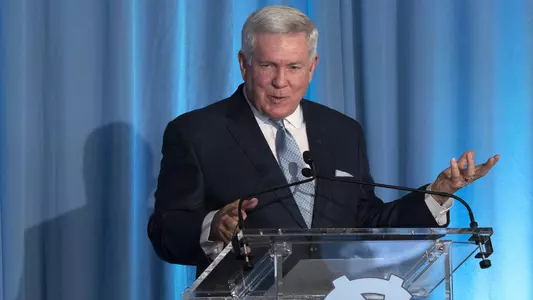
Photo by: Jeffrey A. Camarati
Extra Points: Homecoming
November 27, 2018 | Football, Featured Writers, Extra Points
By Lee Pace
Mack Brown coached his second to last football game on a bitterly cold, windy night in Waco, Texas, in early December 2013. His Texas team was soundly beaten by the Baylor Bears, ending its season 8-4 and leading to Brown's resignation one week later after winning 206 games over 16 years at Texas and collecting the 2005 national title. But he knew that was no way to go out, and certainly not by losing a meaningless bowl game to Oregon three weeks later.
"You miss the players, you miss the coaches and the camaraderie, you missing having an impact on young men's lives," says Brown, who then spent five years doing studio and game analysis for ABC and ESPN. "I hoped one day I would find the right situation. I got calls every year. But my wife Sally and I would visit and it wouldn't feel right or not be a place we wanted to live.
"The University of North Carolina is the one place we would go. This one is right. We love this place, we understand this place. The university is unique, and it's one of the best in the country. I know we can win here because we have already."
Brown was introduced Tuesday as the Tar Heels' new head coach, beginning his second stint leading a program that he took in the 1990s to six straight bowl appearances, two consecutive top 10 finishes and a five-year run of beating every opponent in the state of North Carolina. That he is 67 years old and out of coaching for five years were the least of anyone's worries at a Blue Zone introductory press conference that served in part as a reunion of many of his former friends and players from 1988-97.
"That fire's still burning," said Dwight Stone, a member of the UNC Board of Trustees and its immediate past chair. "He didn't like the way it ended at Texas and he feels like he has something prove. He's a competitor."
"I think Mack wanted it as much as we wanted him," added current board chair Haywood Cochrane. "You can hear how much this place means to him. I'll say we got lucky—lucky that he was available when we needed to make a change. If you look across the board, we've got so many sports winning national titles and thriving. Football is one sport that's struggling. Mack fits here and he'll turn this program around."
Athletic Director Bubba Cunningham announced Sunday morning that Larry Fedora was being dismissed after seven years and two difficult seasons of winning only five games. Rumors immediately began flying that Cunningham and Brown were discussing a potential second act in Chapel Hill, and word was officially released Tuesday morning that Brown had signed a five-year contract worth $3.5 million a year. Within two hours of that news release, Brown attended a meeting of other Tar Heel head coaches, did a quick round of in-house media tasks and then sat with Chancellor Carol Folt and Cunningham on the dais at a formal press conference.
Cunningham and Brown spoke of their longtime friendship making it easy to do a deal quickly—that it began in 1997 when Cunningham visited Chapel Hill while on the athletic staff at Notre Dame to tour the new Kenan Football Center, and it continued in 2011 when Cunningham was interviewing for the Carolina athletic director's post and wanted Brown's counsel on the landscape at Carolina.
"What stands out to me looking at Mack's success is how he got people to believe in themselves," Cunningham says. "He spent a career trying to get them to believe in themselves and have a great ambition for themselves just as he had for them. The lives that men have led after playing for Coach Brown are truly remarkable."
Brown said he didn't have a bowl game to worry about, recruiting trips to reschedule, a boss to get permission from and that he and Sally were at a point financially that he didn't need to squabble over a contract.
"We had a relationship with Bubba, we trust him and that's so important," Brown said. "We wanted to coach and wanted to coach here. We love challenges, and this a great opportunity. It gives us an opportunity to fix things, and we love to fix things."
Brown said his phone was blowing up with texts from coaches interested in joining his staff but that he'd had no time to actually talk with or interview potential coordinators and assistants. He planned to meet with the current team later in the afternoon and then begin making recruiting calls that night and hit the road to see prospects on Wednesday. Certainly having an early December 19 signing date puts the onus on recruiting.
As he did at Carolina before, Brown said he'd put a high priority on recruiting in the state of North Carolina and emphasize games against in-state rivals.
"We had a great relationship with the high school coaches when we were here before," Brown said. "We will renew that relationship with the ones still out there and get to know the new guys. That's such a key to getting better. Our team was probably 90 percent from the state of North Carolina when we left.
"It's all about making your place the 'cool' place to be. Carolina was that place when we left, and it will be again."
Stone said he'd had five calls from high school coaches in 24 hours and all of them said, "Home run hire."
"Mack gives us three things," Stone continued. "He gives us hope. He'll reestablish our recruiting in-state, and he'll create excitement and bring people back to Kenan Stadium."
Watching the proceedings from the periphery in the Blue Zone were several dozen former Tar Heels, many of whom played for Brown and heard the same messages on this day from Mack circa 2018 that they knew so well from their days posting a 10-3 record in 1993 or 11-1 four years later. The common thread that the current Tar Heels would begin assimilating as soon as Brown met with them later that afternoon was that this wasn't just about football, it was more than just Xs and Os.
"Mack had a way of making you feel special and that you were a part of something special," said David Bomar, who walked on to the team during Brown's final two years in 1996-97. "It was bigger than the individual. If you fell outside that line, you were not just hurting yourself, but you were hurting the team. You were held accountable by your teammates. Being selfish would not cut it."
Russell Babb and Jason Stanicek remember stern, one-on-one conversations with Brown during their early-to-mid-1990s careers, Babb as an offensive tackle and Stanicek as a quarterback.
"He called me in before my senior year and said it was time to quit feeling sorry for myself and start being a leader on this team," Babb remembers. "I took it as a personal challenge and it pulled the best out in me. I needed him to get in my face to be the player I could be."
"I remember the discipline and I remember the tough conversations with him," Stanicek added. "He told me to grow up and quit being a baby. I was struggling my sophomore year when I wasn't playing as much as I thought I should. He said, 'You're not good enough yet.' He makes you grow up pretty fast."
Listening from across the country in his California home was Chris Keldorf, a quarterback who Brown and assistant coach Cleve Bryant recruited out of a San Diego junior college in the fall of 1995 when they faced a roster emergency when starter Oscar Davenport suffered a severe knee injury late that fall. Keldorf signed with the Tar Heels and helped lead them to a 21-3 spurt in 1996-97, with landslide wins coming over West Virginia and Virginia Tech in the Gator Bowl.
"Those players today will learn they aren't just performing on the field, that there's a cumulative approach to his process," Keldorf said. "It's like, 'Wow, I'm not just here to play football.' He will hire an excellent staff and they will demand attention to the small details. He has a system and you perfect it on a daily basis. I hope the guys get that message. Guys will buy in quickly. Some won't and will graduate and move on. It's a full body of work and everything matters."
Since leaving the Texas job five years ago and through his friendship with Fedora, Brown had spent more time in Chapel Hill the last three years than he had in all the years since leaving in December 1997. He spoke at Fedora's spring coaching clinic in 2015, attended funerals for basketball coaches Dean Smith and Bill Guthridge and was feted just last August on occasion of him being named to the College Football Hall of Fame. Brown addressed the Tar Heel squad after a Saturday morning practice, pointed around Kenan Stadium and said, "It's a privilege to play in this stadium."
Little did anyone know at the time just how prophetic that moment would be.
Carolina graduate Lee Pace (1979) has written "Extra Points" since 1990 and reported from the sidelines for the Tar Heel radio network since 2004. Reach him at leepace7@gmail.com and follow him @LeePaceTweet.
Mack Brown coached his second to last football game on a bitterly cold, windy night in Waco, Texas, in early December 2013. His Texas team was soundly beaten by the Baylor Bears, ending its season 8-4 and leading to Brown's resignation one week later after winning 206 games over 16 years at Texas and collecting the 2005 national title. But he knew that was no way to go out, and certainly not by losing a meaningless bowl game to Oregon three weeks later.
"You miss the players, you miss the coaches and the camaraderie, you missing having an impact on young men's lives," says Brown, who then spent five years doing studio and game analysis for ABC and ESPN. "I hoped one day I would find the right situation. I got calls every year. But my wife Sally and I would visit and it wouldn't feel right or not be a place we wanted to live.
"The University of North Carolina is the one place we would go. This one is right. We love this place, we understand this place. The university is unique, and it's one of the best in the country. I know we can win here because we have already."
Brown was introduced Tuesday as the Tar Heels' new head coach, beginning his second stint leading a program that he took in the 1990s to six straight bowl appearances, two consecutive top 10 finishes and a five-year run of beating every opponent in the state of North Carolina. That he is 67 years old and out of coaching for five years were the least of anyone's worries at a Blue Zone introductory press conference that served in part as a reunion of many of his former friends and players from 1988-97.
"That fire's still burning," said Dwight Stone, a member of the UNC Board of Trustees and its immediate past chair. "He didn't like the way it ended at Texas and he feels like he has something prove. He's a competitor."
"I think Mack wanted it as much as we wanted him," added current board chair Haywood Cochrane. "You can hear how much this place means to him. I'll say we got lucky—lucky that he was available when we needed to make a change. If you look across the board, we've got so many sports winning national titles and thriving. Football is one sport that's struggling. Mack fits here and he'll turn this program around."
Athletic Director Bubba Cunningham announced Sunday morning that Larry Fedora was being dismissed after seven years and two difficult seasons of winning only five games. Rumors immediately began flying that Cunningham and Brown were discussing a potential second act in Chapel Hill, and word was officially released Tuesday morning that Brown had signed a five-year contract worth $3.5 million a year. Within two hours of that news release, Brown attended a meeting of other Tar Heel head coaches, did a quick round of in-house media tasks and then sat with Chancellor Carol Folt and Cunningham on the dais at a formal press conference.
Cunningham and Brown spoke of their longtime friendship making it easy to do a deal quickly—that it began in 1997 when Cunningham visited Chapel Hill while on the athletic staff at Notre Dame to tour the new Kenan Football Center, and it continued in 2011 when Cunningham was interviewing for the Carolina athletic director's post and wanted Brown's counsel on the landscape at Carolina.
"What stands out to me looking at Mack's success is how he got people to believe in themselves," Cunningham says. "He spent a career trying to get them to believe in themselves and have a great ambition for themselves just as he had for them. The lives that men have led after playing for Coach Brown are truly remarkable."
Brown said he didn't have a bowl game to worry about, recruiting trips to reschedule, a boss to get permission from and that he and Sally were at a point financially that he didn't need to squabble over a contract.
"We had a relationship with Bubba, we trust him and that's so important," Brown said. "We wanted to coach and wanted to coach here. We love challenges, and this a great opportunity. It gives us an opportunity to fix things, and we love to fix things."
Brown said his phone was blowing up with texts from coaches interested in joining his staff but that he'd had no time to actually talk with or interview potential coordinators and assistants. He planned to meet with the current team later in the afternoon and then begin making recruiting calls that night and hit the road to see prospects on Wednesday. Certainly having an early December 19 signing date puts the onus on recruiting.
As he did at Carolina before, Brown said he'd put a high priority on recruiting in the state of North Carolina and emphasize games against in-state rivals.
"We had a great relationship with the high school coaches when we were here before," Brown said. "We will renew that relationship with the ones still out there and get to know the new guys. That's such a key to getting better. Our team was probably 90 percent from the state of North Carolina when we left.
"It's all about making your place the 'cool' place to be. Carolina was that place when we left, and it will be again."
Stone said he'd had five calls from high school coaches in 24 hours and all of them said, "Home run hire."
"Mack gives us three things," Stone continued. "He gives us hope. He'll reestablish our recruiting in-state, and he'll create excitement and bring people back to Kenan Stadium."
Watching the proceedings from the periphery in the Blue Zone were several dozen former Tar Heels, many of whom played for Brown and heard the same messages on this day from Mack circa 2018 that they knew so well from their days posting a 10-3 record in 1993 or 11-1 four years later. The common thread that the current Tar Heels would begin assimilating as soon as Brown met with them later that afternoon was that this wasn't just about football, it was more than just Xs and Os.
"Mack had a way of making you feel special and that you were a part of something special," said David Bomar, who walked on to the team during Brown's final two years in 1996-97. "It was bigger than the individual. If you fell outside that line, you were not just hurting yourself, but you were hurting the team. You were held accountable by your teammates. Being selfish would not cut it."
Russell Babb and Jason Stanicek remember stern, one-on-one conversations with Brown during their early-to-mid-1990s careers, Babb as an offensive tackle and Stanicek as a quarterback.
"He called me in before my senior year and said it was time to quit feeling sorry for myself and start being a leader on this team," Babb remembers. "I took it as a personal challenge and it pulled the best out in me. I needed him to get in my face to be the player I could be."
"I remember the discipline and I remember the tough conversations with him," Stanicek added. "He told me to grow up and quit being a baby. I was struggling my sophomore year when I wasn't playing as much as I thought I should. He said, 'You're not good enough yet.' He makes you grow up pretty fast."
Listening from across the country in his California home was Chris Keldorf, a quarterback who Brown and assistant coach Cleve Bryant recruited out of a San Diego junior college in the fall of 1995 when they faced a roster emergency when starter Oscar Davenport suffered a severe knee injury late that fall. Keldorf signed with the Tar Heels and helped lead them to a 21-3 spurt in 1996-97, with landslide wins coming over West Virginia and Virginia Tech in the Gator Bowl.
"Those players today will learn they aren't just performing on the field, that there's a cumulative approach to his process," Keldorf said. "It's like, 'Wow, I'm not just here to play football.' He will hire an excellent staff and they will demand attention to the small details. He has a system and you perfect it on a daily basis. I hope the guys get that message. Guys will buy in quickly. Some won't and will graduate and move on. It's a full body of work and everything matters."
Since leaving the Texas job five years ago and through his friendship with Fedora, Brown had spent more time in Chapel Hill the last three years than he had in all the years since leaving in December 1997. He spoke at Fedora's spring coaching clinic in 2015, attended funerals for basketball coaches Dean Smith and Bill Guthridge and was feted just last August on occasion of him being named to the College Football Hall of Fame. Brown addressed the Tar Heel squad after a Saturday morning practice, pointed around Kenan Stadium and said, "It's a privilege to play in this stadium."
Little did anyone know at the time just how prophetic that moment would be.
Carolina graduate Lee Pace (1979) has written "Extra Points" since 1990 and reported from the sidelines for the Tar Heel radio network since 2004. Reach him at leepace7@gmail.com and follow him @LeePaceTweet.



Wednesday, October 07
Wednesday, October 07
Wednesday, October 07
Wednesday, October 07