


University of North Carolina Athletics
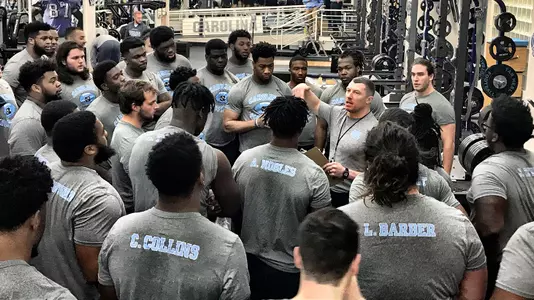
Brian Hess addresses the Tar Heels
Extra Points: To The Edge
February 28, 2019 | Football, Featured Writers
By Lee Pace
Brian Hess watches the digital clock tick in the weight room in Kenan Football Center early Tuesday morning. Seven twenty-nine and 25 seconds … twenty-six seconds … twenty-seven seconds. His lips purse around the whistle lodged in his mouth. Twenty-eight, twenty-nine …
At precisely 7:30 a.m., not a whisker early nor late, Hess blows through his mouth and his whistle responds with a loud skirl, calling to order this weight-lifting session for Carolina football. This morning, it's the offensive and defensive linemen, running backs and linebackers gathered in the weight room for 90 minutes of stretching, core work, squats, clean & presses and more.
"That's Coach Hess," tailback Antonio Williams says. "He's a precise guy. Everything we do is precise—you do things one way and exactly the right way."
"He wants to set the tone from the beginning regarding perfection," adds tight end Jake Bargas. "We are going to do things the right way. We are going to start on time—not a second before or a second late. And when he says, 'Grit it up,' we'd better be in position to attack whatever task is at hand."
Attack mode is the requisite phrase for what Hess has put the Tar Heels through over the first two months of 2019. A 5-18 overall record over two years, a litany of injuries and the Tar Heels' inability to hold a lead in the fourth quarter of multiple games augured that strength and conditioning would be a major building block in resurrecting Carolina back toward its status as ACC Coastal Division champion just four years ago.
"My body's done a 360, not only me but the entire team," Bargas says. "Coach Hess says all the time, 'They're not going to recognize us. We step out on the field against South Carolina, they won't recognize us.' It's a whole new team, a whole new mentality."
"It's been amazing how he's corralled the guys together," adds A.J. Blue, a former Tar Heel running back who's been on the Carolina strength and conditioning staff since 2014. "It's been over six weeks now, and no one's been late—and we're talking 6 a.m. running at times. The energy every day is crazy."
Mack Brown hired the 33-year-old Hess from Army West Point on the recommendation of coordinators Phil Longo and Jay Bateman, each of whom had worked with Hess before, Longo at Sam Houston State and Bateman at West Point. Bateman called him "a secret weapon" and Longo added that Hess has a knack for pushing players to a "level of exhaustion and pain" they'd never felt before and then thanking him for it.
Hess grew up in Kingston, Mass., about an hour south of Boston, and as a youngster, saw how endurance training could make him a better soccer player. Then in high school, he and his brother Matt got hooked lifting on a small Universal gym their father installed in the family basement. Hess's sweat equity paid off in improved performance as a defensive end in high school, and the die was cast.
"I just loved the idea that you could train to get better than someone else," he says. "You could put in work and go earn the ability to be a better player. I learned more about it in college and realized that was definitely what I wanted to do."
Hess first attended Trinity College and then transferred to Springfield College because it had a program of exercise and sports science, and he was a two-year starter at linebacker. He graduated from Springfield in 2008 and set off on a career path that included stints first as an intern at Iowa and Georgetown and then full-time posts at Harvard, Delaware and Sam Houston, where he was in charge of a myriad of sports and athletes. He moved to Army in 2015 and for the last two years was the head strength and conditioning coach for the football team. When Hess came to Chapel Hill, he retained three members of the previous S&C staff in Blue, Dean Moege and Jon Heck and hired Maurice Sims to follow him south from West Point.
"Everyone's bought in," Bargas says. "There is not one person who hasn't—from the fifth-year and sixth-year guys to the new guys. Coach Hess brings so much energy, it's unbelievable how much energy he brings. There's just a whole different persona in the weight room and around the building, and he's a big part of that."
"It's been awesome," Heck says. "I didn't know what to expect, but it's worked out way better than I could have imagined."
Hess moved deliberately his first couple of weeks, focusing on proper lifting technique in all areas—flaring the knees and driving the elbows back and down on the squat, for example, thinking of "ripping the bar apart" when pushing a bench-press and engaging the core on nearly every movement.
"I consider myself a pretty athletic guy so when I squat I think I do a pretty good job," Blue says. "But I've learned cues from him I'd never heard before. The bench press is not just an arm movement. We use our back, our feet, our core—it's a total body lift. There's been so much new to me."
Hess's foundation built from mentors and notable strength coaches and weight-lifters like Chris Doyle, Michael Ungar, Augie Morelli and Bill Starr mandates that the process begins with technique and painstaking attention to detail.
"I owe the guys their health and their development, and technique is going to cover both of those," Hess says. "If we have great technique in our fundamental movements, how to squat, how to hinge at the hip, how to press and how to pull, if we have good technique, we're going to stay healthy. If we keep that good technique, we're going to develop. To me, technique is the most important thing."
The Tar Heels hope to benefit from Hess's emphasis on mobility and flexibility. Each lifting session starts with 10 to 15 minutes of warm-up that includes foam rolling, band-stretching and a variety of exercises to address soft-tissue, back and hip flexibility. Players have a library of exercises they can do on their own.
"If you don't have mobility, you can't display your strength," Hess says. "You can get as strong as you want, but if you're tight and you can't get your hips low, you're not going to be able to ply any of that force. Mobility is a huge focus."
Blue says the perception that recent Carolina squads were not strong is inaccurate.
"We had a strong team, but we were a stiff team," he says. "We couldn't move. We got pushed over because there was a lot of imbalance. Now we won't see that problem. This year, we'll see a bunch of athletic runners, a bunch of guys who will be doing what they were gifted to do. I firmly believe that."
Heck played offensive tackle for Carolina from 2013-16 and after his football career became a competitor in Strongman events and a U.S. Powerlifting Association member. He joined the Carolina staff for the 2018 season.
"Our guys' mobility is improved, and there's a lot of emphasis on keeping their backs and hams healthy," he says. "We're doing a lot more stuff to help prevent injury. It's more functional training opposed to just loading the bar and moving it from point A to point B. It's more stuff that will translate to the football field athletically."
As the Tar Heels transition into spring practice beginning on Sunday, they're wrapping up their two-week, early morning regimens in the Indoor Practice Facility that Hess calls "The Fourth Quarter." It's this staff's version of the Blue Dawn from earlier years, a kaleidoscope of sprinting, jumping, sled-pushing, cone-circling and up-downs ad infinitum in a lively, kinetic and competitive atmosphere.
It's pegged "The Fourth Quarter" for a reason.
"Finishing will always be our goal," Hess says. "When it comes to the fourth quarter, there should be a change in attitude, an excitement as that third quarter winds down and that buzzer hits that says, 'This is where we win, this is what we do, this who we are.'"
Another war cry and frequent phrase around which the team breaks-down at the end of a drill or a practice: Take it to the edge.
"There's an edge between hard work and overtraining, between intensity and insanity," Hess says. "We want to get right to that edge of pushing it as hard as you can and take it right to the edge. We want to get as close as we can to 'too much.'"
Bargas considers the rash of games the last two years when the Tar Heels were tied or leading at some point in the fourth quarter—California, Louisville and Duke in 2017 and Virginia Tech, Syracuse and Georgia Tech last year.
"Obviously we've had some problems in the fourth quarter," he says. "We know we have to be perfect in the fourth quarter. We're learning to take ourselves to the limit and take our opponents to the limit. They will not be able to match our intensity and our tempo. The point is to take your mind where it's never been and your body somewhere it's never been—push yourself to the limit."
Chapel Hill writer and Carolina graduate Lee Pace '79 has written "Extra Points" since 1990 and been the sideline reporter for the Tar Heel Sports Network since 2004. Follow him @LeePaceTweet and write him at leepace7@gmail.com
Brian Hess watches the digital clock tick in the weight room in Kenan Football Center early Tuesday morning. Seven twenty-nine and 25 seconds … twenty-six seconds … twenty-seven seconds. His lips purse around the whistle lodged in his mouth. Twenty-eight, twenty-nine …
At precisely 7:30 a.m., not a whisker early nor late, Hess blows through his mouth and his whistle responds with a loud skirl, calling to order this weight-lifting session for Carolina football. This morning, it's the offensive and defensive linemen, running backs and linebackers gathered in the weight room for 90 minutes of stretching, core work, squats, clean & presses and more.
"That's Coach Hess," tailback Antonio Williams says. "He's a precise guy. Everything we do is precise—you do things one way and exactly the right way."
"He wants to set the tone from the beginning regarding perfection," adds tight end Jake Bargas. "We are going to do things the right way. We are going to start on time—not a second before or a second late. And when he says, 'Grit it up,' we'd better be in position to attack whatever task is at hand."
Attack mode is the requisite phrase for what Hess has put the Tar Heels through over the first two months of 2019. A 5-18 overall record over two years, a litany of injuries and the Tar Heels' inability to hold a lead in the fourth quarter of multiple games augured that strength and conditioning would be a major building block in resurrecting Carolina back toward its status as ACC Coastal Division champion just four years ago.
"My body's done a 360, not only me but the entire team," Bargas says. "Coach Hess says all the time, 'They're not going to recognize us. We step out on the field against South Carolina, they won't recognize us.' It's a whole new team, a whole new mentality."
"It's been amazing how he's corralled the guys together," adds A.J. Blue, a former Tar Heel running back who's been on the Carolina strength and conditioning staff since 2014. "It's been over six weeks now, and no one's been late—and we're talking 6 a.m. running at times. The energy every day is crazy."
Mack Brown hired the 33-year-old Hess from Army West Point on the recommendation of coordinators Phil Longo and Jay Bateman, each of whom had worked with Hess before, Longo at Sam Houston State and Bateman at West Point. Bateman called him "a secret weapon" and Longo added that Hess has a knack for pushing players to a "level of exhaustion and pain" they'd never felt before and then thanking him for it.
Hess grew up in Kingston, Mass., about an hour south of Boston, and as a youngster, saw how endurance training could make him a better soccer player. Then in high school, he and his brother Matt got hooked lifting on a small Universal gym their father installed in the family basement. Hess's sweat equity paid off in improved performance as a defensive end in high school, and the die was cast.
"I just loved the idea that you could train to get better than someone else," he says. "You could put in work and go earn the ability to be a better player. I learned more about it in college and realized that was definitely what I wanted to do."
Hess first attended Trinity College and then transferred to Springfield College because it had a program of exercise and sports science, and he was a two-year starter at linebacker. He graduated from Springfield in 2008 and set off on a career path that included stints first as an intern at Iowa and Georgetown and then full-time posts at Harvard, Delaware and Sam Houston, where he was in charge of a myriad of sports and athletes. He moved to Army in 2015 and for the last two years was the head strength and conditioning coach for the football team. When Hess came to Chapel Hill, he retained three members of the previous S&C staff in Blue, Dean Moege and Jon Heck and hired Maurice Sims to follow him south from West Point.
"Everyone's bought in," Bargas says. "There is not one person who hasn't—from the fifth-year and sixth-year guys to the new guys. Coach Hess brings so much energy, it's unbelievable how much energy he brings. There's just a whole different persona in the weight room and around the building, and he's a big part of that."
"It's been awesome," Heck says. "I didn't know what to expect, but it's worked out way better than I could have imagined."
Hess moved deliberately his first couple of weeks, focusing on proper lifting technique in all areas—flaring the knees and driving the elbows back and down on the squat, for example, thinking of "ripping the bar apart" when pushing a bench-press and engaging the core on nearly every movement.
"I consider myself a pretty athletic guy so when I squat I think I do a pretty good job," Blue says. "But I've learned cues from him I'd never heard before. The bench press is not just an arm movement. We use our back, our feet, our core—it's a total body lift. There's been so much new to me."
Hess's foundation built from mentors and notable strength coaches and weight-lifters like Chris Doyle, Michael Ungar, Augie Morelli and Bill Starr mandates that the process begins with technique and painstaking attention to detail.
"I owe the guys their health and their development, and technique is going to cover both of those," Hess says. "If we have great technique in our fundamental movements, how to squat, how to hinge at the hip, how to press and how to pull, if we have good technique, we're going to stay healthy. If we keep that good technique, we're going to develop. To me, technique is the most important thing."
The Tar Heels hope to benefit from Hess's emphasis on mobility and flexibility. Each lifting session starts with 10 to 15 minutes of warm-up that includes foam rolling, band-stretching and a variety of exercises to address soft-tissue, back and hip flexibility. Players have a library of exercises they can do on their own.
"If you don't have mobility, you can't display your strength," Hess says. "You can get as strong as you want, but if you're tight and you can't get your hips low, you're not going to be able to ply any of that force. Mobility is a huge focus."
Blue says the perception that recent Carolina squads were not strong is inaccurate.
"We had a strong team, but we were a stiff team," he says. "We couldn't move. We got pushed over because there was a lot of imbalance. Now we won't see that problem. This year, we'll see a bunch of athletic runners, a bunch of guys who will be doing what they were gifted to do. I firmly believe that."
Heck played offensive tackle for Carolina from 2013-16 and after his football career became a competitor in Strongman events and a U.S. Powerlifting Association member. He joined the Carolina staff for the 2018 season.
"Our guys' mobility is improved, and there's a lot of emphasis on keeping their backs and hams healthy," he says. "We're doing a lot more stuff to help prevent injury. It's more functional training opposed to just loading the bar and moving it from point A to point B. It's more stuff that will translate to the football field athletically."
As the Tar Heels transition into spring practice beginning on Sunday, they're wrapping up their two-week, early morning regimens in the Indoor Practice Facility that Hess calls "The Fourth Quarter." It's this staff's version of the Blue Dawn from earlier years, a kaleidoscope of sprinting, jumping, sled-pushing, cone-circling and up-downs ad infinitum in a lively, kinetic and competitive atmosphere.
It's pegged "The Fourth Quarter" for a reason.
"Finishing will always be our goal," Hess says. "When it comes to the fourth quarter, there should be a change in attitude, an excitement as that third quarter winds down and that buzzer hits that says, 'This is where we win, this is what we do, this who we are.'"
Another war cry and frequent phrase around which the team breaks-down at the end of a drill or a practice: Take it to the edge.
"There's an edge between hard work and overtraining, between intensity and insanity," Hess says. "We want to get right to that edge of pushing it as hard as you can and take it right to the edge. We want to get as close as we can to 'too much.'"
Bargas considers the rash of games the last two years when the Tar Heels were tied or leading at some point in the fourth quarter—California, Louisville and Duke in 2017 and Virginia Tech, Syracuse and Georgia Tech last year.
"Obviously we've had some problems in the fourth quarter," he says. "We know we have to be perfect in the fourth quarter. We're learning to take ourselves to the limit and take our opponents to the limit. They will not be able to match our intensity and our tempo. The point is to take your mind where it's never been and your body somewhere it's never been—push yourself to the limit."
Chapel Hill writer and Carolina graduate Lee Pace '79 has written "Extra Points" since 1990 and been the sideline reporter for the Tar Heel Sports Network since 2004. Follow him @LeePaceTweet and write him at leepace7@gmail.com


Players Mentioned

Tight End
/ Football
Tailback
/ FootballThursday, October 15
Wednesday, October 14
Tuesday, October 13
Monday, October 12