


University of North Carolina Athletics
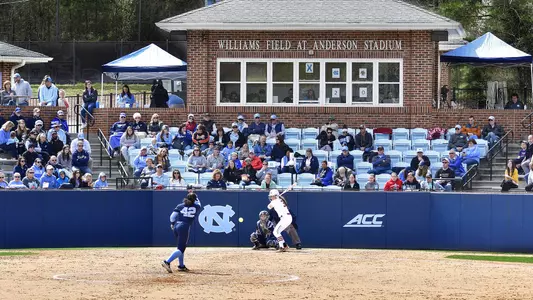
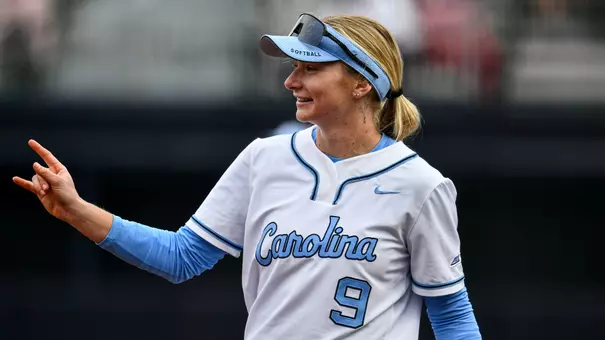
Photo by: Jeffrey A. Camarati
GoHeels Exclusive: Q&A with Carolina Softball's First Olympian
March 29, 2019 | Softball, Featured Writers
By Pat James, GoHeels.com
A four-year starter for the North Carolina softball team from 1999-2002, Natalie Lindley (née Anter) became the program's first Olympian in 2004, when she represented Italy in the Summer Olympics in Athens.
Lindley helped Italy secure its spot in Athens with her three-run home run in the finals of the 2003 Africa/Europe Olympic Qualifier. Before then, she set numerous UNC records, including career marks for home runs, RBIs and total bases. She still ranks in the top six of each category.
Currently, Lindley lives in Costa Mesa, Calif., and works for the pharmaceutical company Merck. As part of Carolina's celebration of Women's History Month, she spoke with GoHeels.com's Pat James last week about her time at UNC, her Olympic experience and how the lessons she learned during her softball career have translated to her job.
Q: When in the early stages of your softball career did you start thinking that playing in college might be a possibility?
Natalie Lindley: Very early. The area I came from actually had six Olympians. So we were just a very competitive city. My high school, the entire starting nine went Division I full ride. So I'd say probably the age of 11. At that time, we were all pretty much getting groomed and even trying out for Junior Olympic teams, the Pan-Am teams. We were playing very competitive and elite levels very young, so it was kind of a foregone conclusion that we were going to play at the college level.
Q: When did the prospect of one day playing in the Olympics become more of a goal than something you dreamed about?
NL: I would say my sophomore year in high school. One of my teammates tried out for the '96 Olympic Games and she was a freshman in college at UCLA. So just to start seeing some of the girls who I grew up playing with actually have a chance to do it, it became something that could actually be done. It wasn't just some of the older generation of people. Of course, I wanted to play for the U.S. National Team and I was given a chance early on in my career and that didn't work out. … After I didn't make the U.S. Team, I was approached by a coach from Cal State Fullerton who knew I was Italian. It was during my time at Carolina that they started talking about looking through my ancestry and seeing if I could become a dual citizen.
Q: What was the process like of attaining dual citizenship?
NL: It actually takes a long time. You are working with lawyers and people who translate and you're working with the Italian consulate and the American embassy out here. And they're going back and forth to find your paperwork, translating it, having someone explain it to you out there. So my parents were doing a lot of it while I was still finishing up at Carolina. … It was about a year of back and forth with paperwork and lawyers and getting both embassies to work together. And then I had to go get my passport and things like that.
Q: How did going through that process change how you viewed your Italian heritage?
NL: Unfortunately for me, it was my great-grandparents who were originally from Italy, and I only knew them when I was small. So, a lot of my family didn't speak the language. It was great. I got to go and see the village where my great-grandparents were from, and I learned the language. I lived out there for almost three years. It very much enriched my Italian heritage and my culture, much more than even my immediate family. I still to this day can speak Italian and am very close to everyone I met out there. I got to see the entire country and really understand the different regions and the different dialects and things like that.
Q: What led you to UNC?
NL: From California, the majority of us go play in the Pac-12. So I was for sure going to go play at Arizona or actually even Stanford, which was where I wanted to play and that's where I was being recruited. I did't get my SATs high enough to get into Stanford, so I kind of missed that initial recruiting window, the first group of us who committed early. … Then one of my batting coaches knew Coach (Donna) Papa over at North Carolina, and I had no idea even where North Carolina was. My mom was going, 'That's Michael Jordan.' … So I said, 'OK, I'll go visit it.'
It was fall and back then we were No. 4 in football, Mack Brown was there, we were playing Florida State and it was Halloween. Just every amazing thing about Chapel Hill was happening when I went on my visit. And it was so different than where I'd grown up. I went to a small private school. Just to see how amazing and beautiful the campus was, the energy around Halloween, the energy on the football field. I'd never seen a University like that in my life. I was just totally blown away.
Q: During your time at UNC, how did you grow as a player and a person?
NL: As a player, it was very different. Softball had only been in North Carolina at fast pitch, I think, for five years. … So the level of play wasn't anything that I was used to. I had to definitely grow as a leader and learn how to mature and expect that everyone has a role. I had to temper myself and learn a lot of different things about working with the team and helping others because I was still used to a very high functioning, high level of play. It was very different and people were from all over. I think two of my teammates from my class were from Southern California.
As a person, I was 3,000 miles away from home, coming from an Italian Catholic family and a private school of like 200 kids. It was a huge change for me. The culture was totally different. It was a large campus. My sport hadn't started until spring so I was very shy. And the transformation to take care of yourself, be by yourself, learn the southern culture, to be at this huge university and part of an athletic program like that, it was amazing, the best thing I ever did in my life.
Q: What's your best memory from your time at UNC?
NL: When we won the first ACC championship for the program (in 2001), I think for us, that solidified ourselves in the athletic program. I think we were not known very well, and a lot of the women's sports were so great. The soccer program, lacrosse was always good. Everybody was so good. So, I think when we finally won our ACC conference championship, we felt a part of the rich women's history in the athletic program.
Q: What do you remember most about your home run against the Czech Republic in the finals of the 2003 Africa/Europe Olympic Qualifier?
NL: I remember it was probably one of the farthest home runs I've ever hit. I remember I had been having such a rough tournament. I remember hearing my dad screaming. I could always hear his voice out of a crowd. And I remember the president of my team ran and found it and came and hugged me, crying. … I always knew we would go (to the Olympics), but to be such a significant part of winning that game, it was awesome. It was just great. I'd already felt such a part of the Italian National Team, the heritage, the community, but to be such a big part of the reason we went, it increased my tie to the country.
Q: What stands out most from your experience at the Olympics?
NL: I don't think you realize the magnitude of it from watching it, versus when you're there. I always tell the story of the opening ceremonies. You're in this holding cell. You're in a whole different part of the Olympic Park. You have no idea what's going on. I was hanging out with Allen Iverson and Shane Battier was there, and I even have a picture with Roy Williams because he was coaching. Kind of just mingling with everybody with your brown bag lunch.
Then they call your country, and you line up and you go through this tunnel. You kind of start hearing the cheers, and then you walk out in that stadium and hear 100-something thousand people. … To go from pitch dark, this normal hanging out, to that? It was the most incredible experience of my life.
Q: How much consideration did you put into continuing to play? What influenced you to change paths?
NL: I think a lot about what I did going to Carolina: Being able to live 3,000 miles away from home, to embrace a whole new culture and way of life, and then to go to Europe and live there for three years. I had experienced a lot. … I had gotten offers to play in Japan professionally, and you make really great money, and I thought that was the path I was going down. But my father was the one who sat me down and explained that I'd gained all of this worldly experience, I went to an excellent academic institution. Had I not had those experiences, I think that I would maybe be an assistant coach somewhere. So, I wanted to use the degree I had. I wanted to use the level of experience I had and be able to bring my athletic experience into something that I could actually use, as well, so that led me to sales.
Q: What do you do in your current role at Merck?
NL: Currently, I am the region analyst for the California region. So, we're all broken up by areas of the United States. California and Hawaii are one region called the California region. I'm in charge of analyzing all of the data, the trends, the market expectations, opportunities, and I take all of that data and make presentations that go out to our director, to the executive teams and to the regions. So, I'll present at meetings. … I basically show where people are ranking, where their opportunities are, where they're underperforming. There are about 20 of us in the nation that do this, so basically, we're our director's right-hand man as far as analyzing. Then, I'm still in the field another portion of the time, as well.
Q: How has your time as a student-athlete at UNC benefited you throughout your career?
NL: Basically, you're going into physicians' offices – I work with cardiologists – or hospitals. They see maybe 20 reps a day. When you can differentiate yourself on something, that immediately gets you more respect, versus you're just another sales person. It's huge. When you have the backing of such an incredible university and you were a legit athlete there and you were an Olympian, it gets me way further in the door than many of my peers and colleagues. I don't think if I didn't have it that I would have the confidence, the success, any of it.
We have two little boys, and I keep telling my husband all the time, 'I want them in sports.' I think it completely shapes a lot of who you are.
Stay up to date with Carolina Softball by following the Tar Heels on Twitter and Instagram.
A four-year starter for the North Carolina softball team from 1999-2002, Natalie Lindley (née Anter) became the program's first Olympian in 2004, when she represented Italy in the Summer Olympics in Athens.
Lindley helped Italy secure its spot in Athens with her three-run home run in the finals of the 2003 Africa/Europe Olympic Qualifier. Before then, she set numerous UNC records, including career marks for home runs, RBIs and total bases. She still ranks in the top six of each category.
Currently, Lindley lives in Costa Mesa, Calif., and works for the pharmaceutical company Merck. As part of Carolina's celebration of Women's History Month, she spoke with GoHeels.com's Pat James last week about her time at UNC, her Olympic experience and how the lessons she learned during her softball career have translated to her job.
Q: When in the early stages of your softball career did you start thinking that playing in college might be a possibility?
Natalie Lindley: Very early. The area I came from actually had six Olympians. So we were just a very competitive city. My high school, the entire starting nine went Division I full ride. So I'd say probably the age of 11. At that time, we were all pretty much getting groomed and even trying out for Junior Olympic teams, the Pan-Am teams. We were playing very competitive and elite levels very young, so it was kind of a foregone conclusion that we were going to play at the college level.
Q: When did the prospect of one day playing in the Olympics become more of a goal than something you dreamed about?
NL: I would say my sophomore year in high school. One of my teammates tried out for the '96 Olympic Games and she was a freshman in college at UCLA. So just to start seeing some of the girls who I grew up playing with actually have a chance to do it, it became something that could actually be done. It wasn't just some of the older generation of people. Of course, I wanted to play for the U.S. National Team and I was given a chance early on in my career and that didn't work out. … After I didn't make the U.S. Team, I was approached by a coach from Cal State Fullerton who knew I was Italian. It was during my time at Carolina that they started talking about looking through my ancestry and seeing if I could become a dual citizen.
Q: What was the process like of attaining dual citizenship?
NL: It actually takes a long time. You are working with lawyers and people who translate and you're working with the Italian consulate and the American embassy out here. And they're going back and forth to find your paperwork, translating it, having someone explain it to you out there. So my parents were doing a lot of it while I was still finishing up at Carolina. … It was about a year of back and forth with paperwork and lawyers and getting both embassies to work together. And then I had to go get my passport and things like that.
Q: How did going through that process change how you viewed your Italian heritage?
NL: Unfortunately for me, it was my great-grandparents who were originally from Italy, and I only knew them when I was small. So, a lot of my family didn't speak the language. It was great. I got to go and see the village where my great-grandparents were from, and I learned the language. I lived out there for almost three years. It very much enriched my Italian heritage and my culture, much more than even my immediate family. I still to this day can speak Italian and am very close to everyone I met out there. I got to see the entire country and really understand the different regions and the different dialects and things like that.
Q: What led you to UNC?
NL: From California, the majority of us go play in the Pac-12. So I was for sure going to go play at Arizona or actually even Stanford, which was where I wanted to play and that's where I was being recruited. I did't get my SATs high enough to get into Stanford, so I kind of missed that initial recruiting window, the first group of us who committed early. … Then one of my batting coaches knew Coach (Donna) Papa over at North Carolina, and I had no idea even where North Carolina was. My mom was going, 'That's Michael Jordan.' … So I said, 'OK, I'll go visit it.'
It was fall and back then we were No. 4 in football, Mack Brown was there, we were playing Florida State and it was Halloween. Just every amazing thing about Chapel Hill was happening when I went on my visit. And it was so different than where I'd grown up. I went to a small private school. Just to see how amazing and beautiful the campus was, the energy around Halloween, the energy on the football field. I'd never seen a University like that in my life. I was just totally blown away.
Q: During your time at UNC, how did you grow as a player and a person?
NL: As a player, it was very different. Softball had only been in North Carolina at fast pitch, I think, for five years. … So the level of play wasn't anything that I was used to. I had to definitely grow as a leader and learn how to mature and expect that everyone has a role. I had to temper myself and learn a lot of different things about working with the team and helping others because I was still used to a very high functioning, high level of play. It was very different and people were from all over. I think two of my teammates from my class were from Southern California.
As a person, I was 3,000 miles away from home, coming from an Italian Catholic family and a private school of like 200 kids. It was a huge change for me. The culture was totally different. It was a large campus. My sport hadn't started until spring so I was very shy. And the transformation to take care of yourself, be by yourself, learn the southern culture, to be at this huge university and part of an athletic program like that, it was amazing, the best thing I ever did in my life.
Q: What's your best memory from your time at UNC?
NL: When we won the first ACC championship for the program (in 2001), I think for us, that solidified ourselves in the athletic program. I think we were not known very well, and a lot of the women's sports were so great. The soccer program, lacrosse was always good. Everybody was so good. So, I think when we finally won our ACC conference championship, we felt a part of the rich women's history in the athletic program.
Q: What do you remember most about your home run against the Czech Republic in the finals of the 2003 Africa/Europe Olympic Qualifier?
NL: I remember it was probably one of the farthest home runs I've ever hit. I remember I had been having such a rough tournament. I remember hearing my dad screaming. I could always hear his voice out of a crowd. And I remember the president of my team ran and found it and came and hugged me, crying. … I always knew we would go (to the Olympics), but to be such a significant part of winning that game, it was awesome. It was just great. I'd already felt such a part of the Italian National Team, the heritage, the community, but to be such a big part of the reason we went, it increased my tie to the country.
Q: What stands out most from your experience at the Olympics?
NL: I don't think you realize the magnitude of it from watching it, versus when you're there. I always tell the story of the opening ceremonies. You're in this holding cell. You're in a whole different part of the Olympic Park. You have no idea what's going on. I was hanging out with Allen Iverson and Shane Battier was there, and I even have a picture with Roy Williams because he was coaching. Kind of just mingling with everybody with your brown bag lunch.
Then they call your country, and you line up and you go through this tunnel. You kind of start hearing the cheers, and then you walk out in that stadium and hear 100-something thousand people. … To go from pitch dark, this normal hanging out, to that? It was the most incredible experience of my life.
Q: How much consideration did you put into continuing to play? What influenced you to change paths?
NL: I think a lot about what I did going to Carolina: Being able to live 3,000 miles away from home, to embrace a whole new culture and way of life, and then to go to Europe and live there for three years. I had experienced a lot. … I had gotten offers to play in Japan professionally, and you make really great money, and I thought that was the path I was going down. But my father was the one who sat me down and explained that I'd gained all of this worldly experience, I went to an excellent academic institution. Had I not had those experiences, I think that I would maybe be an assistant coach somewhere. So, I wanted to use the degree I had. I wanted to use the level of experience I had and be able to bring my athletic experience into something that I could actually use, as well, so that led me to sales.
Q: What do you do in your current role at Merck?
NL: Currently, I am the region analyst for the California region. So, we're all broken up by areas of the United States. California and Hawaii are one region called the California region. I'm in charge of analyzing all of the data, the trends, the market expectations, opportunities, and I take all of that data and make presentations that go out to our director, to the executive teams and to the regions. So, I'll present at meetings. … I basically show where people are ranking, where their opportunities are, where they're underperforming. There are about 20 of us in the nation that do this, so basically, we're our director's right-hand man as far as analyzing. Then, I'm still in the field another portion of the time, as well.
Q: How has your time as a student-athlete at UNC benefited you throughout your career?
NL: Basically, you're going into physicians' offices – I work with cardiologists – or hospitals. They see maybe 20 reps a day. When you can differentiate yourself on something, that immediately gets you more respect, versus you're just another sales person. It's huge. When you have the backing of such an incredible university and you were a legit athlete there and you were an Olympian, it gets me way further in the door than many of my peers and colleagues. I don't think if I didn't have it that I would have the confidence, the success, any of it.
We have two little boys, and I keep telling my husband all the time, 'I want them in sports.' I think it completely shapes a lot of who you are.
Stay up to date with Carolina Softball by following the Tar Heels on Twitter and Instagram.
Tuesday, June 23
Sunday, June 21
Sunday, June 21
Saturday, June 20