University of North Carolina Athletics
From Fetzer to Finley: A Critical Look At Issues Involving UNC Olympic Sports
May 15, 2000 | Men's Tennis
May 15, 2000
By Dave Lohse
Director of Media Relations for Olympic Sports
When University of North Carolina senior men's tennis player Tripp Phillips told Tar Heel head coach Sam Paul last summer that he would be returning for his senior year at Carolina this year, there was a gleam in Paul's eye. The gleam was there not because Paul knew that Phillips' innate physical talent would make the Tar Heels a much better tennis team in the year 2000. It more represented Paul's satisfaction that a truly solid human being would be returning to Carolina in the year 2000 to provide leadership for a young, but talented tennis team.
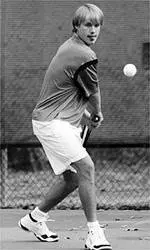
In so many ways Tripp Phillips is old school. Now he would probably hate me for using that term but it is the truth. Tripp can be as cool as any Charlotte, N.C. kid out of the Country Day School can expect to be. He's a tall, lanky good-looking kid with long blond hair and an infectious smile. He's a frat boy at Carolina and it is a sure bet that many a Carolina coed has swooned over him during his time here. He's also a good student and he can be found many days on the computer in the foyer of the Cone-Kenfield Tennis Center checking his email and surfing the web. There is no mistaking Tripp Phillips for a college student in the year 2000.
But he is still old school. In an era when so many athletes are only interested in the "me" of college sports, Phillips is the kind of competitor who puts the team first. That isn't the easiest thing to do in a sport that is as individual in its nature as college tennis is. But you will find no better leader on the UNC campus than Tripp Phillips. Add to that the fact that you are unlikely to find a harder worker or a fiercer competitor and you can now understand why Phillips' senior year has been so spectacular.
Next week, Phillips will compete in the individual singles phase of the NCAA Tournament for the third time in his career. He also earned NCAA bids in 1997 and 1998. He goes in this year as the 22nd ranked singles player in the Intercollegiate Tennis Association rankings. Considering that he started the year ranked #80, virtually anyone can appreciate the kind of season Phillips has had to move his ranking to its current lofty status.
That Phillips is still around competing for the Tar Heels is somewhat of a minor miracle in itself. After three extremely solid years as a Tar Heel in 1996-98, Phillips injured his shoulder in the summer of 1998. The injury was so painful that he had no choice but to red-shirt during the Tar Heels' 1999 season. That was a devastating blow to Carolina. After losing a large group of seniors from the year before Carolina was counting on Phillips to be the mainstay on a young team in '99. Without him the team struggled and ended up 11-14, Carolina's first losing season since 1986.
The season could have been much worse. Paul had scheduled the Tar Heels with the belief that Phillips would be in the lineup. Without him Carolina simply went into too many encounters overmatched. But a silver lining appeared. The 1999 Tar Heels, despite their losing record, were fighters. Paul knew that with most of those players returning for 2000 and with three impact newcomers arriving the Tar Heels could be much improved. It was also hoped that the naysayers who were calling for Paul's removal as head coach would be silenced.
When Carolina started its fall 1999 season Phillips still wasn't ready to play. The pain when he served was still too great. But there was hope that he could be ready for the spring. And with fellow senior Assaf Drori, an All-ACC pick in 1999, back to play #2 singles for the Tar Heels, Phillips and Paul both knew the Tar Heels could be a much improved team this spring.
That they were. Every player on the team made a contribution to the success of the team. And Phillips was the great leader he was expected to be. In the process the Tar Heels finished 18-6 overall and they reached the finals of the ACC Tournament for the first time since 1996. In the NCAA Tournament the Heels easily dispatched Ball State in the first round before falling to Southeastern Conference champion and ninth-ranked Tennessee 4-2 in the regional final. Phillips won both of his singles matches this past weekend and he goes into the NCAA Tournament with an overall ledger of 22-5 this season.
Phillips' outstanding senior season was probably best defined by his come-from-behind win over Clemson's Josh Goffi in the semifinals of the ACC Tournament. Phillips, breaking the 3-3 tie and lifting the Tar Heels into the team final eventually won the three-set thriller between two evenly matched competitors.
Probably more than anything else I know about Tripp Phillips is that he represents for me a hope for the future of college athletics. In an era when the pampered, egotistical and tempermental individual in sports seems to earn the most ink, it is comforting to know that "old school" kids like Phillips still exist.