University of North Carolina Athletics
CAR-O-LINES
May 2, 2000 | Football
May 2, 2000
By Rick Brewer
They are perhaps the two most magical names in Carolina football history.
Charlie Justice and Don McCauley.
They played years apart. They operated in widely different offensive systems and certainly had contrasting styles on the field.
Yet, in some ways they were quite alike. Their personalities were similar and each helped rebuild the Tar Heels' football fortunes.
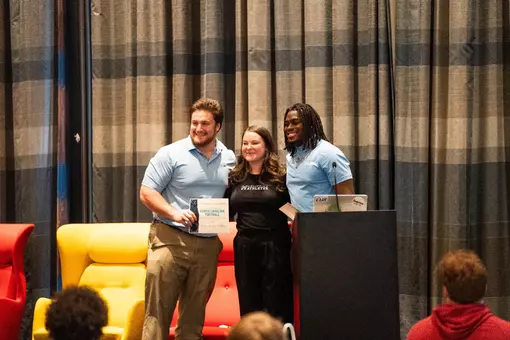
They were together last week in Raleigh when the Triangle Chapter of the National Football Foundation and Hall of Fame held its annual meeting. Justice received the Chapter's Distinguished American Award and McCauley served as the guest speaker.
Justice, of course, is the all-purpose tailback who was the centerpiece of Coach Carl Snavely's single-wing attack in the late 1940's. He was a brilliant open-field runner, a fine passer and perhaps the top punter in the nation. Plus, he could block and catch the football, as well.
In his four years on campus, the Tar Heels went to the Sugar Bowl twice and the Cotton Bowl once.
Carolina had been one of the top teams in the nation during most the late 1930's. But, during World War II, the school had off-and-on success in the sport. All that changed when Justice arrived on campus. He had been a heralded high school star in Asheville before joining the Navy. After the War ended he enrolled at Carolina and helped propel the school to its greatest heights in football.
And "help" is unquestionably the word he would use.
Justice was a modest young man who always gave credit to his offensive line anytime he broke off a great run. He said any of the other players in the power-packed Tar Heel backfield could make the plays he did if given the opportunity.
Actually, there have been few players anytime, anywhere who had Justice's football instincts. His ability to change direction while running full speed was uncanny. He could be racing downfield, come to a complete stop as a defender approached and be off again in an instant as if he had never broken stride.
As the nation, the state and the University began to recover from the horrors of the great war it had just endured, heroes were needed. Justice was one of those heroes. On Saturdays, students and fans could crowd into Kenan Stadium and forget for a while what they and their families had been forced to suffer so recently.
No athlete, not even Michael Jordan, has had an effect on this state like Justice.
However, after his four years here were over, the Tar Heel football program struggled. There were hopes of a rebirth when Jim Tatum returned to his alma mater as head coach in 1956. But, just when Tatum seemed to have things turned around, he died suddenly of Rocky Mountain Spotted Fever prior to the 1959 season.
Two of Tatum's three teams went 6-4. Along with the 1963 Gator Bowl squad, they were the only ones after Justice's senior year in 1949 to have winning records until Bill Dooley was hired as head coach prior to the 1967 season.
Dooley's style of football resembled Snavely's about as much as the campus today looks as it did during the Justice Era.
Dooley believed to be successful you had to run the football and keep your opponent from running it at you. Ball control would win games. He installed the I-formation and looked for a tailback who could make it work. He found him in McCauley.
Although he was recruited with the idea of making him a defensive back, McCauley was perfect for Dooley's offense. Although only 6-1 and 211 pounds, McCauley was capable of carrying the football 40 times a game. As defenses tired in the fourth quarters of games he would seemingly still be as strong as he was on his first carry.
McCauley was also a tremendous threat as a receiver. He had great hands out of the backfield and that only caused more problems for the opposition. Although he didn't have the speed of a Kelvin Bryant or a Curtis Johnson, no linebacker could cover him one-on-one.
Although not called on to block a great deal, he was very good at it. He also handled the team's punting in his senior season.
In 1969 he came the first of Carolina's record 24 backs to gain 1,000 yards rushing. The following year he broke O.J. Simpson's NCAA single-season rushing record with 1,720 yards and sparked his team to an 8-3 regular-season finish. That earned the Tar Heels a berth in the Peach Bowl.
Like Justice, McCauley was humble and modest. He made a point to credit his offensive line and his fullbacks for the yardage he gained. In locker rooms after games he would tell reporters to talk to a defensive player who had made a key stop or maybe the passing combination of Paul Miller and Lewis Jolley.
Beginning with McCauley's senior season Dooley's teams went to six bowl games in eight years.
Not only did McCauley help return the football program to national prominence, but he started the school's incredible list of 1,000-yard backs.
Justice and McCauley.
Two players from vastly different times, but two who have meant so much to Carolina's football success.
It's fitting McCauley was there last Monday night in Raleigh to help honor Justice. They've been the key figures in two of the Tar Heels' most successful football eras.