University of North Carolina Athletics
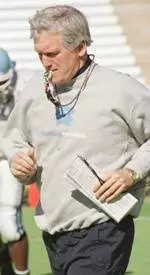
Lee Pace on Ken Browning
September 23, 2000 | Football
Sept. 23, 2000
y Lee Pace
It always frustrated Kenny Browning that he could never rig a device to simulate the snapping of a football during drills for defensive linemen.
Moving on an audio call wouldn't work, of course. If the linemen got used to charging to the word "hut," for example, they'd do that in a game and get drawn offside when the ball remained perfectly still.
Having a manager snap the ball was fine, if one was available. But not always in the high school ranks does the support personnel stretch that far.
Snapping the ball himself was no good because he couldn't get as good a look at his players from a crouching position. If he couldn't see them well, he couldn't tell them their rears are too high, they're stepping with the wrong foot, leading with the wrong hand--any of dozens of minutia on his technique checklist.
So Browning tried tying a football to a string and yanking it to simulate the snap. That worked okay but it was cumbersome to replace the ball each time.
Then one day six or seven years ago, he was at a coaching clinic and one of the exhibitors had a football mounted as part of a lamp. He noticed the football had been filled with some foam rubber.
A light went on.
"I thought maybe you could fill a football with foam rubber, then mount a stick of some sort on one end," Browning says. "That way you could stand several yards away from the football and move it with the snap count."
He massaged the idea and now for most of his years at Carolina, Browning's been satisfied that he's properly teaching defensive tackles to charge upon movement of the football. His "ball-on-a-broomstick" beats anything any of the coaches have ever seen--even some newfangled device made of plastic and sold nationally.
"I told him when he came up with that thing he ought to patent it," Tar Heel head coach Carl Torbush says. "Kenny's always trying to figure out a better way to do things."
It's this attention to detail, this obsession to get things exactly right, that Browning brings to his new position as defensive coordinator for the Tar Heels. After six years as defensive tackles coach, and, before that, a sterling career as a high school head coach, Browning was a natural to succeed Torbush when the latter decided to relinquish his dual role as head coach and coordinator after the 1999 season.
"I don't know a man more dedicated to the game of football, who loves the game more, who loves coaching more," Torbush says. "He loves to study the game. Kenny'd rather read a book on playing the `bear' defense than reading Sports Illustrated. He'd rather watch tape of the Tampa Bay Buccaneers' zone blitz than watch The Green Mile. And he's very, very smart with it. He'll do a fine job, I have no doubt."
rowning grew up on a farm outside of Durham and played football at Guilford College.  One of his college teammates, Allen Brown, remains one of his best friends. "He was a tough guy, one who played way beyond his abilities," says Brown, the retired head coach at Thomasville High. "The rougher and tougher the job, the more he liked it."
Browning coached six years at Ledford High in the early 1970s and then went on to compile a 178-35 record in 18 years at Northern Durham High. All the while, there was something new to learn: More about Bear Bryant, the legendary Alabama coach, and Johnny Unitas, the renowed Colts quarterback, who were heroes to many a 1960s adolescent. More clinics to attend at Carolina, N.C. State, Wake Forest, Clemson, Duke, or anywhere coaches talked football.
"Boy, we had a lot of road trips," Brown says. "We logged a lot of miles. We've had a lot of fun."
A couple of observations from six-plus years of frequent conversations with Browning:
One, he has quality insides and knows how to balance winning and losing with other missions of a coach. During the depths of the Tar Heels' 3-8 season in 1999, Browning was asked about the difficulty of keeping the players' spirits bolstered.
"You don't treat the players any differently just because you're losing," he said. "If one way was good enough when you're winning, it's good enough when you're losing."
And two, though there are many more bells and whistles around his job at Carolina compared to the high school ranks (more salary, nicer offices, plane rides on road trips), he doesn't think any more of himself or his job now than he did a decade ago. The game, he says, is exactly the same from one level to the next. That's the mark of a true coach.
Lee Pace, Carolina 1979, is a Chapel Hill free-lance writer who is in his 11th year writing Extra Points, a newsletter devoted exclusively to Tar Heel football. You can read Extra Points each Monday during the football season at TarHeelBlue.com.