University of North Carolina Athletics
October 11, 2001 | Football
Oct. 11, 2001
By Lee Pace
A nice piece of X-and-O scheming and a purposely underthrown football led to one of the key plays for the Tar Heels in last week's 24-21 win over East Carolina.
The Tar Heels had the ball at the Pirate 29, trailing 10-0 with about six minutes left in the first half. It was second down, 13 yards to go.
Offensive coordinator Gary Tranquill and his staff had developed the opinion in watching tape of East Carolina that a particular route known as a "wheel" might be especially good against the Pirates. ECU predominantly plays a three-deep zone against the pass, with the cornerbacks and free safety passing receivers off to one another as they move from one zone to the next. The strong safety and linebackers are involved as well, depending on the particular defensive call.
If a split end runs a post pattern against most three-deep zones, the cornerback will check the receiver while in his zone but then release the split end to the safety. Then the cornerback will look for a second receiver in his zone.
The Pirates, however, send the cornerback with the split end, doubling-up that receiver with the safety. It's then the responsibility of the strong safety or a linebacker to cover a second receiver that runs into the flat area to the split end side.
Tranquill believed that by running a wheel route--essentially a "flat" pattern turned into a "go" or streak" route, a faster receiver should be able to lose the slower linebacker or strong safety. The latter is inevitably the less-talented cover guy in the secondary.
Thus the play shown here.

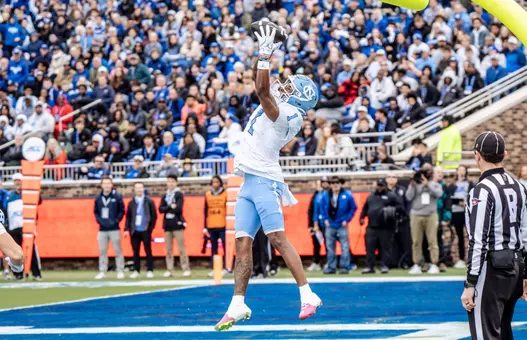
Chesley Borders went in motion to the right. QB Darian Durant faked a handoff to the tailback out of the shotgun, then executed a bootleg roll-out to the right. Sam Aiken (88) ran the post, with the cornerback and safety, as expected, covering him. That left Borders one-on-one with the strong safety, Anthony Adams (12).
Tranquill's first hope was that the safety would bite on the first leg of the route. As Borders runs what appears to be a flat pattern, he turns his head to the right, as if to receive the pass. If the safety breaks on that move, then it's a simple matter for Borders to get wide open when he "wheels" and takes off downfield.
Adams actually covered Borders well. First, he did not bite on the fake. Then, he covered Borders' inside shoulder downfield. That's when Durant made a critical aiming decision.
"Coach Tranquill says the most dangerous play in football is the underthrown deep ball," Durant says.
That's because the receiver always finds the football in the air before the cover guy. He knows when to look and where to look. If the cover guy is running with the receiver and hasn't looked for the ball, the receiver can slow down or stop his route in time to catch an underthrown ball before the defender can react. The defender invariably overruns the play.
That's precisely what happened here.
Borders applied his brakes at about the five yard-line, came back a step or two to make the catch and squirted into the end zone before the safety could figure out what had happened.
"Durant did the right thing," Tranquill says. "If he throws it out in front, Borders probably doesn't get it. The safety was running right with him."
"Darian did a great job," says Borders. "He read the coverage and threw a perfect ball. I don't think the safety ever saw the ball."
The touchdown for Carolina cut the ECU lead to 10-7. Coming as it did amidst four three-and-outs in five possessions for the Pirate offense, it effectively erased any early game momentum remaining for ECU.
I will admit to being part of the problem. I promise to be part of the solution in 2010, the next time East Carolina comes to Chapel Hill for a football game.
I helped four East Carolina fans get tickets to the game. Never again. Not ECU fans, not N.C. State fans. No one but Carolina fans. (I don't have any friends who are Duke fans, so that's not an issue.)
When Pirate QB David Garrard connected with receiver Derric Collier for 30 yards on the third snap of the game Saturday, I was stunned at the noise made by East Carolina fans throughout the stadium.
Okay--so they sold out all 5,000 of their official allotment of tickets. Good for them. That positioned the purple-and-gold partisans in the traditional visitors' area--north side, near the old field house, and some in the corner of the new enclosed end of the stadium.
Granted--an estimated 150 Pirate fans purchased season tickets for six Carolina home games so they'd have a seat for this one game. That's Pirate pride, for sure. But anyone buying their first season tickets this fall and not coughing up many thousands of dollars for an Educational Foundation membership would not have had prime seats with those season tickets.
So how the blazes did Pirate fans get seats throughout the stadium in primo locations--between the 30s with good elevation?
It's our fault. We gave them and sold them to friends and relatives and business associates. Shame on us.
"The kids were hurt. We lost our 12th man Saturday," says Jeff Connors, the Tar Heels' new strength and conditioning coach who moved last winter from East Carolina. "I'll guarantee you one thing--when we go down there in 2003, their fans won't let our fans in like happened here Saturday."
"Yeah, I'd have to say I was disappointed," defensive tackle Will Chapman says. "It was one thing to ride in on the bus and see all these East Carolina people tailgating--Pirate flags and purple everywhere. Then to hear all those people in the stadium ... hopefully, that won't happen again."
With five Division I football schools within 180 miles of one another in North Carolina, there are bound to be plenty of mixed families. I saw one couple walking down Franklin Street about 8 p.m. Saturday, the man in a Carolina sweatshirt and the woman in East Carolina garb. Remarkably, they were smiling and holding hands.
I was hit up repeatedly over several months by a long-time friend, golf buddy and sometimes business associate for a pair, and by a member of my extended family for two more. "So what?" I thought. "My four interlopers can't do any harm." I was right--those four couldn't. But if 2,000 other Carolina fans had the same belief and helped get 8,000 more East Carolina fans into Kenan Stadium, you can see where the Pirate noise began to escalate. It won't happen again.
Remember next time--when you let opposing fans in a Carolina arena, you're diminishing the home-field advantage for the Tar Heels. I've learned my lesson. (Same goes for Smith Center ticket-holders who always let N.C. State fans invade en masse for the Wolfpack's annual visit to Chapel Hill.)
Speaking of Jeff Connors, he's proudly sporting a brand new interlocking "NC" logo on his right arm near the shoulder. It's even two-toned--navy blue outline, Carolina blue interior.
"I think most strength coaches are about half crazy," Connors says with a smile.
Connors has led a complete overhaul of the Tar Heel strength and conditioning program and is well-respected by the players. He promised them he'd get the tattoo if they beat the Pirates. The deed was done Monday night.
"I guess I'm here for good," he says.
Kenan Stadium officials have had to work overtime this week flushing an inordinate number of liquor mini-bottles from the toilets--despite the fact that every rest room has a plentiful supply of trash cans.
It was 34-0 Carolina at halftime, and Al Groh was fit to be tied. Groh, the head coach at Wake Forest from 1981-86, stared down his Demon Deacons in the visitors' dressing room in Kenan Stadium and laid down the law.
"For every point we get beat by, we practice tomorrow for five minutes," Groh said.
The Wake Forest players did a little math: At the current pace, that meant a two-hour, 50-minute practice on Sunday.
"The second-team guys were already mad we were down that much and we weren't playing," says a Deacon receiver at the time, Gunter Brewer. "The idea of practicing on Sunday made us really mad."

|
"Coach Groh hated Carolina back then," Brewer says. "Well, he loved 'em and hated 'em, if you know what I mean. He'd coached here [1973-77] and knew how great it was here. He would have loved to come back as head coach. But if you're against Carolina, you're really against 'em."
Either Groh's motivational trick worked wonders or the Tar Heels lost interest with their big lead that afternoon back in 1985. It was probably a little of both. Anyway, the Deacons played respectably in the second half, shutting out the Tar Heels and scoring 14 fourth-quarter points in a 34-14 victory.
Sure enough, Groh had his team on the practice field Sunday morning for practice.
"Not only that, he bused us over to Groves Stadium that afternoon and we scrimmaged." Brewer says. "The guy keeping the time-clock fell asleep and it went on and on and on. Coach Groh about had a mutiny on his hands."
All the extra work did not pay off, however. Groh and the Deacons lost the following Saturday to Maryland, 26-3.
The Philadelphia Eagles had just lost their second straight game to open the 1978 season, and linebacker John Bunting was in a panic on Monday night to reach head coach Dick Vermeil.
He called Vermeil at the office, trying various numbers and extensions.
He called him at home.
He left messages everywhere.
Bunting was dying to talk to Vermeil, to pass along the key to the kingdom, the morsel of

the Eagles. |
Finally, Vermeil returned the call, reaching Bunting at home the following morning.
"John, here's my private number if you ever need me this desperately again," Vermeil said. "Okay, now what's so important?"
"Coach, I've figured it out. I've got the answer!" Bunting chirped.
"So what is it?" Vermeil asked.
"Three in a row. That's it. We've got to win three in a row. Then we'll be fine, Coach," Bunting said.
"Three in a row?" Vermeil answered. "I just want one!"
Bunting laughs today at the memory.
"I knew we were better than those two losses," he says. "I was really upset. It was killing me. We lost one game by two points, the next by five. We'd worked so hard. We were so close. But still--no cigar. It just seemed to me that if we could get the confidence that would come from winning three in a row--not just one, not just two, but three--we'd have it made."
Guess what: Next week, the Eagles beat New Orleans by seven, the following week, Miami by 14, and the third week, Baltimore by three.
"And the next week I tear my knee up, miss the rest of the season and we make the playoffs for the first time under Dick," Bunting says.
This story comes up now because the Tar Heels have just won their third in a row.
"Every place I've been, when you win three in a row, you gain a genuine, deep-seeded level confidence," Bunting said this week. "I hope we'll have that now."