University of North Carolina Athletics
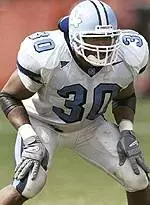
Tar Heel Monthly: Thornton Finishing Long Climb
November 24, 2001 | Football
Nov. 24, 2001
Tar Heel Monthly is a new monthly publication devoted to the stories and personalities behind UNC sports. For more information, visit www.tarheelmonthly.com
By Jennifer Jordan Engel
Tar Heel Monthly
John Bunting's first North Carolina football team was 0-3. After a loss to Texas, the rookie head coach convened a meeting of his seniors in his office.
The group talked for almost an hour. Eventually, one player had enough of the talk.
"Guys, there has been a lot of talk in here," senior linebacker David Thornton said. "Now, it's about doing it. We have got to go out and do it."
It wasn't surprising that Thornton was the one to speak up. Since his childhood, he has lived by a simple motto:
"You're going to have speed bumps in life and what are you going to do? Stop? No, you just run right over 'em."
What else would you expect from a former walk-on who arrived at Carolina in 1997 looking for an opportunity to play a team sport and found it with Carl Torbush's club in 1998 and again as starter on John Bunting's inaugural team?
It was only natural for Thornton to seek out athletics at Carolina. Growing up, he didn't have to look very far for heroes on the playing fields. When older brothers A.J. and Terrance found glory as quarterbacks, point guards and pitchers, Thornton obediently followed their lead. For each year of high school, Thornton easily earned those same high profile positions for all three sports, even earning all-conference as a senior for football.
If his brothers smoothed the way for the development of his athletic prowess, then it is his minister father, Arnold Thornton, to whom he credits the shaping of his leadership style and passion for volunteerism.
"My father instilled in me that desire to lead by example at a very early age," Thornton said. "He always taught me to suck my stomach in, keep my chest high, and sit in the front of the classroom. Setting an example for others included the activities I do outside of sports, such as tutoring, mentoring and helping out in the community. Giving back to others has always been a part of my life."
Colleges asked Thornton, who was president of both the student body and the National Honor Society, to continue his giving back by way of football at their respective schools. He turned down full rides from Division II schools such as Elizabeth City State, where brother Terrance played football and baseball, and Fayetteville State. In his mind, there was only one place he wanted to be--North Carolina.
"My father felt like Carolina had a prestigious name and was known for their academic reputation," said Thornton. "Once I was accepted, there was no hesitation about where I was going. I was Tar Heel bound."
Getting to Carolina was one thing. Finding his niche outside of the classroom was another matter entirely. True to form, Thornton immediately began his search for opportunities.
The volunteer activities presented themselves right away. As a freshman, Thornton immersed himself in organizations such as Minority Student Recruitment and UNC Upward Bound, a mentoring program. It's a wonder he found time to breathe, let alone sleep and study, with his extra-curricular involvement.
"It's almost as if there are not enough hours in the day," he admitted, "but it can be done."
He took a year to find an outlet for his athletic energies. Not surprisingly, he was a Carolina basketball fan growing up, and acknowledged that he didn't know much about the football program. What he did know is that he wanted to play a team sport at Carolina.
With a sheepish grin, he added, "I thought about basketball and I knew that was only a slim possibility. Football has many positions and I felt like I had a better chance of fitting in there."
But college life couldn't be all fun and games. As a walk-on, he needed to have a job to pay for his tuition and meals. For that, he turned to the Student Recreation Center, working his way up to Center Manager and a member of the board of directors. However, his job that almost cost him his chance with the football team.
"Many times I would have to leave early because I had to get something to eat and get to work," he said. "My position coach at that time was Coach [Ken] Rucker and he understood, but I don't think it sat very well with Coach Torbush.
"I understood. Of course they want you to be out there for the whole practice, but I didn't have a scholarship. I had to work to provide for my needs."
He almost lost sight of his football dreams. Thornton remembers the first time he faced being left behind as the team traveled. He considered letting football go and sticking with the books and other activities.
"But my father told me he never raised a quitter and I sounded like a quitter. He said you've got to stick it out and things will get better," Thornton said. "And he was right. You've just got to expect those things and run right over those speed bumps. And that's exactly what I did. I thank God for having a father like that."
As a walk-on, Thornton was at the bottom of the Tar Heel football totem pole. Hot meals weren't always rapidly available, and a replacement pair of cleats required more than just a simple request.
Thornton was reluctant to elaborate on any woeful tales of walk-on treatment, mostly because he knew that his teammates respected him for his work ethic and upbeat personality. They watched him put his time in the weight room, observed him make plays on the field and listened as he led them spiritually. He and junior teammate Ronald Brewer organized a team Bible study that draws a regular and healthy attendance.
"David Thornton is always excited and he always has a smile," Brewer said. "He is always ready to give."
"One thing I've noticed is that when David and I came in we were about the same build," teammate Kory Bailey said. "I haven't slacked off in the weight room, but he has definitely gotten bigger. It's a tribute to him, because that's a lot of long hours. When he came in he was a defensive back and he was my size, so to put that weight on and get faster is tremendous."
Some walk-ons never quite adjust to the second-class status they have to endure. Thornton prefers to look at the bright side of finally receiving a scholarship this past spring.
"When you get on scholarship, you truly appreciate the things that you didn't have before, such as the provision of your books and meals," stated Thornton. "It's a blessing to be on scholarship. I definitely appreciate everything that Carolina has done for me."
Thornton patiently did his time with special teams, playing 316 snaps in 2000, and prayed a door would open for him. That door came in the form of Bunting, a man he solemnly describes as a "football mastermind."
"When Coach Bunting got here, he gave me a real chance," said Thornton. "That's all I've been waiting for throughout my Carolina football experience. He's proud of me, he's been supporting me, he's confident of my abilities and I'm so thankful for that.
"And if another opportunity presents itself, I'm going to walk through that door and definitely give it all I've got. That's what I've been doing all my life. I'd love to keep playing."
He might get that chance. Bunting has been quick to direct professional scouts visiting Chapel Hill toward his senior linebacker. They don't always know his name when they get to town, but before leaving they have a good idea about David Thornton.
And at least one man with a pretty good idea of how to play linebacker thinks Thornton could make an NFL roster.
"He's what I'd call a very cerebral linebacker," former Eagles linebacker Bunting said. "He's also a big-play guy. Next to Julius Peppers, he's probably the biggest playmaker on our defense. He studies the game, and that's what a linebacker should do. I think he will play at the next level."
Considering his performance this season, that might not be such a far-fetched goal for this exercise and sports science major who graduates this December. But he also has a fallback plan.
Thornton is already taking masters level courses in sports administration as a way to continue his athletic career at Carolina. Advising him on the NFL and other opportunities is former letterman Corey Holliday, who took exactly the same route when his playing days at Carolina ended.
Holliday, Carolina's coordinator of student-athlete development, is quick to note Thornton's talent and dedication to the game. However, it's his dedication to life off the field that impresses Holliday the most.
"I was on the phone with someone who is doing a program with him, and I told her practice would run long and he'd be late," Holliday said. "She said it was no problem and that she had done so many activities with him, and that he was a pleasure to work with...If we could get all our team to do half the things he does off the field, we would be a great community service team. "
A recent issue of Sports Illustrated marks the 50th time a certain former Tar Heel has been featured on the cover. But look inside the magazine and you'll find a shot of this current Heel who is quietly making his mark on the program.
Pretty heady stuff for a walk-on. One would probably imagine that this season has been filled with numerous Kodak memories for Thornton.
Yet, the media guide bio indicates that his greatest athletic moment is getting to play in Kenan Stadium. Think that's changed? Not so, according to Thornton, who happily describes himself as a fan-slash-player.
"I'll never forget the first time I ran out of the tunnel in Kenan Stadium," he said. "Even though I wasn't playing, just wearing that uniform with my name on the back was phenomenal. When I got on the field to play my first snap, I was thinking, 'I'm actually out here getting the chance to compete in Kenan Stadium. This is unbelievable.' I've been excited about it ever since."
When asked about how he'd like to be remembered at Carolina, the answer is obvious.
While his time at Carolina has been marked by speed bumps, the football player, volunteer and minister's son has always known to stand tall and run right over them.
"I know a lot of guys who are walk-ons, not just in sports but in life, and a lot of times you want to throw in the towel and give up on your dreams," Thornton said. "But I believe that with God, all things are possible. I think people know the story of how I made it on to the team and how I've contributed, but I really want to be remembered for the hard work and the perseverance that I've put into this program."