University of North Carolina Athletics
Justice Era Reunion 2001
August 22, 2001 | Football
Aug. 22, 2001
y Irwin Smallwood
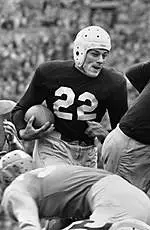
CHAPEL HILL -- When Carolina football players from the Charlie Justice years come to town Sept. 13-15 to celebrate the 55th anniversary of their first season, stories of glory days will abound. Most of them, in one way or another, will center around the legendary Justice, a 165-pound triple-threat tailback from Asheville who captured the hearts of North Carolinians as no other college athlete before or since.
They will talk of his great runs against Duke and Tennessee and assorted other victims. They will talk about how in 1948 he completed a dozen touchdown passes, as many as thrown by either Duke's great Sonny Jurgensen or N.C. State's Roman Gabriel in their banner college years.
They will talk about how, after having the first two punts of his college career blocked by Virginia Tech, it never happened again and he finished his career with a 42.6-yard average.
But they will talk about something else. Something outside the arena of athletic competition. The life accomplishments of the young men who turned the 1946-47-48-49 seasons into Carolina's authentic Golden Years.
The 150 or so players who wore Tar Heel blue during those four years were, indeed, a diverse collection of athletes. Many had lettered before World War II and were returning from distinguished and soul-wrenching military service. They had played under four different head coaches before finding a common bond of promise under the guidance of the old Dutchman, Coach Carl Snavely.
What they did during those four years is well documented. Two trips to the Sugar Bowl, one to the Cotton Bowl, three Top Ten finishes. Thirty-two victories, nine defeats and two ties. Unbeaten in `48 until a 14-6 loss to Oklahoma in the Sugar Bowl. Almost total dominance of the Big Four (4-0 against Duke, 3-1 against Wake Forest, 3-0 against NC State).
Yet as impressive as the record was, in many ways it pales by comparison with the business, professional and civic accomplishments of the players later in life.
Art Weiner, the target of most of Justice's passes, perhaps summed it up best. "I'm not ashamed of any one of them, and whatever they did, they never forgot where they came from," he said recently. Weiner, who tied an NCAA record with 52 receptions in 1949 and is the son of a New Jersey policeman, is one of five players who later became officers of major corporations -- he was vice-president of Burlington Industries when he took early retirement after 23 years with the textile giant. Later he made another name for himself in the travel business.
Paul Rizzo, one of Justice's blocking backs in the old single wing, had a storied career with IBM. And after retiring as vice chairman of that multinational corporation, he returned to Chapel Hill and was dean of the University's School of Business for five years. He's still a much sought-after consultant in the world of finance.
Bob Cox, an end and the team's nationally-ranked place-kicker, had a successful clothing business in Chapel Hill, became national president of the Jaycees and then rose to the position of senior vice president and assistant general sales manager of Pepsi Cola before returning to North Carolina and a career as a stock broker.
Joe Neikirk, a tough center for the Tar Heels, was a national leader in the transportation business, rising to the position of vice chairman of Norfolk Southern Railway. Little wonder that the team had no trouble putting together a special train for a 50th reunion trip to New Orleans and the Sugar Bowl in 1996.
And Ted Hazelwood, who at 238 pounds was one of college football's biggest tackles in his day, worked his way up to the presidency of Winchester Arms of Canada. Hazelwood is famous for a quote when he once knocked down a would-be Justice tackler twice on the same play. When his victim asked him why he did it, Hazelwood replied, "You never know when that guy might be coming this way again."
But that is just for starters. The guard playing next to Hazelwood on the right side of the line, Sid Varney, left a successful coaching career early on, earned his doctorate and recently retired as Dean of the College of Applied Professional Services at the University of South Carolina. End Ed Bilpuch also went the academic route and became a well-known nuclear physicist, teaching at Duke among other scientific endeavors. His end teammate, the late Ed Washington, was a Superior Court judge.
Guard Ralph Strayhorn and fullback Bobby Koonts, like Washington, had distinguished legal careers. Strayhorn was chief legal counsel for Wachovia, and Koonts held a similar position with Jefferson-Pilot.
A number also stayed in athletics with more than average success. Backup tailback Bud Carson has had a long and successful career coaching in the NFL and is generally regarded as one of the pro game's best defensive minds. Wingback Jim Camp had a successful coaching career in the college ranks before returning to Durham, where he was executive director of the Chamber of Commerce. The late John Tandy made a name for himself as coach at Winston-Salem Reynolds High School before retiring to Holden Beach, where he operated a gift shop and became mayor of the coastal community. Guard Dick Bestwick is still assistant athletics director at Georgia. Before he turned to acting and photography, back Chunk Simmons twice won Olympic bronze medals in the decathlon. End Mike Rubish became a golf professional.
On and on the stories of service and success goes. The late Don Hartig, another of Justice's blocking backs, gave up a successful career with Blue Bell (Now VF Corp.) to become a lay minister. The late Max Cooke, a good end, became a YMCA executive and youth counselor. Running back Dick Weiss is a dentist, and tailback Dick Bunting an ophthalmologist.
Dan Stiegman, a center star, became a Navy captain, end Billy O'Brien was a coach, teacher and Virginia state legislator.
Quite a number also have had more than average success in the world of business, including end Kenan Rand Jr. (multiple entrepreneur), center Joe Swicegood (restaurants), blocking back Joe Wright (oil, transportation), and end Dan Logue (developer, construction).
And then there is Justice himself. After a solid pro career with the Washington Redskins, he entered the business world and found much success in the travel and insurance fields. He and Weiner were partners in at least one travel agency venture. And when he was awarded an honorary doctorate by his University in 2000, Grandfather Mountain's Hugh Morton, a long-time UNC supporter and favorite son, said:
"No person will ever know the benefits that have come to our University as the result of the loyalty which Charlie Justice kindled in thousands of our alumni. The best thing about Charlie Justice, however, is that he has been a model citizen since college. He has contributed his fame to hundreds of drives and worthy causes and has generally and consistently served as a wholesome example to impressionable youth."
Typical of his personality, Justice has long protested the label Justice Era. Any time it is mentioned, he deflects attention to the ones he calls the real heroes: "my teammates."
The Golden Years reunion weekend will begin with a golf tournament and dinner on Thursday, Sept. 13, followed by another golf outing Friday, a game-day breakfast and dinner to follow the home opener against SMU. An accompanying fund-raising campaign has as a goal to turn an existing but modest Charlie Justice scholarship fund into a major Justice Era Endowment.