University of North Carolina Athletics
Extra Points Thursday
September 20, 2001 | Football
Sept. 20, 2001
By Lee Pace
Theory is one thing.
Putting it into practice is another.
You do not have to cover Carolina's football team under first-year coach John Bunting long to understand the importance he places on the kicking game.
Bunting's coaching mentor, Dick Vermeil, was the first full-time special-teams coordinator in the NFL, working for George Allen in the late-1960s with the Los Angeles Rams. Bunting covered punts his first five seasons as a professional with the Philadelphia Eagles, even while starting at linebacker. Through eight years of coaching in the NFL, he recognizes how important field position and special teams are in separating the wheat from the chafe in a league where talent is more balanced from top to bottom than it is in college football.
One of Bunting's first hires last December was a special-teams coordinator and

|
Looking back on his playing and coaching career, Bunting marvels at how much the emphasis on the kicking game has increased over the years.
"When I played here, we used offensive linemen on the punt team," he says, referring to his career as a Tar Heel in 1969-71. "Can you imagine? It's a wonder every punt wasn't returned for a score. But the kicking game just wasn't an emphasis back then."
As one of the guest speakers at his first spring coaching clinic last March, Bunting brought in Al Everest, the special-teams coach from the New Orleans Saints. Among the points Everest made to several hundred high school coaches were these:
"That's more than twice the combined total of offense and defense," Everest said. "If you don't think special teams have a major, major impact on the game, you don't understand football."
Despite commitment and emphasis, the Tar Heels' performance in the kicking game so far in 2001 has been spotty. In particular, covering the punt at Texas was a

|
John Lafferty's average of 40.7 yards a punt on 27 kicks is respectable, ranking No. 43 of 94 punters who've kicked at least 3.6 punts a game. But the Heels are 91st among 115 Division 1A schools in net punting-the figure taken by subtracting return average from punt average. Carolina's net punting average is 32.4 yards.
A number of factors accounted for the outstanding performance of Longhorn Nathan Vasher.
One, Vasher is very, very fast.
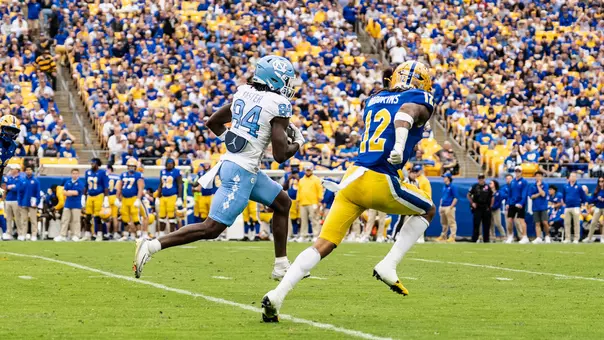
Two, none of the Tar Heel gunners fought off their blocks and made a play. Gunners are the defensive backs (sometimes receivers) used to spread wide from the punt formation "box" and angle downfield at breakneck speed. Huxtable says candidly that he made a mistake against Texas by rolling three groups of two gunners in and out throughout the game.
"I thought we had six players who could make those plays, but I was wrong," he says. "That was an error on my part. With the heat and the number of times we punted, it was an effort to keep fresh guys in there. But it backfired. We'll go with our first-team guys, maybe work someone else into the mix. But we don't go six-deep there right now."

The Tar Heel gunners shown in the diagram are Errol Hood (29) and Kevin Knight (21).
Three, poor spacing by the coverage team.
The diagram shows the basics of the players in the "box"-you shuffle back three steps in protection, then release. Each player has a "landmark" that he sprints to about 15 yards downfield. The wings (Brandon Russell, 31, and DeFonte Coleman, 25), split the sideline and the numbers on the field. The tackles (Madison Hedgecock, 44, and David Thornton, 30), aim for the top of the numbers. The guards (Devllen Bullard, 57, and Robert Harris, 55) use as their landmark the point halfway between the numbers and the hash marks. (The landmarks vary depending the location of the ball and its proximity to the sideline.)
Huxtable uses cones spaced across the width of the practice field to serve as landmarks since the practice field isn't marked with yard-line numbers like the playing field. The week of the Texas game, he hoped his players were disciplined enough to find their landmarks without the use of the cones.
"I tried to get away from the cones, and as a result our spacing was bad," says Huxtable, who's gone back to using the cones in practice.
Four, poor effort by the cover team.
"We had a letdown that game," Huxtable says. "No one's happy with that. We have to win the kicking game every week. Covering punts has to improve. And it will, I'm confident of that. I'll still go to war with these guys."
And five, two poor punts by Lafferty with little hang time that flew directly to Vasher (without him having to work to field the ball), left little time for the cover players to get downfield.
From days of using offensive linemen to cover punts, today's special teams rely on linebackers, fullbacks and tight ends to protect and then cover. Those players provide the best combination of strength and power to block, with speed and athleticism to cover. The wings can be smaller, speedier guys like Russell and Coleman. Huxtable uses safeties often as the wing players.
"Our protection has been good this season," Huxtable says. "Protection comes first. There's no point covering a punt that's been blocked. We're doing that very well. It's covering that we've got to do a better job with."
Carolina will have a challenge this week against Florida State, traditionally one of the best punt-return teams in the nation.
Hopefully, instead of long returns by the Seminoles, one of the Tar Heel gunners can elude his "jammer" (the player assigned to ride him downfield and distract him from covering the kick) and make a full-speed hit on a returner who's just fielded the punt.
"That's an instant game changer, an instant attitude changer," says Hood. "You're hyped, the team's typed, That's what all it's about for the gunner, to go down and blow someone up."
From this week's Emailbag:
One reader wants to know about a junior-varsity game played last Sunday between Carolina and Hargrave Military Institute.
Carolina edged Hargrave 21-14 Sunday in Kenan Stadium, with QB Landon Mariani completing a nine-yard pass to receiver Aaron Leak late in the game for the winning touchdown.
This was the Tar Heels' first JV game in many years. I can't remember any of Mack Brown's teams playing a JV game. You've probably got to go back to the Bill Dooley years, when scholarship limits were higher, costs weren't as much a concern and all universities fielded JV teams, for the last Tar Heel JV game.
The Tar Heel staff has initiated a makeshift JV program for at least one game a year as a means to give lower-rung players a chance at competition and provide incentive to potential walk-ons. If you happen to play a prep school that might be a source of potential recruits, so much the better. One Hargrave player is Derrele Mitchell, a wide-receiver who committed to Carolina last February and now is spending a year at Hargrave.
Four freshman scholarship players competed for the Tar Heels-offensive linemen Chase Page and Jason Brown, tailback Jacque Lewis and cornerback Chris Hawkins. That means they cannot be red-shirted because NCAA rules stipulate any competition against another institution counts toward their eligibility allotment.
True freshmen Jocques Dumas, a defensive end, and Chris Curry, a safety, have already played this year. Bunting says the coaching staff plans to use each of the six in enough snaps a game (a minimum of 10 to 12) to make using their year worthwhile.
Page, a guard, and Brown, a tackle, have worked with the second-team offensive line this week. Brown has even played first-team with starting tackle Greg Woofter missing some time with bruised ribs.
Danny Bibb of Winston-Salem writes to express concern about the number of penalties and turnovers the Tar Heels have committed.
"Correct me if it is my imagination. Week after week, Andr? Williams fumbles. Sam

|
Danny, these problems are definitely not your imagination. Rest assured that these mistakes and many more have been reviewed in the film rooms and practice field.
When Bunting hired running backs coach Andr? Powell, the boss told the assistant that ball security was priority No. 1. The running backs do an assortment of stripping drills in preseason and throughout the week to improve their ability to hang onto the football. Right now, Williams brings the best combination of speed, power and agility to the offense among the tailbacks, especially considering that Willie Parker has a sore ankle. His ball-handling has definitely been a concern. Rest assured he's on a short rope.
The rule for punt-return men is to catch nothing inside the 10 yard-line and for kick-off return men return nothing deeper than two yards in the end zone. Punt returners are schooled to field every punt. But judgment comes into play as well. The easiest punts to field are those where the return man can stand still and catch the ball. The hardest ones are those when he has to run to field the ball-particularly moving east-to-west. Sometimes the return man's judgment, made in the hair of a second with six guys sprinting downfield to remove his head, is to not risk fielding the ball. Sometimes the judgment is right. Sometimes it's wrong. Sometimes a kick-off return man might judge that the kick was low enough to warrant breaking the two-yard rule. Again, sometimes he's right. Others he's wrong.
Receivers not making plays? Quarterbacks making bad reads and throws? Those problems are there. Bunting talked at length after the Texas game about the need for receivers to make the difficult catch. And now reserve QB Darian Durant is moving toward an opportunity for more playing time. I will say in Curry's defense, however, as I wrote in the Extra Points of Monday, Sept. 10, that the pick he threw for a Texas TD early in the game came against a zone blitz and was made by a defensive end that Curry never had a chance of seeing.
In sum, your concerns are legitimate. I would suggest we exercise a measure of patience and see if they continue throughout the year against teams not in the nation's Top 10.
Finally, Jim Dickens of Rocky Mount writes to say how much he enjoyed reading "Born & Bred," the new book chronicling the playing and coaching career of John Bunting. I relate this not as much as a not-so-subtle promotion for the book but as a compliment to Bunting who, at 0-3, needs all the help he can get.
"Based on everything I have read and seen regarding John Bunting, I am convinced that he is the right man for the job," Dickens says. "However, if I had only read what you had to say in the introduction and what Dick Vermeil had to say in the foreword in your new book, I would be equally convinced from those two writings alone! He is the man!"
For those coming to Chapel Hill for the first time this season for the game this weekend, you can find Born & Bred at merchandise concessions in Kenan Stadium, at UNC Student Stores, and along Franklin Street at Johnny T-Shirt, Top of the Hill Restaurant, Sutton's Drugstore, The Shrunken Head and Carolina Sportswear. You can also call 1-800-55GO-UNC or look soon in the FANStore here on TarHeelBlue.com.
Previous installments of Extra Points Thursday:
Send your questions to Lee Pace to answer in Extra Points Thursday at leepace@earthlink.net. Please provide your name and tell us where you live.