University of North Carolina Athletics
Tar Heel Monthly: The Quiet Type
October 16, 2002 | Football
Oct. 16, 2002
Tar Heel Monthly is the premier magazine devoted to the stories and personalities behind UNC athletics. For more information, visit www.tarheelmonthly.com.
The following is the cover story from the most recent issue of the magazine.
By Adam Lucas

 |
|
It's always been that way for Aiken, whose family lived in six different states before he entered eighth grade. Count them off -- California, Maryland, Delaware, New York, North Carolina, South Carolina. About the time the quiet kid was getting used to his new school, Sam Aiken, Sr., who was in the military, would tell the family it was time to move again.
It's that last move that Sam, Jr., remembers the most vividly. It's the one that still affects him even today, almost ten years later. It has shaped his view of fatherhood and family responsibility, and it will in all likelihood mold the way he interacts with his own family and children when that time comes. He's not going to tell you about it, of course. With only one exception, which happens only a handful of times each year, he keeps his deepest feelings tucked away safely inside. It's that one exception that allows the tiniest sliver of a window into his personality, and it's one that most people can't see without binoculars.
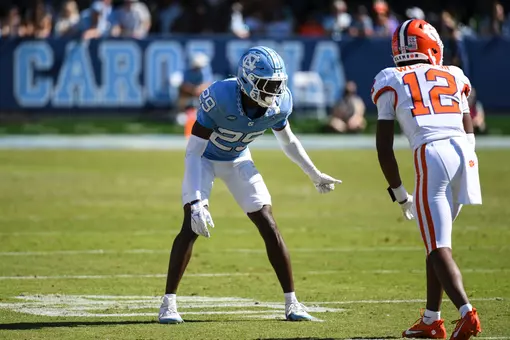
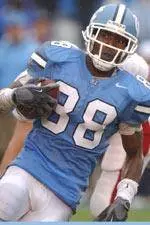
On game day, when his face is obscured by a helmet and his number 88 Tar Heel jersey is tucked in and looking just the way he likes it, Sam Aiken is an open book. Reading it requires some outside sources, some cross-referencing and double-checking. You want to know about Sam Aiken? You have to know how to read the uniform.

|
|
This is who Sam Aiken is. Carolina's leading receiver, the player who has a chance to end his UNC career as one of the best pass-catchers ever at the school is, well, a neat freak.
"Oh man, Sam is a character," says sophomore Chase Page, who lockers near Aiken. "He is always dressed up. It takes him quite a while to put on all that stuff he wears."
"He's the last one to come out of the shower," wide receivers coach Gunter Brewer says. "He's got all the gear that matches, the outfits, the jewelry, the cologne. We give him a hard time about that lotion he likes, too."
This isn't a recent phenomenon. Aiken attended James Kenan High School in Kenansville. The town wasn't exactly a hot spot on the weekends, but when there wasn't a game to play or practice to attend, which was rarely, Aiken and best friend Johnta Philyaw would road trip to Clinton.
At least, they would try to road trip. When Philyaw could persuade Aiken to finish his beauty ritual, that is.
"It takes him forever to get ready," says Philyaw, who plays football for Western Carolina. "He is so picky. And he probably didn't tell you this, but he looks in the mirror all the time. I don't know what he's looking for. Maybe he's trying to see if he's getting any uglier," and the longtime best friend laughs evilly as only a close friend can do.
Aiken, who for the record is on this day wearing a colorful button-down shirt, jeans that are exactly the right bagginess to be the height of style, and a New York Yankees cap tilted just so on his head, knows that his sharp dressing makes him a target in the locker room, where some players consider high fashion to be changing their t-shirt at least once per week.
"I think sometimes people can think I'm conceited," Aiken says. "But I just like to look in the mirror. If I could have my dream house, I'd probably have a mirror on every wall."
The irony is that on the field, Aiken may be the least conceited player on the team. He doesn't whine for the ball or lobby to have plays called for him. It's impossible to catch him making a scene on the sideline, trying to push blame on another player or evade criticism. As he is fond of saying, he just makes plays. Last year against Florida State, it was Aiken who grabbed a pass from Darian Durant and somersaulted over a Seminole defender -- "I still don't know where that came from," he says now -- touching the nose of the football to the end zone pylon to give the Tar Heels a 7-0 lead on the way to one of their biggest wins in history.
Go back to the portrait of Sam Aiken on game day. Look at the gloves he wears. They're Nike, of course, the brand preferred by most top receivers. Inside the familiar Nike swoosh, Aiken writes three letters: "C-A-P." What does it mean?
He has no idea.
As a high schooler, Aiken loved to watch former NC State receiver Torry Holt. The Wolfpack might have even had a chance to sign Aiken to replace Holt, but they didn't begin paying any attention to the unknown kid from 1-A James Kenan until his senior year, and even when they began writing him letters, they talked about moving him to safety. Carolina began recruiting Aiken as a sophomore, loyalty that he repaid after he had a breakout performance at the Shrine Bowl during his senior season.
At the Shrine Bowl practices he had the opportunity to flash his considerable talent, which had been below the radar for most of the season in a conference that receives little Division I recruiting attention. The practices were filled with the best high school seniors in North and South Carolina, and the tall kid from Kenansville began receiving a flood of recruiting letters. By then, it was too late for the other suitors; he wanted to be a Tar Heel.
But he still harbored a deep admiration for Holt. In 1998, as high school seniors, Aiken and Philyaw attended the Wolfpack's home game against Florida State. That turned out to be the contest in which State, a 25-point underdog, got a 68-yard punt return touchdown and 63-yard touchdown reception from Holt on their way to a 24-7 victory. And the gloves Holt wore in that game? Aiken has them.
"I wanted to go ask him for his gloves, but I was too nervous," Aiken says. "Johnta went up to him and asked him for them and he got them, and then he gave them to me. I still have those gloves."
Upon examining them, Aiken saw that Holt had written, "C-A-P" inside the Nike swoosh. His efforts to find out the meaning of the three letters have been futile, but that hasn't stopped him from marking the same inscription into every subsequent pair of his receiving gloves.
"I have no idea what it stands for," Aiken says. "But ever since I got that pair of gloves I have written, 'C-A-P' into every glove that I get."
So now you're watching Sam Aiken warm up before the game, and you notice that he has something on his arms. At first glance it looks like enormous sweatbands, encircling his forearms almost up to the elbow, but it turns out to be athletic tape.
"When you have that, when you block, it puts less stress on your wrist," Aiken says.
But the tape isn't just physical. It's also mental.
Before every game, before he has gone out to warm up, before he has come back into the locker room and opened his Bible to read the 23rd Psalm, he takes the time to make a few notations on his tape. On one arm, there's the familiar inscription, "WWJD," which stands for What Would Jesus Do? There's the word, "Mom," so that he'll have his mother, Natalie Aiken, close to him. And then there are a series of cryptic initials and phrases that are sometimes subject to misinterpretation.
Take the "WF," for example. One confused teammate thought that it stood for Wake Forest, perhaps as a reminder to keep playing hard in order to avoid the second-half collapse the Tar Heels suffered against the Deacons last year. While that's a worthy point to remember, it's not what those initials on Aiken's arm mean.
They stand for Wilhamina Faison, his maternal great-grandmother. She and her husband, Will Faison, had always wanted a son. When Aiken moved back to North Carolina before the eighth grade, he began spending time with his great-grandparents. They were part of an extremely close family that included his maternal grandmother, Margaret Dixon, mother, Natalie Aiken, and Sam's three younger brothers and one younger sister.
Will Faison passed away during Sam's junior year of high school, and his great-grandmother died during his senior year, just days before an important football game against North Johnston. The death crushed Aiken, who had grown exceptionally close to his great-grandmother. With the funeral just one day before the game, there was considerable doubt among his teammates as to whether or not he would play. Aiken himself never considered skipping the game, and on Friday night, he took the field.
"He scored four touchdowns in that game and wasn't touched on any of them," Philyaw says.
"My second touchdown that night came off a punt return," Aiken says. "When I saw the ball go up, I saw a star. I felt like that was her watching me, and I pointed to it."
"Everybody up in the stands was wondering what he was pointing to," Natalie Aiken says. "But he said he was just doing it all for her."

|
|
Among the many family members honored on Aiken's tape, there is no mention of his father, the military man whose job necessitated frequent moves around the country. Sam Aiken, Sr., lives in South Carolina now and was unable to be reached for this story. That means that the only memory of the last time his father was a real member of the Aiken family comes from Sam, Jr.
"When we moved from California to North Carolina, we drove for like five days," Aiken says. "He dropped us off -- me, my brothers, my sister, and my mother -- at my grandmother's house. We had our clothes in plastic bags. And when he pulled out of that driveway and left us there, he never looked back. It's been hard ever since."
"My brother and I talked, and we said that this was no time to mope," says Natalie's second-oldest son, Stephen, who is two years younger than Sam. "All we had at that point was each other. That's when we had to step up and be the men in the house."
Sam added the role of pseudo-father figure to his job as big brother to his siblings. Even before he turned 16, he was driving them to and from school and after-school activities when his mother had to work. That landed him in trouble on one occasion, when a police officer pulled over the 15-year-old Sam Aiken and wanted to see his license and registration. Registration, he had. License, he didn't.
It was during those years that much of Aiken's current personality was formed. The Aiken family wasn't rich, and they were quickly learning that reliable people were hard to find.
"He was hurt by his dad leaving," Natalie Aiken says. "He keeps a lot of things inside, but I think he is motivated by it in a way. He wants to be able to show that he can achieve things despite any problems."
Now that his oldest son is close to achieving a lifelong goal, playing in the National Football League, the elder Aiken is beginning to come back into the picture. It's an unenviable situation for the Tar Heel receiver, who vividly remembers the hardships he and his mother endured without his father present, but also recalls an upbringing that encouraged forgiveness.
"Now that I'm getting some publicity, he's making phone calls, telling me that he loves me," Aiken says. "I try to forgive and forget, but it's hard. Don't get me wrong, I still love my father. People make mistakes. But it's something I will remember when I have kids. I'm not going to do the things he did. I know what he put my mom through and what he put my family through."
Watch him during the game. Watch him go over the middle for a pass, stretch to make the reception. When his quarterback leaves a pass high and Aiken has to reach for it, you might catch a glimpse of the tattoo on his stomach.
For a graduation present, his high school Spanish teacher told Aiken he wanted to get him a tattoo. The pair went to Jacksonville to get the artwork, and when it came time to make his choice, Aiken remembered an article that had been written about him following one of his sparkling Shrine Bowl practices. Calling the kid from Kenansville a "sleeper with unlimited potential," the author went on to predict great things from the future Tar Heel. That's why, when the tattooist's needle finished penetrating the teenager's skin -- only after Aiken had learned that a stomach tattoo delivers sharp pain that increases if the subject doesn't find a way to unclench his stomach muscles -- it had inked the word "Sleeper" on Aiken's torso in Greek letters.
He might have been a sleeper to those who hadn't been paying attention. Frequent moves meant that he never had the chance to build up the type of athletic legend that community fixtures create, but his mother knew she had a football prodigy the evening she went into his room to check on him in eighth grade and found him fast asleep -- wearing his football helmet.
"That's what really hit me," she says. "I knew that when he first started playing, he always seemed to go into every new school and wind up taking a starting position. But that night with the helmet is what made me think he was destined to do it."
At Carolina, he has piled up catches at a near-record clip, and has a good chance to eclipse Marcus Wall's school record of nine touchdowns in a season during 2002. It's where Aiken makes his catches that is almost as important as the quantity. While some receivers try to stay on the outside of the field, away from hard-hitting linebackers and bone-crunching safeties that patrol the middle, Aiken is fearless about routes that send him over the middle.
He admits to a bit of trepidation early in his career about taking the helmet-jarring hits that are so common in the middle of the field, but says that after he made his first college catch over the middle, during his sophomore year against Tulsa, that concern vanished. "You're going to get hit regardless when you go over the middle," he says. "You might as well catch the ball."
"There is no question that the courage you need to go over the middle is just inside of some people," Brewer says. "There have been great receivers who were deep threats but not known for going over the middle. But with Sam, he does everything. He blocks, he catches short passes, he catches long passes, and he plays any position that we ask him to play."
It's that package of characteristics that is likely to put Aiken among the best receivers eligible for the 2003 NFL Draft. The main question raised by scouts is his speed. That's because Aiken isn't particularly fast, at least in the stopwatch-crazy world of the NFL. His 40-yard dash has been timed at 4.5, which isn't plodding, but it's also not blazing. As teams have learned in recent years, however, games aren't won on a track, they're won by making plays. And if Aiken continues to make plays at the same rate that he did during the first month of the season, when he averaged over 20 yards per catch and 109 yards per game, he'll hear his name called early in the NFL Draft.
It doesn't surprise his mother, who made a prophetic prediction four years ago.
"When he graduated from high school, what I gave him as a present was that I blindfolded him and walked him outside," says Natalie Aiken. "I took off the blindfold and made him look up and asked him to tell me what he saw. He said that he saw the sky, and I told him that he could do anything he wanted to do under that sky. He just had to keep reaching for it."
Adam Lucas is the publisher of Tar Heel Monthly and can be reached at alucas@tarheelmonthly.com. To subscribe to Tar Heel Monthly, click here.