University of North Carolina Athletics
FSU, ACC Enjoy Beneficial Relationship
November 14, 2002 | Football
Nov. 14, 2002
Tar Heel Monthly is the premier magazine devoted to the stories and personalities behind UNC athletics. Click here for subscription information.
The following story is from the November issue of the magazine.
By Adam Lucas
A full decade after Florida State's entrance into the Atlantic Coast Conference, their impact might be more tangibly measured in dollars and Nielsen ratings rather than wins and losses.
When the Seminoles joined the league prior to the 1992 football season, the immediate concern for North Carolina football fans was staying competitive with the newly-added power on the gridiron. Common wisdom was that the 'Noles would boost ACC football, while ACC basketball would boost the FSU hoops program. Initially, it looked like an appropriate evaluation. Despite meager success against the 'Noles in the beginning, playing Bobby Bowden's powerhouse energized conference football stadiums; meanwhile, Pat Kennedy's basketball program announced their arrival into the league with a shocking win at the Smith Center.
As John Bunting prepares to lead his team into Tallahassee this Saturday, we take a look back at what the Seminoles have brought to the Atlantic Coast Conference, both on and off the field.
Prior to Florida State's arrival, ACC football wasn't quite the barren wasteland that revisionist historians would have you believe. Virginia held the nation's number-one ranking for several weeks during the 1990 season, and Georgia Tech, a team that featured a tie at Kenan Stadium as the only blemish on their record, won the national title that year. The ACC was enjoying a solid run of success against national powerhouses. Clemson whitewashed Illinois 30-0 in the 1990 Citrus Bowl, and the Jackets whipped Nebraska 45-21 in the 1991 Citrus Bowl. That same year, Virginia lost by one point to Tennessee in the Sugar Bowl.
Although the league was enjoying some success against prominent programs, their national profile was meager. The conference champion was tied into the Citrus Bowl, where they suffered the indignity of playing the runner-up from the Southeastern Conference instead of another conference champion. The Citrus Bowl payout, $1.3 million per team, was barely a third of the payout of the Orange, Cotton, and Sugar, all of which paid $3.2 million per team. Revenue from the ACC's football television contract was just $3.6 million in 1991, and usually included only a very rare national appearance.
It was Penn State that felled the first expansion domino. The Nittany Lions accepted an invitation from the Big Ten in 1989, and then the SEC picked up Arkansas from the imploding Southwest Conference. South Carolina joined the SEC in 1990, and Miami signed on with the Big East in 1991.
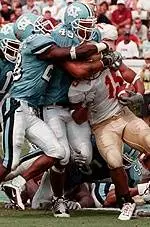
 UNC fans celebrate last year's 41-9 win over Florida State.  |
|
And suddenly, the SEC wasn't an automatic choice anymore.
Florida State administrators, led by school president Bernard Sliger, expressed some concern about the Southeastern Conference's reputation, especially academically, when compared with the ACC. Athletically, the SEC had the football advantage, but the ACC appeared to promise an improved standing in the basketball world. Although not widely discussed, there was also a financial aspect. The Atlantic Coast Conference has true revenue-sharing among member schools, while the SEC does not.
The doubts about the SEC expressed by Sliger and others eventually manifested themselves by accepting an invitation to the Atlantic Coast Conference.
That made the league a major player in discussions involving a new bowl system. Just a decade ago, it was still the era of prearranged bowl bids that sometimes led to absurd matchups. The SEC still sent their champion to the Sugar Bowl, the Big 8 was tied to the Orange Bowl, and the SWC to the Cotton Bowl. Sentiment was growing for a playoff system, which gave birth to the Bowl Coalition in 1992. Marketed as the best possible way to potentially create a true national championship game, the Coalition kept the previous conference tie-ins but created a possible one-versus-two matchup in the Fiesta Bowl.
With the Seminoles, the ACC was included in that arrangement. Ten years later, the evolution of the Coalition has created the Bowl Championship Series, which annually pays the conference champion $13 million for an appearance in one of the BCS bowls. That's a tenfold increase over the former payout from the Citrus Bowl.
The improvement has been similarly sharp from a television perspective. At the time FSU entered the conference, the ACC was part of the CFA football package, which paid out a meager $8.5 million per season. That changed in 1994, when the league inked a deal that put two or three conference games on television every weekend. The ACC television deal is now worth $20 million per year, and should be up to $25 million per year by 2005. That improved television exposure has come with an unfortunate consequence for fans. The conference formerly set football schedules years in advance, but to help create more attractive and meaningful late-season matchups for television, the ACC began creating schedules from scratch in 1995. It's just a fact of life these days, but at the time the switch caused some teeth-gnashing from fans who had been used to planning their road trips well in advance.
On the field, the first decade of ACC football featuring the Seminoles went virtually as expected: nine out of ten conference titles were won by FSU during that timespan. The only slip came last year, when the 'Noles were beaten by NC State and North Carolina and Maryland slipped into the BCS with a 7-1 conference record.
The Seminoles came into the conference as a brash, bullying, bad boy. Their first trip to Kenan Stadium created an electric atmosphere that included 54,100 fans, the second-biggest pre-expansion crowd in Carolina football history. Even after the new end zone addition, the top two crowds in school history belong to FSU -- 62,000 in 1997 for the Judgment Day showdown and 60,000 in 1999.
For the first time, the Tar Heels were on the other end of the phenomenon they created in ACC basketball. Everywhere Dean Smith took his UNC basketball team, they faced a jacked-up, sold-out arena. Carolina coming to town was an event not to be missed, a happening. Florida State had the same aura in football. They fueled the fire with a swaggering attitude that let opponents know that the 'Noles wouldn't just be content with a beating; they were in town to demoralize.
Some member schools helped perpetuate the Florida State and Eight Dwarfs myth popular in some media circles. In 1996, the Seminoles had to leave the state of Florida only twice to play a football game. The Seminole athletic department bought out a handful of road games and moved them to Florida, with Duke the most frequent customer. The Blue Devils got $1 million for moving a game planned for Durham to Florida, and they also got a 70-26 whipping.
|
Carolina contributed to the fall of the king, as John Bunting engineered a 41-9 shocker in the fourth game of the season.
|
Carolina wasn't having much more success than the rest of the league. Their best chance to upset the new powerhouse came at Doak Campbell Stadium in 1994, when a controversial pass was ruled a completion and fumble by Octavus Barnes. That was one of three controversial calls in that contest, including a questionable offensive pass interference ruling against Marcus Wall and a timekeeping error at the end of the first half. The Tar Heels lost a 31-18 decision in that game, continuing an early trend of being more competitive in Tallahassee than in Chapel Hill.
The most damaging home loss came in 1997. The Heels were ranked fifth in the nation, Florida State third. FSU players gathered before the game to stomp on the midfield logo at Kenan Stadium, enraging the earliest-arriving crowd in Kenan history. They then proceeded to stomp Carolina, allowing just nine yards in the first half and 73 for the game. The 'Noles piled up nine sacks and broke Oscar Davenport's ankle as Mack Brown and Greg Davis's offense sputtered behind a perplexing gameplan.
"It was 8-0 against 8-0, so a lot was at stake," Seminole linebacker Daryl Bush said after the game. "They called this the biggest game in ACC history, and we played it like that."
"We were just the better team," said Andre Wadsworth. "That's not being cocky. We're used to big games. We've been there before, we've done it before, we did it again tonight and we'll keep on doing it."
Unbeknownst to Wadsworth, both the ACC and the Tar Heels would experience a breakthrough in 2001. Behind Ralph Friedgen's magic touch, Maryland became the first team other than FSU to win an ACC championship since 1991. Carolina contributed to the fall of the king, as John Bunting engineered a 41-9 shocker in the fourth game of the season.
It happens every year, but this summer there was some merit to the idea that the league was catching up to their once-dominant king.
"I don't have any trouble defending our conference," Bowden said this summer. "I've always said that no one will take the ACC seriously until someone starts beating us. Well, that happened last year. We lost two games. We didn't win the conference. Now, I don't want that to ever happen again, but it was good for the conference, just not good for us. But this conference has continually gotten better and better. It's going to be a gradual thing in terms of respect."
Florida State players still talk tough. Defensive end Alonzo Jackson promised to "smack [the league] in the mouth" this season. He's also looking forward to the November 16 tussle with the Tar Heels. "I've already got the date circled on my calendar," he said this summer.
That's the kind of talk that used to send conference foes cowering. With the off-the-field aspects of the ACC-FSU marriage a rousing success, both financially and in national exposure, it's only on the field where the direction of the ACC is in question. A non-FSU school winning one conference title is a fluke. Two schools pulling the feat would signal the arrival of true parity.