University of North Carolina Athletics
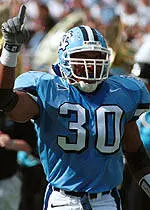
Tar Heel Monthly: Thornton Does It The Right Way
June 10, 2002 | Football
June 10, 2002
Tar Heel Monthly is a new monthly publication devoted to the stories and personalities behind UNC sports. For more information, visit www.tarheelmonthly.com.
The following is excerpted from the most recent issue of the magazine.
y Adam Lucas
The couple had to borrow a car to go to the prom. David Thornton wanted to take his girlfriend, Nicole Lesesne, to the Goldsboro High prom in style, but neither had a suitable mode of transportation. So the three-sport star got a loaner from one of his brother's friends. It was a red Acura Legend, the kind you don't see many of in Goldsboro. This car was the stuff of dreams, which is exactly what the teenagers did as they drove to Lane Tree Country Club. At that moment, with the music filling the leather-trimmed import and the future seeming to stretch much farther than Highway 70 through Goldsboro, David Thornton had it all. And it was right about then that he looked over at Nicole and made a simple statement. "One day, I'm going to have it like this," he told her. "And I'm going to get it the right way."
Right about now you're thinking that you know how this story turns out. Little David Thornton is going to make good, and he's going to cruise through Goldsboro in a shiny new ride, and he's going to pick up Nicole a few years later and they'll ride off into the sunset.
You want the Disney version? That's what happens.
You want the real version? That's still what happens, except between the Legend and the Escalade come an unexpected baby, a college freshman sitting in his dorm room trying to comprehend being cut from a team for the first time in his life, a college sophomore ready to ditch football forever, and a father who used to stick needles in his arm three times a day. Between the Legend and the Escalade comes a man running onto the Kenan Stadium turf with an oblivious crowd totally unaware of the player in the number 30 jersey. Between the Legend and the Escalade comes a Goldsboro native being drafted by the Indianapolis Colts. Between the Legend and the Escalade comes real life.
Real life is different in Goldsboro, which is one of those small towns that you hate if you grow up there and then long for once you have to leave. It's unbearably suffocating to a teenager eager to see the world, but comforting to an older, wiser 20-something. It's the kind of town where a good date usually involves a cheeseburger from Andy's, and it's the kind of town where people know if something happens, and they don't just know how, they know when, where, and what the consequences were.
Which is why it shouldn't have been a surprise to David Thornton that he was summoned to the principal's office early in his senior year. He was a baseball, basketball, and football star who was popular and well known in the community. He was also soon to be a father, but that was supposed to be a secret. His first response when Nicole told him about the pregnancy had been, "Are you serious?"
"I wouldn't play with you like that," she told him, and then they proceeded to do exactly what all 17-year-olds do when they find out they are about to be parents: they got very scared.
"We were confused about a lot, and about what would happen to our futures," Lesesne said. "We had all these plans and we didn't know if they would fall through."
Upon returning to Goldsboro High that fall, Thornton got word that he was wanted in the principal's office. School principal Gerald Whitley closed the door and sat down behind his desk. "David, I know what you're going through," he said.
"I had no idea what he was talking about," Thornton said. "But he already knew that I had gotten Nicole pregnant. He immediately began to build me back up and tell me that I was a leader in the school and he still had high expectations for me. I felt so much better after I came out of there."
Qieara Lesesne was, remarkably, not born on a day when her daddy had a game. Most of his nights were full, as his school year was filled with transitioning from football Fridays to basketball Tuesdays to baseball Thursdays. Qieara conveniently arrived during basketball season on a Saturday night, with her father present for the delivery and a host of family members immediately ready to help.
With the help of a supportive family, both parents followed through on their college plans. Thornton had a grand total of zero Division I scholarship offers, and despite a scholarship offer from Fayetteville State, he packed his bags for Chapel Hill, while Lesesne went two hours down I-40 to UNC-Charlotte. As a less than 200-pound defensive back in high school, Thornton didn't have much hope of playing football for the Tar Heels. He did, however, think he could contribute on the basketball court.
He found his way to the junior varsity tryouts, which were run by then-assistant coach Phil Ford. Approximately 50 players tried out; 12 would be selected.
He made the first cut. The final cuts were to be posted on the back door of the Smith Center. Thornton had to take a bus from his dorm room to the Dean Dome. He got off the bus and walked around back of the arena. On the door was the roster for the 1997-98 junior varsity basketball squad. His eyes darted down the 12 names. He had done this plenty of times before, had been looking at cut lists for most of his athletic life. Every time before, he would find his name somewhere on the roster. This time, it wasn't there.
"It crushed me," Thornton said. "I was like, 'I'm not good enough to play JV basketball?' It's not that I'm Michael Jordan or anything, but I thought I was good enough to make that team."
Two of Thornton's friends made the team. He was left to deal with the first time in his life that he had ever failed to make an athletic squad.
This is the part in the story where some dreams end. Plenty of Carolina students have packed up their suitcases and headed back home after finding out that the world is bigger than their little corner of the state where they had dominated their chosen field during high school. This wasn't just a college freshman failing to make a team. This was David Thornton, Goldsboro High School bigshot, being told by a piece of paper taped to a glass window that he wasn't quite as good as he thought he was.
Most athletes don't have the luxury of being cut from one high-revenue program and simply trying another, but that's exactly what Thornton did. He got in touch with football assistant coach Donnie Thompson, who organized the walk-ons for the Tar Heels. Prospective players had to endure a survival run and a strict tryout, and if they persevered through that, they were awarded the title of scout team player.
For that honor, they got exactly nothing. The last pick of the cleats. Last in line to be taped. No scholarship money, no books, no food. David Thornton had somehow found his way to the most exclusive extracurricular activity on campus, one that required at least 20 hours per week and rewarded participants with sore muscles and a lack of sleep.
Thornton was handed uniform number 30, a defensive back's number. It took only a few practices for the staff to decide that the new kid wouldn't make it at strong safety, and they shifted him to cornerback, and then to linebacker before his junior season.
"The first thing I remember about him was that he was wild and wooly," said former head coach Carl Torbush, who is now the defensive coordinator at Alabama. "He had a very high motor and was going hard all the time."
That motor almost got him in trouble. Given a chance to play on special teams, Thornton was eager to make an impression on the coaching staff and earn more playing time. He made an impression-a negative one.
The Tar Heels struggled during the 1999 season, falling to 3-8. The sophomore from Goldsboro wasn't helping matters, as he picked up three 15-yard penalties on special teams.
"At one time, I was about ready to fire him," Torbush said. "He was averaging about one 15-yard penalty per game. He was going to hit somebody on special teams, and didn't really care whether it was in the front or in the back. He, myself, and Coach Thompson had to sit down and talk about what he needed to do."
What he really needed to do was gain weight, because it was becoming clear that he wasn't going to make it in the secondary. Torbush was well known for his work with linebackers, but for some reason the Thornton kid just couldn't put on weight.
Torbush found a clue one day when he was out on his daily jog. Approaching Carmichael Auditorium, he came upon Thornton leaving the gym. The player admitted that he was playing in an intramural team handball league in his spare time. That was somehow squeezed into a schedule that included getting up at 6:30, going to class, participating in football activities from 2:00 until 6:30, and then working part-time at the student recreation center until midnight so that he would have money to buy his meals.
The schedule caught up to him his junior year, when Torbush was in his final season as head coach. Thornton was now a manager at the rec center, which meant increased responsibility for an on-time arrival.
"I had to leave practice early a couple times when Coach Torbush was still there," Thornton said. "The coaches didn't want me to, but I eventually just had to walk off the field. I wanted to be out there, but I also had the responsibility of being at work in a timely fashion. If you're a manager, you can't be late."
 |
"He was wild and wooly. He had a very high motor and was going hard all the time."
- Former coach Carl Torbush
|
When the Tar Heels traveled to Wake Forest during the 2000 season, Thornton was just one injury away from major playing time. The injury happened, as Merceda Perry hurt his ankle. But the major playing time didn't.
"I was expecting to go in the game," Thornton said. "I was the backup, and Merceda was hurt. But someone else went in in my place. That was another devastating experience for me. I'd been practicing with the second team all through camp and during the season, and then I don't go in.
"After that game, I called my brother and my dad and told them that I was supposed to go in, but I didn't. I thought that I would never play and that they would only use me for special teams. That was another devastating experience for me, but there are so many life lessons that I have learned. It wasn't fair to me, but sometimes life isn't always fair, and you just have to suck it up." ... [Part 2]