University of North Carolina Athletics
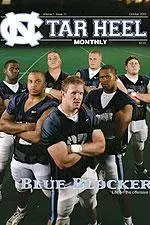
Tar Heel Monthly: Laying It On The Line
September 18, 2002 | Football
Sept. 18, 2002
Tar Heel Monthly is the premier magazine devoted to the stories and personalities behind UNC athletics. For more information, visit www.tarheelmonthly.com.
The following is the cover story from the most recent issue of the magazine.
By Adam Lucas

|
"You're the slowest running back ever to come to Carolina," he told the wide-eyed rookie. "If you want to play offense, you have to play center."
"I went from scoring a bunch of touchdowns my senior year in high school to snapping the football," that freshman, John Bunting, reflected 30 years later. "If I wanted to play it was either going to be linebacker or center, so I thought I should stick to linebacker."
So if the current head coach, who personifies the definition of football player, wasn't willing to play on the offensive line, then who would be? What kind of people are willing to subject themselves to constant pounding, crooked fingers, and four years of anonymity?
Not the kind that you think.
It used to be a sportswriting requirement that any story about the offensive line should be set in a local restaurant. Watching the big uglies go to the feeding trough was a sport to be marveled at, an eating epic.
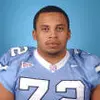
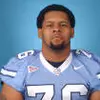
Washington Redskins fans still occasionally can be spotted wearing their beloved "Hog" outfits as a tribute to the offensive line, but the moniker doesn't fit anymore. The days of 300-pound blobs on the line ended around the same time that Mack Brown came to North Carolina. This year's projected starting line averages 6-foot-4, 299 pounds. But it's not a jiggly 299. After viewing the results of the photo shoot that graces the opposite page, center Jason Brown could make only one pronouncement.
"Man," he exclaimed, "I am cut!" Brown, who set school records for linemen in the squat (660 pounds) and power clean (392 pounds) and holds the all-position school record for combined pounds lifted in the squat, bench press, and power clean (1,477 pounds), isn't the only one. Across the country, teams have shifted away from the heavy, slow offensive lines of 20 years ago in favor of a leaner, meaner, (but still slow) 300-pound battering ram.
The trick is to mix deft footwork with constant hand motion. The key to good protection is punching. Instead of waiting back to catch the defender, the goal of linemen is to get a good punch and drive back the opponent.
"Within the last seven to nine years teams have gotten away from the fat slug linemen," first-year Carolina offensive line coach Hal Hunter said. "There was a day when the Redskins had the Hogs, and you had those 340 or 350-pound linemen. These days, everyone has gone to more downsized, athletic offensive lines. You want guys who are 290 or 295 pounds and can move and react."

|
A trade secret: linemen aren't really dumb. They tend to project that image, because a lineman is usually the first to poke fun at himself. However, three of the four NCAA postgraduate scholarship winners in Carolina history were linemen. The Tar Heels have had three football players win the Jim Tatum Award as the top senior student-athlete in the Atlantic Coast Conference -- two of the three were linemen.
Jeb Terry had three options coming out of high school in Dallas, Texas. He liked Harvard for the school's academics. He liked the University of Texas for the school's football tradition. He picked the University of North Carolina for the way it combined both of the other two.
Terry, a junior, starts alongside Brown on the o-line. Brown was a National Honor Society member in high school and attended the prestigious Governor's School. Redshirt freshman Arthur Smith, who will see playing time in 2002, enjoys reading the Wall Street Journal, and junior Marcus Wilson was an NHS member in Mississippi.
That intellect comes in handy on the line, where plays and assignments can change multiple times at the line of scrimmage. A good line also must work together at all times. Receivers, running backs, and even the quarterback can function independently. All five linemen must be in sync at all times to avoid disaster.
"To be a really good lineman, you have to know what everyone is doing next to you and what the running back is doing behind you," Terry said. "If you so much as move your butt the wrong way, you ruin the running back's cut. You have to be able to hear a color and number at the line and do something totally different from what they called in the huddle.
"You could get some of the smartest people around and take them through a week of practice with us and then take them through plays with us and they wouldn't have a clue what is going on."
Hunter's challenge is that all too often over the past decade, Carolina's entire line has looked similarly clueless. Pick your telling grotesque statistic from a bevy of possibilities. In the 25 seasons from 1969 through 1993, the Tar Heels had 23 1,000-yard rushers. In the eight seasons since, they've had only one. Of the 20 greatest single-game rushing efforts in Carolina football history, zero came in the past decade. Only three UNC linemen have made first-team All-ACC in the past ten years -- during that same timeframe, the Heels have had ten defensive linemen selected to the first-team list. There hasn't been a Tar Heel lineman selected in the NFL Draft since Brian Bollinger went in the third round in 1992.
It's a dim recent history. Part of the reason is coaching preference -- after getting manhandled in the early- and mid-1990's, Mack Brown and offensive coordinator Greg Davis eventually decided that their teams could never overpower opponents and would have to rely on a finesse offensive attack. That mentality extended to the offensive line, where the Tar Heels perennially seemed a step slow, a step late, and a pound light. Pro scouts thought so little of Carolina linemen that Jeff Saturday was a two-time All-Conference selection but went undrafted, forced to work his way into the starting lineup of the Indianapolis Cots as a free agent.
Another contributing factor is geography. Big Ten and Big Twelve schools stock their lines with corn-fed Midwesterners and steel-bending schoolboys from the Northeast. North Carolina, on the other hand, doesn't have a tradition of turning out bulldozers.
"We're always a question mark until we prove ourselves," Terry said. "I take offense to it, but it's just another kind of motivation."
It is Hunter's assignment to turn that motivation into production. He comes highly touted from Indiana University, where his line anchored an offense that finished in the top 20 in the nation in total offense the past two years. Last season, the Hoosiers were one of just 11 teams to average more than five yards per carry.

 |
|
This year's collection of blockers suffered a blow in the spring when projected starting left tackle Greg Woofter decided he preferred accounting to football. That opened a spot for Skip Seagraves, who showed good potential in the preseason but then was restricted by a shoulder injury and concussion suffered in the team's final scrimmage. Seagraves is just a sophomore, a distinction that is not unique on the line. In what may be Carolina's biggest roadblock to building a powerful line, seven of the ten players on the two-deep depth chart are freshmen and sophomores. Strength and conditioning coach Jeff Connors has chiseled their physiques, but there is no substitute for the two or three extra years of experience some Carolina opponents will have.
Hunter's responsibility, then, is to make up for that lack of experience with technique. "You have to put players in situations where they can be successful," he said. "You can have a great player who is well-coached, but if you ask him to do things he can't do, he can't be a good lineman."
It was in that vein that one of Hunter's first moves upon arriving in Chapel Hill this February was to shift Brown from tackle to center. The sophomore from Henderson was an immediate hit at that position, drawing praise from Bunting during spring practice.
"Jason is athletic, has good flexibility, and plays low to the ground," Hunter said. "He was way out of position playing tackle. The only missing link was if he could put the ball between his legs and still play. I've had a lot of good offensive linemen who when you put a ball in their hands, become bad linemen."
That center-quarterback exchange was a point of emphasis in preseason, with Bunting harping on the importance of avoiding fumbles before plays unfold. Communication is the foundation of any good center. He is responsible for making split-second recognitions of defenses and blocking assignments and then passing them on to his linemates.
Brown will be flanked by Jupiter Wilson and Terry at the two guard positions, with Seagraves and McNeill manning the tackle slots. When Seagraves missed practice time in late August, Terry slid to right tackle with Arthur Smith filling in at guard. No matter what combination sees the majority of playing time, they have to be able to think clearly in a din of confusion.
"It seems like organized chaos before the ball is snapped," Terry said. "You walk up to the line of scrimmage and look at the front four to see how they are lined up. Then you look at the linebackers, and as the quarterback is going through the cadence, you look for shifts and linebackers walking up. Then you listen for a changed play and the whole time you're communicating with the center and he's working on the blocking schemes."
It's a type of madness that can easily lead to mistakes. Usually, fans assume when a defender comes in untouched that a lineman simply forgot about him. More commonly, however, two members of the line diagnose a defense in different ways, leading one to block one scheme while another picks a different assignment. Even in scrimmages, without 60,000 screaming fans in the stands, it's possible for miscommunications to occur.
That's why linemen sit in the film room for hours every day, trying to break down every possible defense they could face. Hunter allows a little dialogue -- after the coach chastises players who missed breakfast before beginning one film session, Brown volunteers that he would never miss a meal.
The position coach looked his starting center up and down, taking in the 311-pound body stuffed into a little red schoolhouse-type chair and desk combination.

|
|
Once the film comes to life, however, the joking stops. There's a certain hierarchy to the linemen's meeting room, which features the word "Humble" written in large letters on a front chalkboard. Starters, for the most part, take up the front rows. Reserves fill in behind the starters, and lowly freshmen are forced to find a spot near the back.
That puts them near the booming voice of Hunter, who controls the remote-control clicker like a man who has never once yielded control of the remote to his wife. Graduate assistant Scott Frazier reads from the script of a previous scrimmage, announcing the call of each play before it is run.
Hunter favors a staccato style of commentary that never gets particularly loud but also never leaves any doubt about his meaning. The line watches two versions of every snap -- a straight-ahead view showing the line and offensive backfield and a side view familiar to most television viewers. On most occasions, it is the straight-ahead view that shows blocking breakdowns or gargantuan holes that were missed by the running backs.
It's nothing for Hunter to click back and forth ten times on a single play. He'll find something that disturbs him, run it back and forth multiple times, and suddenly bark, "Jupe, what were you doing on this play?"
It's not just starting left guard Jupiter Wilson who takes criticism. Before the afternoon is over, every individual in the room has been singled out for some transgression or another. One lineman is cited for taking a play off. Another blows an assignment and lets a defender approach the quarterback unimpeded.
"That right there will get you beat," Hunter tells the room after a breakdown.
The deceptive part of his method is that he can be instructing one player while loading up on another. That leads to comments like, "Willie, you've got to get your feet set here, right?"
But before Willie McNeill can respond, Hunter has moved on. "Jason, get your pads on that guy," he tells Brown.
Hunter's style is to distribute compliments at least proportionally to the criticism. That's why he can sometimes trick his charges.
"Cincinnati!" he yaps at true freshman Kyle Ralph, who is (surprise) from Cincinnati but apparently has not yet earned the right to be called by his name. Ralph has already been corrected on several aspects of his technique this afternoon, so he is surely expecting the worst, only to hear, "That is a really great job right there. That is great protection."
The only dialogue between players and coach occurs when members of the line explain what audible was called by the quarterback or which assignments were made at the line. For the most part, it is very similar to a Socratic-style classroom, with Hunter firing questions and comments and the assembled players expected to respond.
Hunter's barbs are less polished -- and usually less personal -- than the ones the line exchange on their weekly trips to a Chapel Hill Mexican restaurant. No personal habit is taboo, no family member or girlfriend sacred. This year's group of redshirt freshmen, including Drew Hunter, Smith, and Steven Bell, frequently woof at each other, creating an environment that can be intimidating to newcomers.
But they're also the designated welcome wagon. When transfer quarterback C.J. Stephens arrived in Chapel Hill last fall and immediately developed an acute case of homesickness, the line invited him on their weekly eating excursion.
"Those guys are great," Stephens said. "They are hilarious. It can be tough to be the new guy, especially when you have to sit out and don't get to travel with the team. You're sharing some of the same experiences but it can be tough not to feel like the new guy, so it felt great to be back in that situation and experience team camaraderie."
"I've always found the offensive line to be the most together group on a football team," Bunting said. "They get beaten down a lot, so they hang out together and they work together. They are salt of the earth."
Adam Lucas is the publisher of Tar Heel Monthly and can be reached at alucas@tarheelmonthly.com. To subscribe to Tar Heel Monthly, click here.