University of North Carolina Athletics

Tar Heel Monthly: Kenan Gets Video Board
January 24, 2003 | Football
Jan. 24, 2003
Tar Heel Monthly is the premier magazine devoted to the stories and personalities behind UNC athletics. Click here for subscription information.
The following is from the most recent issue of the magazine.
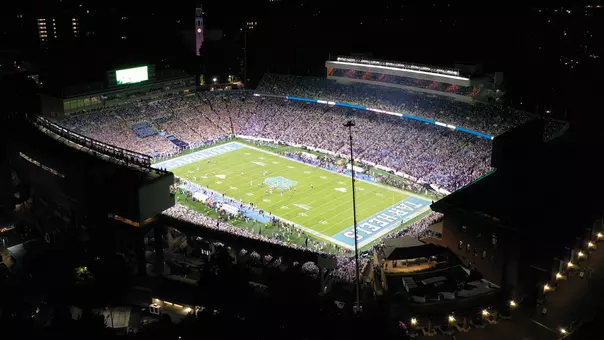
Football Saturdays in Kenan Stadium will have an added element next season when a video scoreboard is added in the east end zone. Tar Heel Monthly sat down with athletic director Dick Baddour to discuss some of the positives -- and also some of the concerns -- about the new board.
Tar Heel Monthly: How is the video board being financed and what is the timeline for its construction?
Dick Baddour: On December 18, we announced a multimedia contract extension with Learfield Communications, the company that currently has those rights. We signed a nine-year contract with Learfield. A significant part of the contract is a commitment from Learfield to finance the purchase and initial installation of a video board in Kenan Stadium, funds they will pay out over the term of the contract.
Corporate financing is paying for the board. These are funds that would not be committed to any other part of the University. By the way, it is not a $2 million scoreboard as some have said. The board itself cost $600,000. The $2 million includes the board, its installation and startup costs, and a new public address system, which was badly in need of replacement.
Some of the infrastructure for the board, such as electrical distribution, is already in place because of the renovations we previously made at Kenan. Our goal is to have the board installed in time for Commencement in May. The first time that part of the structure may be seen coming out of the ground will be probably in February.
THM: Is this the same board that was ordered last year with the expectation of it being used during the 2002 season?
DB: It is the same board. We planned to construct the video board prior to the 2002 season. However, Chancellor Moeser asked Coach Bunting and me to delay installation of the board due to the difficult economic times the state was facing. The video board itself is currently being stored in a warehouse in Texas.
Last winter, several members of my staff and I visited a number of professional and college stadiums to check out different kinds of video boards. We talked to a number of people who have bought and installed boards of their own to help us decide which type of board would be best for Kenan. We have a high-resolution board in which the screen size is 24' by 32'. It will be well presented. The standards holding the board will be made of the same material you already see in Kenan. It will include a scoreboard, game clock, down and distance, those typical scoreboard features. It will have Carolina across the top, an Educational Foundation logo on one side, and the interlocking NC logo on the other side. We will not take down the scoreboards that are on the sides of the stadium, but the scoreboard on ground level in the corner will be removed.
A new public address system is one aspect of the board that doesn_t get a lot of attention, but I think people will be very happy we are installing. When we get letters from fans about their gameday experience, many of them say they are not satisfied with the sound system in Kenan Stadium. That will no longer be a problem.
THM: Where will the board be located?
DB: The board will be anchored into the ground directly in front (the end zone side) of the original Kenan Fieldhouse. It will sit almost against the front of the fieldhouse. The bottom of the board will be just about even with the roofline of that building.
THM: Given that location, are there any ticket-holders who need to be concerned over whether they will be able to see the board?
DB: Fans may have noticed this year that the visiting team section was moved in part to the southeast side of the stadium. We did that in anticipation of this board. Fans will be able to see the video board from the 5-yard line on the east end of the stadium and out. There is a small segment of the stadium inside that 5-yard line who will not be able to see the video board due to the angle at which it must be installed. For the most part, given the new seating arrangement, those will be visiting team seats.
THM: In case of any future stadium improvements, is this a movable structure?
DB: It's actually a temporary structure with the idea that we could move it someday. At some point we hope to construct a new facility in the east end and look at the feasibility and need of adding seats. If and when those plans move forward, we need to be able to move the video board to another location.
THM: How will this board improve the game day experience?
DB: It will add to the experience in a positive way. Video boards are the norm in football stadiums across the country, even at smaller schools. People see replays on their televisions and they expect to see them at the game, too.
We will use it to engage the crowd in the game. It will have player features, statistics, highlights and other game-related information. We'll also make use of the opportunity to show our supporters University-related features that showcase people who may not be as well known as some of our student-athletes and coaches.
The challenge is for us to use the board in a way that fits the special culture at Carolina and doesn't take the crowd out of the game. That's actually more complex than you may think. Production is quite an undertaking. It was interesting to see the various studios other schools use, how many cameras they have, whether they're fixed cameras or hand-held, among other things.
THM: There have been some concerns at other schools that the boards take the fans out of that game. How can that be avoided?
DB: The commercial messages professional teams and some colleges show are what interrupts the flow of the game. We will use "associated messaging," like we do in the Smith Center. That's where a company sponsors a replay or a feature and all you see is the company's logo leading into and/or out of a replay. We've gotten positive feedback from our fans that have seen them in the Smith Center in the first three basketball games. We'll have a similar setup for football. We want to use the board to create additional enthusiasm in the stadium and draw people into the game.
THM: Times are just as tough now for the state as they were last summer. Are you still concerned about the perception of the public?
DB: I am concerned about how the people of North Carolina view their University. We've worked hard to educate the public about how the board is being paid for and I think we've been able to get our message out to them.
The video board will pay for itself over the life of the contract with Learfield. Tar Heel Sports Marketing will sell associated electronic messaging that in turn creates the new dollars to build the board. Our hope is the public will understand that in these difficult times, this is a creative way to enhance the game day experience for people without an increase in ticket prices for this purpose and without using University money or existing athletic department dollars. We've worked hard to create this opportunity. We've consulted with a lot campus leaders, faculty and students, about their ideas and how we are doing this. We've talked about it at Educational Foundation chapter meetings and found that people generally understood how the funding was developed.
We are proud of the fact that the athletic department does not use money from other parts of the University, especially academics, to fund itself. But the financial challenges to fund a 28-sport program are becoming increasingly more difficult. That's true not just at UNC, but nationally. It is incumbent upon us as stewards of this program to find new revenue streams that are acceptable to our culture and traditions.
Logos on a video board do not mark our first commercial ventures. Just as we have been privately assisted by Educational Foundation donors, we have been corporately assisted for many, many years through sponsorship contracts with the Village Companies (now Vilcom) and Learfield Communications, among others.
The key to it all is keeping a balance between the corporate interests and those of our culture. I think, and most people across the country think, that UNC has been a model program for maintaining this balance. And we will continue to maintain that balance even with a video board.