University of North Carolina Athletics
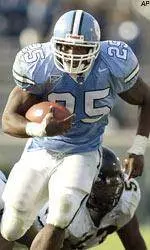
McGill Carries The Load
November 21, 2003 | Football
Nov. 21, 2003
by Adam Lucas
Tar Heel Monthly
When you're a college freshman, sometimes things don't make sense.
Maybe that explains why the game in which Ronnie McGill made perhaps the biggest special teams play of the season was also the game that wound up costing the freshman his starting spot on several Tar Heel special teams units.
Confused yet? Stay with us.
Like many of Carolina's talented freshmen, McGill's first exposure to college football came on special teams. Even before he began carrying the football-with 120 carries through the Georgia Tech game, he's nearly doubled the rushing attempts of any other running back-he was chasing it as a member of the Heels' kick and punt coverage teams.
It is not a glamorous job, not a way to make it on SportsCenter. And not something that high school superstars are accustomed to doing.
"Special teams probably weren't very important to some of these freshmen in high school, but they are very important here," John Bunting says.
How important? Maybe important enough to rescue a season.
When the Tar Heels punted to Wake Forest midway through the second quarter on Nov. 8, the future looked bleak. The Deacs had stuffed McGill on 2nd-and-inches, and a third-down screen pass lost two yards. As David Wooldridge boomed a 42-yard-punt, scattered boos echoed through the Kenan Stadium pines.
Enter Ronnie McGill. The South Carolina native ran headlong down the field, arriving at Wake Forest's Willie Idlette just in time to pick up Idlette's fumble at the Wake 22. Three plays later, the Tar Heels found the endzone to tie the game at seven, and after McGill and the offensive line slowly took over the game through the next two quarters, suddenly the future didn't look quite so dreary.
ut that fumble recovery may have been one of McGill's last special teams plays of the year. Since he was hired at Carolina after the 2000 season, John Bunting has frequently expressed his desire to locate a big, powerful running back who can get stronger as the game progresses and make opposing defenders think twice about trying to tackle him. Problem is, when you find a back like that in the prep ranks, every other school already knows about him.
Unless you unearth a 6-foot-1, 210-pounder who is punishing opponents in Clover, S.C., a small town just across the North Carolina border about halfway between Sparta and Rock Hill. That's where running backs coach Andre' Powell found Ronnie McGill, who started at safety as a freshman and quarterback and safety as a sophomore and junior. He outgrew those positions as a senior, and head coach Marty Woolbright switched him to running back and linebacker. All McGill did then was the lead the team in tackles with 105 and rush for nearly 2,000 yards while also returning six punts or touchdowns for scores.
ut colleges knew the McGill kid as a quarterback or defensive player. Carolina, meanwhile, didn't even have him on the radar until Powell showed John Bunting some film he had just received from Woolbright.
"What I saw in that video was him taking tacklers on and running over them," Bunting says. "I saw him run away from people. Over and over again, his tape demonstrated balance and toughness."
Let's see-balance, toughness, and fully qualified to enroll at Carolina a semester early? Bunting could have been excused for thinking Powell was making up this character named Ronnie McGill. This, it appeared, was the running back Bunting had been hunting for for the past two years, and now he had found him playing linebacker roughly 150 miles away from Kenan Stadium. The Tar Heels offered McGill a scholarship as soon as the head coach finished watching the tape. The bruiser committed on January 8 and was enrolled at Chapel Hill just a few days later.
Tar Heel coaches emphasize the importance of enrolling early to recruits because it allows the freshmen to go through spring practice and get acquainted with Carolina's system. But as McGill learned, it's also a valuable way to adjust to the college lifestyle.
"I had to adjust to classes and being everywhere on time without as much supervision as in high school," he says. "You don't have teachers writing on the board every minute. You have to know to make your meeting times and you have to know what to write down in your playbook and the key points to everything."
He picked up 12 carries in the season opener against Florida State and 10 against Syracuse, but then developed a problem with cramping that significantly limited his practice repetitions and caused him to get just nine carries over the next three games. By the time he became completely healthy again, Carolina's running game was struggling and no one had asserted themselves as the team's feature back.
Against Arizona State, the coaching staff wasn't confident enough to go for it on fourth-and-1 in what could have been a game-clinching situation, and the Sun Devils took the ball back and drove for a game-winning score.
It was hard not to think about that situation against Wake Forest, as the Heels lined up for a fourth-and-one with under a minute to play. Get a yard, and they had their first home win in two years. A field goal was a possibility, but Bunting signaled the offense back on the field. He'd been looking for the type of back who could make a guaranteed yard for over two years. Now was the time to see if he'd found him.
McGill was hit in the backfield on the play, but shook off the tackle and twisted forward for a gain of three yards. It was the last of his 244 yards, the second-best single-game rushing performance in the ACC this year and the eighth-best rushing game in the entire nation.
And maybe, just maybe, the Tar Heels had found that player to give them the tough yards.
"That was by far the toughest yard I've gotten all season," McGill says. "I got hit and thought I had made the yard, but I didn't expect to break the tackle."
John Bunting expects him to break plenty of tackles over the next three seasons. He's taken McGill off the kick and punt coverage units, unwilling to risk his suddenly prolific back in a non-rushing situation. McGill will be on the field on plenty of occasions-just not on special teams.
"I'd love to see Ronnie run the ball 20 to 25 times a game," Bunting says. "I wish he was on all of the special teams, but we can't afford to do that...Once we get everything under control in terms of the cramping and the repetitions and the experience factor, I think he is going to be a great player."