University of North Carolina Athletics
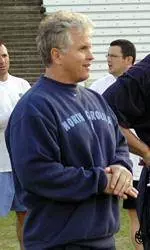
A Q&A With Coach Jeff Connors: Part II
July 31, 2003 | Football
By: Joe Bray
TarHeelBlue: Let's take a look at the offense, starting along the line.
Coach Connors: "We're looking at an offensive line that's pretty much been intact for the last three years. I would put their strength levels up against almost any group in the country. Jason Brown has got to be one of the strongest offensive linemen in the country no matter the position group, center, guard or tackle. He is extremely strong.
"All of the other offensive linemen have continued to make gains. I'm excited about that group. They have a great attitude and chemistry. Hal Hunter gives a lot of support to the weight program, as do the other coaches. He really emphasizes to those guys how important it is to lift. It helps me that the offensive line is a self-motivated group when they come into the weight room."
TarHeelBlue: Let's move out to the tight end.
Coach Connors: "We're looking for big things from Bobby Blizzard, he's a very athletic tight end. He has good field strength, he has good hip and lower body strength. He's certainly a guy that the NFL scouts will be looking at.
"We don't have a lot of depth there, but we have three guys who are working hard because they realize they can be on the field. It's always easier to be motivated if you feel like you have a chance to play."
TarHeelBlue: Which wide receivers have made the most gains?
Coach Connors: "When Dauntae Fields came here he was 152, now he's 174. Danny Rumley had an excellent summer because of a big-time commitment.
"Jarwarski had a great winter, he's beefed up some and is a lot stronger than he was previously."
TarHeelBlue: What about the running backs?
Coach Connors: "We have four solid tailbacks with different strengths. Willie Parker has had an excellent summer. The guy weighs about 212, he is physically very impressive, it's quite visible. I used him as a test person to check the time on the turf in the indoor facility because we felt the indoor turf was kind of soft and slow. We took him in there and he ruined our theory because he ran a 4.4 flat, a 4.39 and a 4.45.
"Jacques Lewis is very strong for his size. Ronnie McGill and Chad Scott continue to work hard. All those guys bring something different to the table. Running back is a very interesting position this season."
TarHeelBlue: Take a look at the fullback position.
Coach Connors: "Rikki Cook is a big strong kid, he's 250 plus but he still runs well. I'm very anxious to see him perform now that he's eligible. James Gibson is running well, he's bigger and stronger.
TarHeelBlue: How do you put proper weight on a player?
Coach Connors: "The way that you do it is to cut their running down, increase their lifting and increase their caloric intake.
"You lift twice a day, with the second lift being a body-building lift where we're looking for maximum muscle hypertrophy. We consume close to 2,500 or 3,000 calories a day in the weight room during the course of the workout. We give them bars, shakes, carbohydrate drinks, whatever we're allowed to give them.
"Then we want to make sure they're also eating another three to four thousand calories the rest of the day. We do check their conditioning levels one to two times a week to make sure they're maintaining their conditioning. If I have to throw a guy into a running group for a while, I'll do so.
"We don't want to recruit guys who need to gain a lot of mass, because it's going to be tougher to do that. We need to recruit people who already have mass and make them stronger, and if need be decrease their percent of body fat.
"What we don't want to do is bring in guys who have too high a percentage of body fat, because that's often a symptom of a behavioral eating problem. We don't want to bring in any obese guys. We don't want to bring in any guys who play, let's say offensive line, who are above 18 or 19 percent body fat.
"We have to be smart about who we're bringing in in regard to their future physical development."
TarHeelBlue: Is any certain position group that is more challenging with which to work?
Coach Connors: "I think that traditionally skill athletes are more challenging. They have gone through their high school careers and been all-stars in many respects, with many of them having been three-sport athletes, and they really haven't had the great commitment to strength training because they've been successful without it.
"On the other side of the coin, I've had some very strong quarterbacks that I've coached over the years. Guys like Jeff Blake, Marcus Crandell, David Gerrard and now Darian Durant. Darian's very strong. He bench presses 365, squats 600 pounds, power cleans over 300 pounds. Darian's no slouch strength wise.
"Darian is sort of like David Gerrard. Darian has very strong hips and a very solid lower body and he's quick. The modern-day quarterback has to be very durable, since a lot of times they're running the football. They're constantly at risk.
"Receivers and corners are probably the most challenging because they have been successful without a whole lot of lifting. A lot of times they don't see the lifting as being as important as we see it. I've encountered that ever since I've been coaching.
"You always have to develop a mentality with each of those groups."
TarHeelBlue: I've had several of the coaches talk about how we needed to get tougher players in here. How do you make the players who are already here tougher?
Coach Connors: "Talent cannot be a substitute for exceptional conditioning because fatigue overrides physical attributes and directly causes mental error. There is only one way to acquire this weapon. You must win the battlefield of the mind. We are not coaching athletes to overcome an obstacle. The battle is within yourself. This battle will not disappear. If you are a great competitor it will show up on your doorstep everyday because you will never be satisfied with mediocrity.
"This is what I want them to understand. You're always trying to reach another level. I look at where we're picked nationally and where we're picked in the conference and we're underdogs. I'm comfortable with being an underdog, but we have to have a very high expectation because at some point we've got to make it to the top. These guys have to understand what that fight is.
"I'm here to instill confidence. If someone feels good about himself physically and mentally and has no sense of intimidation, then they're going to go out and be confident that they can get the job done, no matter who steps on the field against us. Collectively, they're going to understand that they have a chance to win the game.
"We've tried to make things very tough for these guys over the past three or four weeks.
"We have got to produce. We have to continue to recruit athletes who have an appreciation for preparation, leadership qualities, good character and a love for the game."
"A particular challenge to strength & conditioning coaches is that much of what we have the players do is on a non-mandatory basis. The players have to be sold on what we do. We go hard, we have a high expectation.
"There has been an arms race of sorts between conditioning coaches over the past few years. The point is that we do have to provide athletes with recovery. We have to be smart about recognizing when these athletes need recovery, but we also have to be careful not to lose them for too long, because you can lose your strength in a hurry. It's a real challenge to determine the optimal schedule."
TarHeelBlue: You seem to particularly enjoy your job.
Coach Connors: "This profession is a great profession because of the deep satisfaction you get at seeing young people improve on a day-to-day basis. It's not always easy, and sometimes it takes a while to see what you want in a kid, but to see people change and gain confidence to a level that you know they'll be successful, and to feel like you had a part of that, that's why I'm in this profession.
"There can't be anything more gratifying in life. It's all about the young athlete and what you can do for him."