University of North Carolina Athletics
COUNTDOWN TO KICKOFF: Choo Choo alone at the top
August 17, 2003 | Football
Aug. 17, 2003
Tar Heel Monthly is the premier magazine devoted to the stories and personalities behind UNC athletics. Click here for subscription information.
The following is a story from the August issue of the magazine.
By Lee Pace, EXTRA POINTS
Editor's Note: Carolina athletics history is rich with legendary figures. Lee Pace begins an annual Tar Heel Monthly series that will look back at the people who have played singular roles in Carolina athletics. The first choice for the series was obvious.
Hero - A man of great strength and courage, favored by the gods and in part descended from them, often regarded as half-god and worshipped for his nobility and exploits.
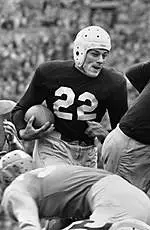
Charlie Justice was a hero of epic proportions.
Throughout the state of North Carolina and beyond from his days as a football player at the University of North Carolina in the late-1940s, the legendary "Choo Choo" set the standard for celebrity worship.
He was certainly a hero to Knox Hillman, a young boy growing up in Concord in the 1950s and for many years an active member of the Educational Foundation Inc.
"Choo Choo was my idol," says Hillman, a Hampden Sydney College graduate who links his loyalty to Carolina through Justice. "I never saw him play in person, but my parents went to Chapel Hill many times to see him, and I could not wait for them to come home and tell me what he had done. I watched the newsreel highlights of him and tried to imitate his moves. Every football, basketball and baseball jersey I owned was number 22 unless someone else had already claimed it."
He was a hero to Woody Durham, an aspiring young athlete in Albemarle, also later a Carolina graduate and for 33 years the "Voice of the Tar Heels."
"He was magic, even years after his playing days were over," Durham says. "He did color on the radio network one year, and I'll never forget a game in the 1970s a punter named Johnny Elam was having a bad day. Charlie remarked on the air that Elam had a bad 'drop' of the football before he kicked it. Elam's dad met Charlie outside the press box as soon as we went off the air. He took Charlie straight to the locker room and they had a meeting with Johnny. After that, he had a great year punting. He averaged more than 40 yards a punt."
And Justice was a hero to Moyer Smith, a highly regarded football player in the mid-1950s at Lexington High School. Smith would be recruited by coach Jim Tatum to Chapel Hill, where he played football, later graduated and went on to a career in coaching, athletic administration and 15 years as president of the Educational Foundation Inc.
"I was one in a line of about 40 halfbacks who were supposed to be 'the next Choo Choo,'" Smith says with a wry smile. "But Charlie set too high a standard for us. There's still not been a 'next.'
"I remember once they had a sprinting contest at my high school. The prize was a T-shirt with Charlie's name on it and an image of him kicking the football. I've never run so hard in my life. I wanted that shirt. Somehow, I won that sprint. That T-shirt was my most-prized possession for many years. It only came out on special occasions, I'll tell you that."
The 1946-49 Tar Heels won 32 games, lost nine and tied two and were ranked in final Top 10 for three of those years. Justice played tailback and punted, and his tailback position on Coach Carl Snavely's teams allowed him to showcase his outstanding running and throwing abilities. He was twice runner-up for the coveted Heisman Trophy and was a consensus All-America his junior and senior years. He's a member of the College Football Hall of Fame and held the UNC career total offense record for 45 years before being passed in 1994 by Jason Stanicek.
Justice for more than half a century has eschewed the reference to "The Justice Era," instead preferring to call it the "Golden Age" of Tar Heel football. Friends say Justice, the subject of two books and at least one film project, was delighted with the 1996 publishing of a book, Hark The Sound, honoring the 50-year anniversary of Carolina's Sugar Bowl team because it featured every member of the team. It wasn't just about him.
"I was just one of many outstanding football players," Justice says. "But as tailback in the single wing, I was the star. I got all the attention."
Teammate Bob Cox and others allow that the Tar Heels of that period would have been a very good team without Justice.
"But with him, we were great," Cox says.
"I'll never forget that he was the first player on the field and the last one off it. And his durability was amazing. He never complained. Not many people could catch him and beat up on him, but on those rare instances when he was beaten up, he never said a word. Charlie had a remarkable ability as well to see the entire field. Others of us might focus on one guy, for instance the halfback assigned to cover us on a pass pattern. But Charlie could see that guy and everyone else, too. That's a trait of the great athlete in team sports."
Today both Charlie and Sarah Justice have daily challenges fraught of Father Time's assault on the aging human physique. Each have good days and bad days. In mid-June, the Justices joined a handful of their teammates and wives in Cherryville for a spread of barbecue-courtesy ex-teammate Joe Swicegood of Little Pigs of America renown-and a planning session for a reunion this fall in Chapel Hill.
"Like all of us gray-heads, Charlie doesn't get in and out of chairs as well as he used to," Cox says. "But he stands erect and has a great appetite-particularly for pecan pie. He swears he'll be at Chapel College for the reunion October 18."
The Justice Era has held a reunion every other year and its confab in 2001 took on added significance with the christening of the Charlie "Choo Choo" Justice Hall of Honor and the team's presentation of more than $1 million to the Rams Club to seed the Justice Era Endowment. It's the team's effort to establish a lasting legacy of commitment to the university beyond the glory it brought to the state and its citizens more than 50 years ago.
"Charlie Justice inspired more loyalty at a key time following the war that was reflected in a huge amount of support for every facet of the University, not just athletics," says Hugh Morton of Grandfather Mountain. "It would be impossible to put a value on his contributions to the University-it would be in the real big millions."
One of John Bunting's most prized moments in his first year on the job as the Tar Heels' head coach in 2001 was a springtime visit to the home of Charlie and Sarah Justice in Cherryville, where the Justices have lived most of their adult lives. Bunting mentioned to Durham as the Rams Club's annual schedule of spring chapter meetings across the state and ACC area kicked off that year that he had never met Justice but would love the opportunity to do so. So Durham arranged for Bunting to visit in late May.
"He's up there in a special place," Bunting says. "He's so revered - so revered - by his teammates. I wanted to find out what he's all about. I got goose bumps shaking his hand. What a thrill. I'd heard of him all my life but never met him. He still has that fire in his eyes."
Bunting, Durham, Morton and the Justices sat down in the living room and the legend and head coach swapped stories-Bunting wanting to know about Choo Choo's career and Justice in turn wondering about prospects for the coming fall in Chapel Hill. Justice told the story of how he got into the business of punting the football.
"Well, it was just one of those breaks," he said. "I don't care how good you are, the Good Lord's got to give you a break along the way. I was on KP duty, but I didn't have to go back to KP duty that day. I was shagging punts. They weren't kicking too well. I thought, 'I can do better than this.' So I kicked one back. It looked like it'd been shot out of a cannon. The coach just happened to be looking. He said, 'Who kicked that ball?' He asked if I could do that again. For 30 minutes I didn't miss one. That ball was booming. That gave me my chance. The Good Lord had the coach look when I kicked that ball. That's the break I needed."
"Wow. I got some breaks like that too," Bunting said. "I was trying to figure out whether to go into broadcasting or coaching when I quit playing. My son just happened to meet a coach at Glassboro State in a golf camp in 1987 that led to me getting into coaching."
Justice, his teammates and their accomplishments from 1946-49 provide yet another bar for Bunting to leap as his builds the Tar Heel program. There have been great periods in Kenan Stadium over the last half century-Jim Hickey, Bill Dooley, Dick Crum and Mack Brown each enjoyed success of some degree during their decades leading the Tar Heels.
"Choo Choo" Justice remains the capstone. As Moyer Smith will attest, there still hasn't been another one come along.
"All I knew going up to meet 'Choo Choo' was that he was a great, great player in Carolina history," Bunting says. "Then all he does is talk about his teammates. He doesn't want the credit. That was really, really neat. And I looked right down in his eyes a couple of times. They're still burning-burning with pride, burning with energy. He's a player. He's a gamer, I think, as well. That trip made me feel really good. I'm glad I did it."