University of North Carolina Athletics
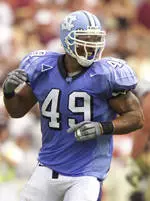
Carolina Adds Elite Eight to Honored Jerseys
August 26, 2003 | Football
Aug. 26, 2003
by Steve Kirschner, Director of Athletic Communications
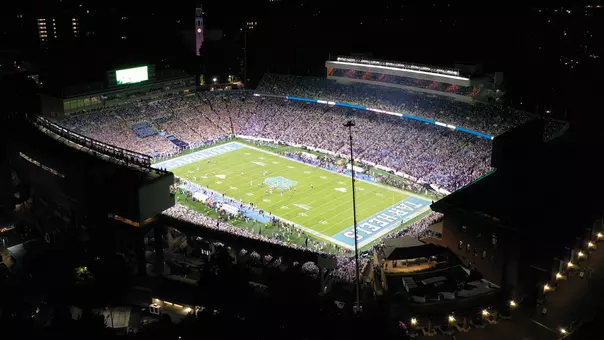
When you look around Kenan Stadium on Saturday night, you may notice a few changes with the blue and white signs that honor many of Carolina's greatest football players. One change is the sign itself that represents each player. The signs have been redone to fit better along the front of the upper deck.
The other more significant change is the addition of eight former Tar Heels who will join the prestigious list of players who have received this honor.
Those eight players and/or family representatives will be presented on the field at halftime of this evening's game. The new honorees include six first-team All-Americas and two of the Atlantic Coast Conference's 50 Greatest Players.
They are 1939 and 1940 All-America end Paul Severin, 1950 All-America center/linebacker Irv Holdash, 1963 All-America receiver Bob Lacey, 1983 All-America offensive tackle Brian Blados, 1986 All-America offensive tackle Harris Barton, 2001 All-America defensive end Julius Peppers, and tailbacks Kelvin Bryant and Amos Lawrence, who were each named to the list of the ACC's 50 Greatest Players.
Peppers was a consensus first-team All-America. That was one of three ways to have qualified when the criteria was first established in 1994.
The original criteria, established by the University's Athletics Council, included the five players who previously had their jerseys retired, six players who were consensus first-team All-Americas and three players who were ACC Players of the Year.
The original 14 honorees included (retired jerseys) George Barclay, Andy ershak, Bill Sutherland, Charlie Justice and Art Weiner, (All-Americas) Don McCauley, Ron Rusnak, Ken Huff, Dee Hardison, Lawrence Taylor and William Fuller, and (Players of the Year) Danny Talbott, Mike Voight and Ethan Horton.
Since 1994, four other players joined the ranks by virtue of earning consensus first-team All-America honors. They were Marcus Jones, Greg Ellis, rian Simmons and Dre' Bly.
Athletic department officials reviewed the original criteria to determine if additional deserving candidates should be included. The Athletics Council formally adopted two of those criteria - first-team Associated Press All-Americas and the ACC's 50 Greatest Players.
"No matter what the criteria, you are going to generate debate about players who were left out," says Director of Athletics Dick Baddour. "That is why it is so important to have objective standards. The Athletics Council felt the Associated Press was the most prestigious and widely recognized All-America team and the ACC 50 is a special group of players who certainly deserve to be honored. We are thrilled to have them join the previous honorees. It is an impressive list of Tar Heels."
Harris Barton was a four-year starter for the Tar Heels. As a senior, he led an offensive line that helped UNC rank first in the ACC and sixth nationally in total offense. He was chosen for a post-graduate scholarship by the National Football Foundation and was a first-round selection in the NFL draft. He won three Super Bowl titles with the 49ers.
rian Blados, a 6-6, 305-pound left tackle, dominated the line of scrimmage as Carolina set a school total offense record and finished seventh nationally in yardage in 1983. UNC had two 1,000-yard rushers that year. He was a first round choice by the Cincinnati Bengals and played in Super Bowl XXIII.
Kelvin Bryant rushed for 1,000 yards three times and was a three-time first-team All-ACC tailback. He is fourth at UNC with 3,267 yards. In 1981 he rushed for 17 touchdowns, including six in a win over East Carolina.
Irv Holdash played center and linebacker. He was a three-year regular who never missed a game during his varsity career. He sealed All-America honors in 1950 with a sensational performance at Notre Dame.
ob Lacey led the ACC in receiving in 1963 with 48 catches for 533 yards. His pass-catching led UNC to a 9-2 record and a win over Air Force in the Gator Bowl. He was the first Tar Heel player to have at least 40 catches in two seasons.
Amos Lawrence became the second player in NCAA history to rush for 1,000 yards in four seasons. Lawrence is Carolina's alltime leading rusher with 4,391 yards, holds the school record with 25 100-yard games and was a two-time bowl game MVP.
Julius Peppers was one of the top athletes in Carolina history. He won the Lombardi Trophy as the nation's top lineman and the Bednarik Award as the top defensive player. In 2000, he led the nation with 15 sacks and established a school record with 24 tackles for losses. He became just the second Tar Heel and the first since Lawrence Taylor to earn unanimous All-America honors. He was the NFL's Defensive Rookie of the Year in 2002.
Paul Severin was an Associated Press All-America in 1939 and 1940. His career was filled with big plays-a touchdown catch to tie Tulane and two scoring catches against Penn in 1939 and a touchdown-saving tackle from behind in a 6-3 win over the Blue Devils in 1940.