University of North Carolina Athletics
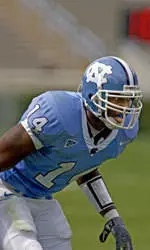
Sensabaugh a Quick Study
November 18, 2004 | Football
Nov. 18, 2004
By Adam Lucas
North Carolina co-defensive coordinator Marvin Sanders summoned safety Gerald Sensabaugh to his office earlier this season. Carolina usually practices until about 6:30 p.m. on weekdays, and every aspect of the practice is recorded by the squad's crack video staff. Sanders wanted to review part of the tape with Sensabaugh and go over something the Heels had worked on in practice the previous day.
The transfer from East Tennessee State popped into Sanders's office the next morning at 9 a.m. And that's when Sanders realized something unusual had happened:
Sensabaugh had already watched the film of yesterday's practice.
"Come on," Sanders says with a laugh. "It's 9 a.m. and this guy has already seen practice. That's pretty good."
It's just the latest chapter in what has been a whirlwind relationship between the Tar Heels and Sensabaugh. The 6-foot-2, 217-pound player was orphaned when ETSU cut their football program due to financial reasons after the 2003 season. The Bucs' players were given a year's notice and told they could transfer prior to the 2003 season if they could find a suitable destination. For Sensabaugh, who started all 11 games as a true freshman and was first-team All-Southern Conference as a sophomore, it didn't take long before his phone started ringing.
"Tennessee and Michigan were interested in me, but I decided to stay at East Tennessee and play out my junior year," he says. "Carolina was one of the first schools to contact me after that and I felt really comfortable with them."
He arrived in time for the spring semester and immediately set about impressing his new teammates. At East Tennessee, he'd been a member of a defensive backfield that was virtually unchanged throughout his three years there. They ran the same defenses, had the same checks, knew each other's strengths and weaknesses.
That familiarity evaporated when he arrived in Chapel Hill. But he wasn't the only player new to the Carolina system--Marvin Sanders had just been hired and several players were trying to make their first impression on the Tar Heel depth chart. Based on the film they had seen of him during the recruiting process, Carolina's coaches already knew he was an impact player. He proceeded to prove it during the opening days of spring practice, quickly earning a starting spot that he hasn't yet relinquished.
"I watched him during morning conditioning and when they were running sprints," Sanders says. "He led those sprints and never complained once. And he was always asking us questions about our defense and watching extra film."
He wasn't just impressing the coaches. For the first time in 2004, UNC's spring game rosters were determined by a player draft. Darian Durant and Doug Justice served as captains for the Blue squad, while Jason Brown and Chase Page captained the white. The players were given the responsibility for filling their teams. The first pick was obvious: sophomore tailback Ronnie McGill.
The second pick, at least to the players in the draft room, was just as obvious: safety Gerald Sensabaugh. In less than a month, he'd impressed his teammates enough to make himself the second overall player chosen from the entire roster. Almost by default, he'd become the veteran of the secondary, even though he still wasn't familiar enough with campus to direct a visitor from Silent Sam to the Old Well.
"I get asked a lot of questions by the rest of the DB's," Sensabaugh says. "Being a part of a secondary that has a lot of young guys, I have to be a leader."
Part of that leadership begins in the film room, where Sensabaugh has become a regular visitor. After practice, before practice, late at night--if you can't find him anywhere else in the Kenan Football Center, he's likely to be pausing and rewinding a recent practice or game.
With a junkie's love for video, it's no surprise, then, that he has football aspirations beyond just playing in the NFL.
"I would love to be a defensive coordinator," he says. "I love the scheme part of football. That's my zeal for the game. I like the physical part, but the scheme is very intriguing."
If he ever needs a letter of recommendation for his first coaching job, his coach in Chapel Hill sounds like he'd be happy to provide a reference.
"He's a very bright young man," head coach John Bunting says. "He's one of those guys that truly loves to study the game. He asks a lot of good questions and has leadership skills."
He also happens to be a knee-buckling tackler. He delivered several crushing hits in his first action for the Tar Heels against William & Mary and hasn't slowed down since, leading the squad in tackles through 10 games.
There's no question that he's a gamer, but Sanders's quest in recent weeks has been to get him practicing as hard as he plays.
"He needs to continue to practice harder," Sanders says. "Physically he gets beaten up a little bit, and he needs to do a little better job of taking care of his body. He's physical and fast enough to play in the secondary, but I could even see him at the next level playing outside linebacker. He should have a chance to play at the next level, but he's got to continue to work on practicing hard."
Like many hard-hitting safeties, he occasionally focuses too much on making the big hit, something Sanders worked with him on throughout the preseason.
Off the field, though, he's still got a bit of the gee-whiz kid from Kingsport, TN, in him. After playing his first game for the Heels, it wasn't the speed of Division I-A that impressed him, wasn't the glitz of Carolina's smoke-enhanced entrance, wasn't the live ram leading the team out of the Kenan Stadium tunnel.
It was the fans.
Memorial Center, the home stadium for ETSU, had a maximum capacity of 13,131. Actual crowds were much smaller. So when Sensabaugh took the Kenan Stadium field on Sept. 4, one thing struck him immediately:
"The fans," he says. "I'm not used to playing in front of that many people. What was it, about 50,000? I'm used to playing in front of 7,000. To feel that atmosphere was a great feeling."
It's reasonable to guess, then, that he might have been overwhelmed by the moment. Might have taken him a couple games to get used to it. Did it affect your game at all, Gerald?
"Nah," he says with a big smile. "Football is football."
Adam Lucas is the publisher of Tar Heel Monthly and can be reached at alucas@tarheelmonthly.com. His book on Roy Williams's first season at Carolina, Going Home Again, is now available in bookstores. To subscribe to Tar Heel Monthly or learn more about the book, click here.