University of North Carolina Athletics
THM: Freshmen Led By An Ace
May 31, 2004 | Baseball
May 31, 2004
Tar Heel Monthly is the premier magazine devoted to the stories and personalities behind UNC athletics. Click here for subscription information.
The following is the cover story from the most recent issue of the magazine.
By Adam Lucas
The topic of discussion is Chris Iannetta's nickname. Virtually no one associated with North Carolina's baseball program calls the junior catcher anything other than "Ace." Head coach Mike Fox is asked about the origin of the moniker and has an easy response.
"I don't know the exact background, because the players gave it to him," he says. "I know it's a very respectful thing. I call him 'Ace' because I think he is the best. I think his teammates call him that out of respect or reverence."
A few days later, Fox's comments are relayed to freshman pitcher Daniel Bard.
"No way," Bard says, exploding in laughter. "Did he really say that?"
It would make a nice story to report that Carolina's talented duo of starting pitchers, Bard and Andrew Miller, treat their catcher with the respect of a grizzled veteran, a Carlton Fisk-like reverence. The truth is, though, that they're only two years younger than him. College baseball players are among the most fraternal in the athletic department, so no knife goes untwisted.
Fox's explanation sounds good, a fitting tribute for the leader who has the Tar Heels aiming for Omaha this summer. But, well, it's not quite accurate. Not even close to accurate. Iannetta was labeled "Ace" long before any of the Carolina players had a chance to get to know him, long before they knew he'd eventually hit nearly .350 as a junior and reach base almost one out of every two plate appearances. Before they knew he'd develop into one of the best defensive catchers in college baseball, a rock behind the plate for a pitching staff that features two freshman starters (fellow freshman Robert Woodard has been a valuable swing pitcher and is 7-2 with a 3.81 ERA).
When he arrived in Chapel Hill, all his teammates knew was that his assigned roommate was freshman pitcher Garry Bakker. Unfortunately for Iannetta, it just so happened that a popular "Saturday Night Live" sketch of that time featured the Ambiguously Gay Duo, a spoof on superhero cartoons. The tandem's names--Ace and Gary. Bakker squeaked by with no harm done. Iannetta was not as lucky, and has been known as Ace ever since.
The catcher is firmly comfortable with his heterosexuality, which enables him to joke about the nickname today. But as his head coach says, it's become a fitting way to pay tribute to a player who is the ace of a team that has been near the top of the Atlantic Coast Conference all season.
He's a fixture in the middle of the batting order, one of the rare college hitters who can provide power while also remaining selective enough to take a walk. He leads the team with 35 walks, is second on the team in runs batted in, and pounded out a 23-game hitting streak earlier this season. The Tar Heels aren't an offensive powerhouse this season, so his offense is much appreciated. But it's basically just an afterthought to the defense and leadership he provides the pitching staff.
Bard and Miller can rib their catcher, can tease him during a photo shoot about looking goofy with his hat turned backwards. Both freshmen are phenomenally talented--Bard was a 20th-round pick of the New York Yankees in the 2003 draft, Miller was a third-round pick of the Tampa Bay Devil Rays. They're stalwarts on a staff that may be the deepest in the conference, with Bard having already rung up eight wins and Miller harnessing the control problems that plagued him very early in his Carolina career.
They are good, and they are bound for significant achievements during their Carolina careers. They have the borderline cockiness that all good pitchers have, the ability to bounce back from a home run by throwing the same exact pitch for strike one to the next hitter. But they will be the first to tell you that without the son of a brick mason from Providence, Rhode Island, their freshman seasons would have been much more difficult.
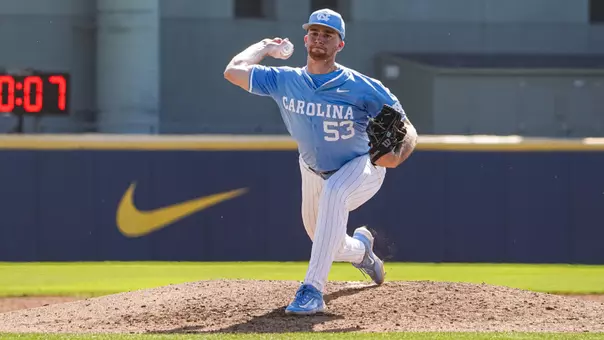
Daniel Bard is the natural. He has been throwing a baseball most of his life, and for many of those 18 years, opposing hitters have simply waved helplessly as the ball settled in the catcher's mitt. He throws a 90+ mph fastball, a slider that has gotten much tighter under the tutelage of Carolina pitching coach Roger Williams, and a changeup.
"He's got a good fastball and good command," Miller says of his teammate. "He's a command guy who throws his fastball hard enough to be able to get people out strictly on that if he wants to."

 |
|
There's that word: command. It is something some pitchers with terrific stuff never develop. Bard has it, a combination of mechanics and poise that make him unflappable on the mound. Watch tape of his first pitch of any start and compare it to the 100th pitch of the same start, and there will be very little variation in his delivery.
"I watched a video of me when I was 12 years old this summer," Bard says. "I was surprised at how my windup hasn't changed at all. I had the same high leg kick even then. That's always been the way I've pitched."
College schedules usually dictate that the most important games of the season, against conference opponents, are played during a Friday-Saturday-Sunday weekend series. Coaches like to have a set three-man rotation they call "weekend starters," their three most trusted pitchers who log most of the innings in the big games. The pitchers usually throw on the same day each week--one is a Friday starter, one is a Saturday starter, and one is a Sunday starter--which enables them to get into a routine with their preparation. At the outset of the season, Fox installed Bard as his Friday pitcher. It is the tone-setting piece of the rotation. A good Friday starter enables a team to start a series with a victory, putting the opponent on the defensive immediately.
It has worked. Opponents are hitting just .255 off Bard, and Baseball America selected him the nation's top freshman pitcher at the season's midway point. He provided victories in five of Carolina's first six ACC series of the season, stumbling only when the Tar Heel offense slumbered against Clemson and couldn't support his six-inning, two-run performance. Williams has worked with him on getting his arm on top of all his pitches rather than dropping his arm angle and on throwing his slider harder and tighter, but he's had very little work to do on his rookie's mental approach.
"He is more polished than most freshman pitchers," Williams says. "What separates him is he has very good presence on the mound."
That's something fellow freshman Andrew Miller is still developing. He has the physical tools--mention a 6-foot-6 lefthanded pitcher with a 94-mph fastball to any professional scout and prepare to clean up the drool--that made him one of the most highly-touted recruits in Fox's tenure at Carolina. At Bucholz High in Gainesville, FL, he was occasionally able to simply blow away hitters with his fastball and slider. But Tar Heel coaches knew he was susceptible to the big inning, and Iannetta noticed something during fall practice that showed him the lefthander might have a longer learning curve than expected.
"He struggles with his control at times and falls behind hitters," the catcher says. "With metal bats, kids are going to stick out their bats and get cheap hits off him."
That's why harnessing his control has been a point of emphasis this season. His lanky frame makes mechanics a challenge. For a more compact pitcher, it's simpler to get every part of the body moving in the right direction. For Miller, establishing a repetitive delivery is more complicated.
"We want him to stay back over the rubber and use his size to his advantage," Williams says. "We don't want him to run off the mound. We want him to go forward to the plate, step, and almost hand the ball to the catcher."
For a pitcher, mechanics are more variable than pitch command. It's unlikely that Miller will go to the mound and suddenly forget how to fire a heat-seeking fastball. But when he loses touch with his delivery, the results can be troublesome. He walked six in an early-season win over UNC-Asheville and five in a no-decision at Georgia Tech, and his 19 hit batters lead the Tar Heel pitching staff. But his 83 strikeouts also lead the squad, and opponents are batting just .198 against him.
The skill is there. And when the mechanics come around on a consistent basis, the results are expected to be dynamic.
"He's got electric stuff," Bard says. "He can go out there and dominate guys with an overpowering fastball and one of the best sliders in college baseball. When he's around the zone, he's tough to hit."
Blessed with recruiting victories that provided them with their talented pitching staff, Roger Williams and Mike Fox decided on a different approach to game management this season. They wanted to spend less time focusing on opponents' weak points, more on their pitchers' strengths--a decision made easier by the fact that their talented pitchers had more strengths than the average staff. Williams still goes over the opposing hitters before each weekend series. But the information he provides to his pitchers is much less detailed than in past years and focuses primarily on the three top threats in the opposing order.
The Tar Heel coaches also made a change in their game management. Last season, Iannetta wore a wristband with the entire scouting report printed on it, so a simple glance at his wrist provided a full chart of each hitter's strengths and weaknesses. Most of Carolina's pitches were called by Williams from the dugout, who relayed the call to Iannetta, who signaled it to the pitcher.
This season, Iannetta has called virtually every pitch thrown by the Tar Heel staff.
"It's the first year we have done that for an extended time," Fox says. "Chris knows our guys pretty well by now. He's smart, and he watches hitters. He knows the pitches our guys feel most comfortable with in certain situations."
Calling a game isn't a skill you'll find on most scouting reports. It's a talent that must be learned through experience and trial and error. Iannetta says Bard is more likely to shake him off than Miller, but both are capable of getting in a rhythm that makes any discussion of pitch selection unnecessary.
"When a pitcher is executing and hitting his spots, your fingers seem to be possessed and they know what needs to be called," Iannetta says. "When a pitcher's stuff isn't there on a particular day, it can be tough. You second-guess yourself. You're thinking, 'What would be more beneficial-take a chance with a pitch he hasn't thrown for a strike and get behind in the count or throw the hitter something to hit and have him hit it up the middle for a single?'"
His game management and defensive abilities--he's thrown out over 50 percent of the runners who have attempted to steal against him this season--have earned him a stellar reputation among the Carolina pitching staff. Some freshmen are hesitant to throw certain pitches in clutch situations for fear of uncorking a wild pitch past the catcher. That's not a problem this season, when the Tar Heels recognize that their backstop has already put considerable thought into any signal he gives.

|
|
"Whatever he calls is what I throw," Miller says. "He knows the hitters better than I do, and by the time I pitch on Sunday he has seen them for two days. I trust him. His defense gets us out of innings and stops the other teams from getting rallies started. Other teams know they can't run on him. And I'm not afraid to throw a slider in the dirt with a runner on third and the game on the line."
To develop his game management, Iannetta watches baseball with a catcher's eye. When he turns on a game in the Boshamer Stadium players' lounge, he's as likely to pay attention to pitch selection on certain counts as he is to home run distance or strikeout totals. As much success as he's had this year, disaster is always just one pitch away--against South Carolina in last season's NCAA Tournament Williams called for a fastball inside and Iannetta mistakenly signaled for a fastball away. The Gamecock hitter hit the pitch for a home run, a play that proved to be one of the decisive moments of the game.
Those are the kinds of plays some catchers forget. Not Iannetta. Almost a full year later, he still relays the story with a grimace, as though he has just watched the ball sail over the fence. It's a mistake he is unlikely to make again. Of all the traits that endear him to the coaching staff--his ability to call a game, the defensive prowess that has earned him the reputation as one of the best defensive catchers on the college diamond, his offensive prowess--it's his coachability they rave about the most.
"He is as smart a baseball player as I have ever coached," Fox says. "He knows himself, offensively and defensively, better than we do. There's not one thing that we've told Chris that he hasn't used to his advantage, whether it's giving signs, setting up late, or flying his front hip open. You tell him stuff one time and that's it. "He is low, low maintenance. I never have to tell him to shave, go to class, be on time. He is a coach's dream, on and off the field."
It's those types of superlatives that make his nickname well-deserved. Even if it didn't have quite the origin his head coach might think.
Adam Lucas is the publisher of Tar Heel Monthly and can be reached at alucas@tarheelmonthly.com. To subscribe to Tar Heel Monthly, click here.