University of North Carolina Athletics
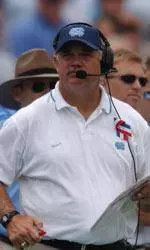
All In The Family: Football Lettermen Come Together
June 21, 2004 | Football
June 21, 2004
By Lee Pace, Tar Heel Monthly
The fortunes of Tar Heel football have ebbed and flowed over a century just as financial markets have rollicked and roiled through bull markets and bear markets. Since the Justice Era more than half a century ago, three coaches have been fired, one resigned under pressure, one died and two left behind good programs for jobs elsewhere. Too often the tendency of the new coach has been to wash his hands of the previous regime; players moving from the campus in Chapel Hill to the working world have felt disenfranchised from the program under a new administration.
Two former Tar Heel lettermen on the athletic department staff in 1987-88 and a new coach with infinite marketing savvy began serious efforts to organize former football players and bring all the eras under one umbrella. Under John Swofford (athletic director), Mack Brown (head coach) and Joe Robinson (recruiting coordinator), the Football Lettermen's Association was formed. A room dedicated to pre-game and post-game functions for lettermen was built into the base of the new South Box expansion project that opened for the 1988 season. Fall and spring reunions were organized. As the Tar Heels' star rose under Brown in the 1990s, there were good reasons to return to campus for games and to take ownership in Carolina football.
"Mack made them feel welcome," says Robinson, who left the staff in 1990 to move to Wilmington and enter private business. "It's no good having individual pieces of a pie scattered all around. You want the whole pie. He wanted them to know their contributions were appreciated and that we wanted them to be part of our program."
Predictably, the coaching transitions from Brown to Carl Torbush to John Bunting and the won-loss freefall from the back-to-back Top 10 seasons of 1996-97 has jostled the continuity and momentum of the lettermen's group. It's not stepped backward necessarily, but it has remained static.
Now two former Tar Heel players, working in concert with John Bunting's staff and the Rams Club, are attempting to further unify the lettermen into a cohesive group. Battle Wall, a Tar Heel from 1966-68, and Brent Milgrom, a Tar Heel from 1964-66, believe former players can bond to create a meaningful social environment and to be of service to Bunting and the current program.
"We want to form a group that will transcend any era, that will be a strong family regardless of whom an individual played for, what position they played and what their contribution was," says Wall.
Adds Milgrom: "You get a little age on you, and you tend to look back and appreciate some of the opportunities you had. You want to improve those opportunities for the next generation. You're at a stage in life where hopefully you can give back something to a program that has been very important in your life."
The Rams Club and Carolina Football Office crunched the numbers in their data base last year and learned that among some 1,200 living lettermen, more than $16 million had been donated to the university for academic and athletic purposes and 20 full scholarships had been funded. The group included 215 executive officers or business owners, 117 educators, 233 managers/supervisors, 91 doctors and lawyers and 99 consultants and sales professionals.
"Those are pretty impressive numbers," says Wall. "There are a lot of resources in a group like that."
Wall and Milgrom are working with Bunting and Corey Holliday of the football staff and Ken Mack of the Rams Club staff to chart the best course for the organization. They are studying similar associations at other schools, and the group made a trip in May to Florida State to learn more about its lettermen's association. Later in the month, Holliday and Mack planned to attend a meeting in Texas for lettermen's associations from around the nation.
An endowment has been established through the Rams Club and christened "The Carolina Football Family Endowment," and as of May it had pledges of approximately $150,000 and money in-hand of more than $100,000. Those funds will be used to underwrite the costs of the group's fall and spring gatherings-thus alleviating some drain on the budget of the football office, which has financed the functions in the past.
"The first thing we want to do is get more former players back, that's our bottom line," says Holliday, who played for Brown from 1990-93. "We want to create opportunities for lettermen to give back to the program-either through their time, their money or simply being around the program and supporting it."
This modern incarnation will be broader than official letter-winners only. Wall and Milgrom are interested in embracing those players who were a part of the program but didn't play enough to earn a letter. During the days of freshmen football, there were players who contributed their first year at Chapel Hill but never made a dent on the varsity. Many players gave several years of blood and sweat as "scout team" players on the practice field but never cracked the starting lineup. Managers and trainers are welcome.
"Those players contributed to the program just as a 'name' player did," Milgrom says. "You cannot have a good team without plenty of practice players, particularly during the spring. Spring is the hardest part of college football, and there were guys who helped build teams in the spring who should be a part of our group."
One era of former players that has remained rock solid in its cohesiveness and consistent return to Chapel Hill for reunions has been that from the 1946-49 period. Those teams went to three major bowl games behind the leadership of Charlie "Choo Choo" Justice and have met every two years for reunions over the last five-plus decades. In 2001, they presented a check to the Rams Club for $1 million as down payment on a fund-raising effort among players of their era.
"The Justice Era is the model," says Rams Club President John Montgomery. "That group has done a remarkable job in how it's stayed in touch over the years. Maybe it was the success they had .... Maybe it was the unique period following the war .... But for whatever reason, they formed a bond that's lasted more than 50 years. What we'd like to see is that kind of continuity and commitment to the program spread throughout all eras of lettermen."
Adds Wall: "Whatever they got at Chapel Hill, they left with it and they never forgot it. They have a special spirit among them. We need to tap into that and understand it and do a great job applying to our entire football family."
The group has designated two "official hotels" for the coming football season-the Hampton Inn and Holiday Inn Express at the Hwy. 54/I-40 intersection. Entertainment, a pre-game meal function and transportation are being considered as ways to help make a return to Chapel Hill a more meaningful and pleasant experience.
The football alumni group can serve as a resource to Bunting on a variety of levels. Former players can pass along names of potential prospects in their hometowns to the coaching staff and serve as the staff's "eyes and ears" within the community during the recruiting process-though they can have no active involvement in the recruiting process. Perhaps the most important function is to provide a network of potential business contacts for Tar Heels graduating to the working world.
"Our players go on to graduate and to careers in the business world and can be a tremendous asset to our current program," says Mack, who played at Carolina in the 1970s before going into the coaching and then fund-raising arenas. "Every year we have players going into the work force looking for meaningful jobs. Our former players can be a great resource in identifying opportunities."
"There's not a stronger piece of equipment in the world than a good network, a group of people who know each other and have a common bond and interest in working together," says Robinson.
It took having former Tar Heels Swofford and Robinson on staff and involved day-to-day in the football program to help generate the impetus to organize the group in the late-1980s. Similarly, having a former Tar Heel now serving as head coach is fueling the efforts of Wall and Milgrom to launch the group to the new level today.
"John has spurred us, challenged us," says Wall, a senior when Bunting was a freshman in 1968. "He's a special kind of leader. You could see it on the practice field all those years ago. As the program grows under him, we want to see the football family get stronger and stronger. He would very much like to see that happen."
For more information on the Carolina Football Family Endowment and the football alumni association, contact Corey Holliday in the Carolina Football Office at 919/962-9114; Battle Wall at 704/889-0402; or Brent Milgrom at 704/552-0113.