University of North Carolina Athletics
PERSPECTIVE: Amid Tar Heels Rebuilding On Defense, A History Lesson Apropos
September 27, 2004 | Football
Sept. 27, 2004
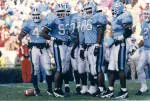
This is one of my favorite photos in the annals of Carolina football. It's framed and hangs on my office wall along with my Chapel Hill diploma and a panoramic black-and-white of the first football game in Kenan Stadium, that 1927 Thanksgiving encounter with Virginia.
I like this picture, taken by Bill Richards, for a number of reasons. That it was taken on Nov. 9, 1996, the last time the Louisville Cardinals came to town, is no coincidence this week.
First, it represents the finest quality of the finest two-year stretch ever of Tar Heel football -- the defenses of the 1996-97 teams that went 21-3 and finished in the national Top 10. Those units allowed an average of 217 yards and 11.5 points per game and were No. 1 nationally in one of those categories each year.
Second, the lighting lends a surreal quality to the image -- the players bathed in darkness, the sunlight of late afternoon awash on the far bleachers. Opposing offenses ventured into the dark hole of this defense and never came out alive. No faces are visible in this picture, even up close in an enlarged version.
It's odd that a photo so void of action should be so appealing. But there's unity, a sense of purpose and a calm-before-the-storm element that resonates from the image. Several years later, defensive coordinator Carl Torbush was reflecting on this team and said, "I've never in my life had a group where you went into every game and felt like whatever you did, you'd be successful."
Third, this photograph tells you everything you need to know about building a quality team: Each player in the frame, save one, earned all-conference or better honors in college, and all of them played in the NFL.
From left-to-right are Brian Simmons (All-America as a Tar Heel, today a starter with the Cincinnati Bengals); Kivuusama Mays (All-America, two-year NFL career); Greg Ellis (All-America, today a starter with the Dallas Cowboys); Vonnie Holliday (All-ACC, up until 2003 a starter with the Kansas City Chiefs); Russell Davis (never an all-conference performer but nonetheless a starter today with Arizona Cardinals); Keith Newman (All-ACC and in his sixth year in the NFL with the Minnesota Vikings); and Omar Brown (All-ACC and a two-year career with the Atlanta Falcons). Future pros Dre Bly, Robert Williams, Michael Pringley and Rick Terry are not in the photo.
I thought of this image when reading pre-game notes for the Tar Heels' encounter Saturday against Louisville. Did you remember that Carolina allowed the Cardinals one yard rushing -- one measly yard rushing -- in its 28-10 win over Louisville?
Lord, how things have changed.
Saturday the Tar Heels surrendered 278 yards on the ground and 455 total -- an average of 6.0 yards per snap. The Cardinals mounted sustained drives of 14, 12, 13 and 12 plays. They had one drive of exactly one snap -- a 37-yard run on the first Louisville play of the second half.
I bring this up because I get the question frequently, "What will it take to get this program turned around?"
The answer is always very simple:
Recruiting.
Everyone who enjoyed the Carolina heyday of 1996-97 should dispatch a belated thank-you note to Mack Brown and his coaching staff for the remarkable recruiting jobs they did from 1992-94. Every player in this photo, except Newman, a member of the 1995 signing class, came from that sweet-spot in the business of identifying, evaluating and selling quality high-school prospects on the Carolina experience.
Those numbers:
The 1992 signing class had 16 players, 13 of whom were productive in college and six of whom played in the NFL.
The 1993 class had 21 players, 13 of whom contributed and nine of whom played in the NFL.
The 1994 class had 21 players, 15 of whom contributed and four of whom played in the NFL.
That's an incredible conversion rate or batting average, whichever parlance you prefer to use. Why those averages have fallen over the last decade could fill volumes, but suffice it to say that Brown and Torbush were playing with a different deck of cards when Louisville visited in 1996 than John Bunting was on Saturday.
Part of that, of course, is Bunting's own doing. It's hard to look at his recruiting classes in 2001 and 2002 and find players who would have been on the field with this group had they been around eight years ago. Some might get there yet; Mahlon Carey and Tommy Richardson from the '02 class have ability but are only four games into their careers at linebacker.
Others like freshmen Kyndraus Guy, Khalif Mitchell, Terry Hunter and Hilee Taylor and sophomores Fred Sparkman, Melik Brown, Isiah Thomas and Larry Edwards from the last two classes might find their way to this level one day. But the waiting process is agonizing -- particularly when the glory days fade further and further into the cobwebs of the mind.