University of North Carolina Athletics
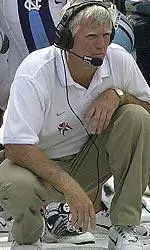
THM: Teaching Never Stops for Browning
October 17, 2005 | Football
Oct. 17, 2005
Tar Heel Monthly is the premier magazine devoted to the stories and personalities behind UNC athletics. Click here for subscription details and information on how to get our basketball championship commemorative issue and basketball preview issue free.
The following story originally ran in the October issue of the magazine.
By Adam Lucas
Kenny Browning can't help himself. He's been sitting at his Kenan Football Center desk for almost an hour, and no one in the room has done anything to get better.
So without warning, he stands up. It is instinct. The person across the desk from him is 5-foot-9, 160 pounds, and couldn't be a defensive tackle in a Pop Warner game. But now Browning, who has moved back to coaching Carolina's defensive tackles after four years with the tight ends, motions for him to stand up.
"See, this is what I mean," he says, and he puts his hands in his guest's chest. "Some guys think you have to play this position with your forearm. But can I push you farther away from me with my forearm or with my hands?"
He does not wait for an answer. He is too busy coaching--or, perhaps, teaching.
"It's my hands, see," he says. "The hardest thing to do is teaching a guy to play this position with his hands."
He sits back down.
Another lesson is taught.
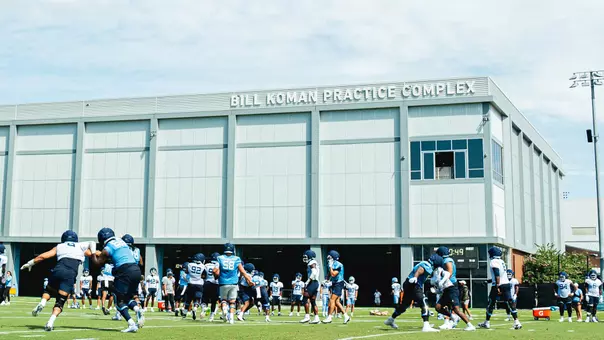
Carolina's practice fields are meticulously groomed. There are two grass fields and an outdoor artificial turf field, and none of them suffer from neglect. They're so well maintained that it's not unusual to see the turf field getting a dose of water on a hot summer day, which invariably prompts someone to ask if it's really possible to grow turf.
But in the corner of the defensive practice field, there's an exception to the lush greenery. In that far corner, away from most of the players and observers who attend any practice, chewed-up dirt peeks through the grass. Six monster truck-sized tires lean against a chain-link fence in the corner. Blocking sleds are scattered haphazardly around the area.
This, it is clear, is not an area for beauty. This is an area for work. And this is where defensive tackles spend most of their time.
"If the field isn't ripped up, we're not doing our job," says sophomore tackle Kyndraus Guy, a hulk of a 6-foot-2, 275-pounder who may be Carolina's next great interior lineman. "If the field isn't ripped up, we're not making cuts and pursuing the ball. We're trying to rip up every field that we can."
Defensive tackles lead a unique existence. They play alongside the better-known defensive ends, the pass-rushing quarterback sackers who soak up most of the ordinary fan's attention on the defensive line. They play in front of the linebackers, the sleek tackling machines who often possess the most unusual combination of size and athleticism on defense.
And then there are the tackles. The best-known among them at the position are usually the gargantuan curiosity pieces, players like Gilbert Brown or Tony Siragusa. They usually disappear under an onslaught of two-on-one blocks from the offensive line, emerging only occasionally to swallow up an unsuspecting tailback who ventures into the middle of the line.
"It's a tough position because on 80 percent of the running plays you are going to get double-teamed," Browning says. "That means you are playing every snap against about 600 pounds. When you are at the point of attack, you're always going to be double-teamed. That's how I usually start when I'm coaching them. I call them `two-hat blocks.' It's our one hat against their two hats. If our guys can't handle that, they're going to get knocked out of there and the linebackers won't be able to fit plays. That's when bad things start happening."
Browning just happens to be one of the best in the country at teaching the position. Under his tutelage, the Tar Heels produced first-round NFL draft picks Vonnie Holliday, Marcus Jones, and Ryan Sims, plus second-round picks Rick Terry and Russell Davis. In 1998, Sports Illustrated recognized the unit's success by selecting Carolina's defensive tackles in its positional "Dream Team."
The draft picks alone would be impressive, or the magazine story extolling Browning's virtues. But it's also misleading. It's not what Browning does with the talented players that makes him a successful coach. It's what he does with everyone. Coming into the year, every defensive tackle he has coached at UNC has been drafted by or signed with an NFL franchise. That includes the athletic marvels like Holliday and Sims. But it also includes former walk-ons like Ross McAllister and Anthony Perkins.
Browning, a Durham native who grew up working 16-hour days on his family's farm, can't seem to help it. Coaching--and teaching--just seem to come naturally to him. He spent 18 years at Northern Durham as a football coach and teacher. He established their advanced physical conditioning program, and soon something unexpected happened: the classes grew so popular he was no longer able to teach all of them.
"When I got here, people told me Kenny Browning was a great coach and a great recruiter, but a greater person and great with kids," says John Bunting, who retained Browning when he became Carolina's head coach. "He is the salt of the earth in terms of his personality. He is very, very loyal. He is one of those guys who can coach any position."
He can coach any position, but he's virtually invisible on the practice field. Some coaches make their presence known with their volume--it's easy to locate them just by listening for their booming voices. Locating Browning that way would be impossible. Over in that ragged area of the practice field where defensive tackles go through daily drills, his voice is barely audible over the sound of pads slapping.
A former defensive tackle and tight end at Northern Durham and Guilford College, Browning says he remembers what kind of coaching made him a better player and tries to emulate that on a daily basis. In 37 years of coaching, he says he has never cursed a player.
This spring, he gathered the tackles before the first day of spring practice and described his personality.
"I didn't believe him, to be honest," Guy says. "He told us that he would never cuss us. Every coach does that. But he hasn't done it yet. I'm still keeping an eye on him just to make sure."
But it's not what he says that makes the biggest impression. It's what he does. Browning's charges are always in motion. Even when they're taking a break, he's instructing them about the drill they just did or the drill they're getting ready to do. When players move over to the shade for a water break, Browning usually drops to the ground and does a few push-ups or crunches. Every second is crucial. Every moment can be used to get better.
That philosophy extends off the practice field. Longtime friend Allen Brown, the highly successful former head coach (and current defensive coordinator) at Thomasville High School, introduced Browning to bicycling this summer. The pair went on a 44-mile ride on the New River Trail in Virginia. When Browning began to get tired, he did the only thing he could think of to take his mind off the soreness--he talked football.
"My oldest son (Chuck) is a psychiatrist," Browning says. "He tells me my life and my work are too closely aligned. He tells me I have to work on that, because otherwise my retirement is going to be really difficult."
The Tar Heels hope that retirement is many years away. Better recruiting is beginning to generate some depth at tackle, with Shelton Bynum, Kenny Price, and Khalif Mitchell providing capable backups for Chase Page and Guy. All are players who could benefit from Browning's tutelage. The evidence is clear: when word began to trickle out that Browning would be returning to coaching defense, his voice mail began to fill up. Julius Peppers called to offer his support, as did Brian Simmons.
Anthony Perkins, who began his Carolina career as a walk-on tight end and ended it as a valued starter who had pro potential before a devastating knee injury, and Riddick Parker, who parlayed one year under Browning into a nine-year NFL career, have both addressed the tackles in person since the spring.
"They told us to keep doing what we're doing and we'll get the confidence we need," Guy says. "That's the biggest thing we need and it's great to hear it from those guys."
"The biggest thing about Coach Browning is that when you go to practice every day you know you're going to work hard," Page says. "We don't waste any opportunity he has with us. Every second is filled with drills to make you a better player."
That's a philosophy Browning tries to extend from the first player on the depth chart to the last. When he was hired by Mack Brown in 1994, the Tar Heel head coach tried to give his new position coach some friendly advice.
"Don't worry about Marcus (Jones)," Brown said. "You don't have to coach him much."
It was meant as a friendly jibe, a way of trying to make Browning aware of Jones's immense talent. The hard-rushing tackle had just finished a sophomore campaign in which he made 10.5 tackles for loss and notched 8.5 sacks. His raw physical talent was evident.
But Browning wasn't satisfied.
"I thought that was the wrong way to look at it," he says. "I thought we needed to coach him even harder than anyone else because he could be dominant. He could get by without any coaching, but we wanted him to be a dominant difference-maker."
That's exactly what happened. Jones broke Lawrence Taylor's school record for sacks, was selected as the 1995 ACC Defensive Player of the Year, and was the first Tar Heel to earn consensus first-team All-America honors since Harris Barton in 1986.
The coaching never stops, whether it's a future NFL draft pick like Marcus Jones or an undersized reporter in the coach's office.
On the last day of practice in Chapel Hill before the 1997 Gator Bowl, Browning and future NFL standout Vonnie Holliday were walking off the Kenan Stadium field together.
"Well, Vonnie, this is the last time we'll get to do this here," Browning said.
Holliday laughed.
"And Coach, you coached me just as hard today as you did on that very first day on the practice field," Holliday said.
"That's right," Browning said. "But you know a lot more now, don't you?"
Adam Lucas is the publisher of Tar Heel Monthly and can be reached at alucas@tarheelmonthly.com. He is the coauthor of the official book of the 2005 championship season, Led By Their Dreams, and his book on Roy Williams's first season at Carolina, Going Home Again, is now available in bookstores. To subscribe to Tar Heel Monthly or learn more about Going Home Again, click here.