University of North Carolina Athletics
Extra Points Wednesday
October 19, 2005 | Football
Oct. 19, 2005
By Lee Pace
Lafayette field, Norfolk, Nov. 30, 1905 - Bets, two to one on Carolina, Virginia team, Carolina team, captains juggle, hearts beat fast, spectators wild, shrill cry of the whistle, they are off, Virginia going strong; and thus begins that drama, which the knockers designate a death-risking combat, between man and man, whose author is his satanic majesty - the devil. Did you ever see the game? If you did, you know how far short one must fall who tries to make one who was not there understand and feel the impulse of such an occasion. The terrific contest, the overwhelming fascination, and the reckless, unbidden force, reminds one of the descriptions of Rome's gladiatorial arenas in the days of Nero. The long line of bleachers was a mass of swelldom; across the fields the automobiles were lost in a vast surge that lined the ropes ten feet deep.
O. Max Gardner, 1906 Yackety Yack
Carolina beat Virginia 17-0 exactly one century ago with a 23-year-old law student and future governor of North Carolina looking on in wonderment. That was the 14th meeting between the Tar Heels and Cavaliers, and since then the two institutions sharing taut academic ideals and winsome environments have played 95 more times.
The rivalry has had its streaks. Virginia had an eight-game winning run from 1907-15 (no game in 1909); Carolina won nine straight years from 1974-82. The Tar Heels won 81 percent of the time between 1927 and 1963, and the Cavaliers have prevailed in 73 percent of the games since 1983. Over 109 games, the series stands at 56-49-4 in favor of the Tar Heels.
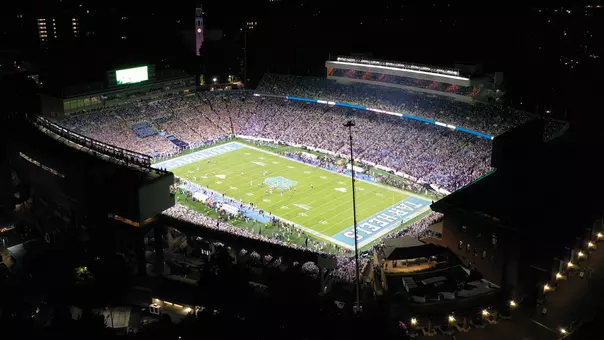
The games were played in Norfolk until 1916 and then commenced a home-and-home exchange, and Carolina used the occasion of the 1927 Virginia game to formally dedicate its new stadium. The Tar Heels clipped the Cavaliers 14-13 on Thanksgiving Day before a standing room only crowd of 28,000 in the new venue set in a valley within the woods south of campus. The Greensboro News & Record said of Kenan Memorial Stadium: "It is one of the finest architectural and aesthetic achievements in North Carolina. It is, in a very genuine sense, a work of art."
Through 1950, the Carolina-Virginia game was almost always the last game of the year, then Duke moved into the last-game slot annually when the Atlantic Coast Conference was formed in 1953. The schools in many respects are mirror images of each other, which is why the rivalry is so heated in football, basketball and every sport.
"They are great public institutions in small Southern towns," says Lance Markos, who holds degrees from both institutions. "Their athletic teams are very important, but they're not the be-all, end-all."
Norwood Teague is a 1988 Carolina grad and worked in Charlottesville from 1992-98 in sports marketing and basketball operations. He's now associate athletic director for marketing and promotions at Carolina.
"I was stunned to learn how much they dislike us," Teague says. "They dislike us more than we dislike them. Most Carolina people don't really understand the degree to which they dislike us. I think there are a couple of things that play into that. One, their in-state rival, Virginia Tech, has never been in their conference until the last couple of years. Meanwhile, we've got State, Duke and Wake in our backyard.
"And I think some of it goes back to basketball in the early 1980s. They gave us their best shot with Ralph Sampson, had their best teams ever, and they couldn't put us away. We won a national title when Ralph was at Virginia. They were down before and they've been down since. That really grates on a lot of their people."
Those of us on the south side of 50 years of age have two epochs in our memory banks from these clashes of orange and baby blue. There were the late-1960s and all of the '70s, when the Cavaliers were slow and un-athletic and had yet to integrate their teams and relax their admission standards. Carolina dominated. Then George Welsh arrived as head coach in 1982, was granted more latitude in whom he could recruit and built Virginia into a quality program.
Ken Mack is a 1979 Carolina graduate and worked on Welsh's coaching staff from 1982-95 before returning to Carolina to join Mack Brown's staff in 1996.
"Through my years there, Carolina was always the most important game of the year," Mack said in 1997. "Over (Virginia) Tech, over Florida State, over Clemson--it didn't matter.
"I don't know how it got that way. I believe it was that way before I got there with Coach Welsh. The schools are so similar, the towns are so similar. It's just become a nice cross-border rivalry. We recruit a lot of kids that Virginia recruits. It makes for a good rivalry."
The Carolina teams during linebacker John Bunting's playing era from 1969-71 won all three games, and Bunting remembers seeing a defensive package against the woeful Cavaliers he'd never seen before.
"We played some nickel," he says. "We got so far ahead, we knew they'd be throwing every down so we played five defensive backs. I'd never seen that before."
Bill Dooley's recruiting operation thrived in Virginia, and his rosters were generally one-third laden with Virginia imports. He considered Virginia and North Carolina "in-state" for recruiting purposes and stuffed his plate with Lawrence Taylor, Amos Lawrence, Buddy Curry, Mike Voight, Billy Johnson and others. Virginia and Welsh soon stopped the mass exodus of good players, and Frank Beamer began competing at Virginia Tech in the 1990s for top local prospects. Since then the rivalry has become spirited, competitive, sometimes bitter and always entertaining.
Remember the gadget play that goofed at the end of the 1984 game in Chapel Hill?
Virginia led 24-21 late in the fourth quarter when Tar Heel QB Kevin Anthony brought his team to the line of scrimmage, deep in Cavalier territory. Anthony stood over center, looked to his right and barked an audible in the direction of the receiver to that side. Then he yelled the signal to his left. The receiver on that side made as if he couldn't hear Anthony, so the quarterback took a couple of steps and repeated the call. Still no connection. Anthony then started to run toward the left, all the while calling an audible to the receiver. What he was really doing, however, was going in motion. The center direct-snapped the ball to tailback Ethan Horton, a high school quarterback with a good arm. Horton was supposed to throw the ball to Anthony, who had released on a pass route into the left corner of the end zone and was wide open. But Horton threw instead to fullback Eddie Colson and the pass fell incomplete. Coach Dick Crum was livid and went for the tying field goal instead of a fourth-down gamble from a deflated offense. The game ended in a 24-24 tie.
Or how about Derrick Fenner rushing for 328 yards in the rain in 1986 in a 27-7 Tar Heel win, with Welsh watching from a wheelchair because of a broken leg?
It rained in 1990 as well. The Tar Heels were rebuilding under Mack Brown, the Cavaliers were ranked 11th nationally and a 24-10 Virginia win bored everyone into flocking to the Smith Center to see a freshman basketball class of Eric Montross, Derrick Phelps, Brian Reese, Pat Sullivan and Clifford Rozier in the Blue-White Game.
And then there was the great media guide brouhaha in 1994. These books printed annually for the press, recruits and fans generally feature action photos on the cover, but that year Virginia commissioned an artist to paint an image illustrating the power and glory of Cavalier football. Who better to show getting the mucus kicked out of him than a Tar Heel? Brown didn't think it funny and made sure copies of the drawing were placed in every Tar Heel locker. Didn't help, though, as the Heels were pummeled 34-10 in Charlottesville that week.
How about the nightmare interception, the Chris Keldorf-to-Octavus Barnes pass that was stolen by Antwan Harris in 1996, igniting a furious Virginia rally to a 20-17 win? The Tar Heels finished 9-2 that year and went to the Gator Bowl, when a 10-1 mark might have gotten them into the Fiesta Bowl and landed the ACC a huge payout.

Markos, son of Art Markos, at the time a Virginia assistant coach, went to work for ESPN in the fall of 1998. Arriving for work at the network's headquarters in Bristol, Conn., he met another young staffer for the network, the very same Chris Keldorf.
"Are you THE Chris Keldorf, the one who threw the interception?" Markos asked. "My Dad coached the the DBs. Sorry."
Keldorf allowed Markos to crash in his apartment for three weeks while Markos was looking for a place of his own. Art Markos sent Keldorf a Virginia T-shirt as a "thank you" gift to Keldorf for granting his son sleeping quarters. A researcher at ESPN saw the T-shirt and said, "That's the $8 million T-shirt."
Lance, now on the administrative staff in Carolina's athletics department, came to grad school at Carolina in the early 1990s.
"And one of the first people I met in class was Octavus Barnes, who was the intended receiver," says Markos. "Small world."
Referee Jim Knight suffered a heart attack during the first quarter of the 1997 game in Kenan Stadium. The stadium went deathly silent as medical personnel attended to Knight, who later recovered and still is a top ACC official. Virginia bolted to a 20-3 lead, which set up perfectly a 38-0 Carolina scoring avalanche in the second half.
Ronald Curry, the two-sport sensation from Hampton, broke Cavalier hearts by opting for the Tar Heels after originally committing to Virginia during the 1997-98 school year. In November 1998 he was chastised by Virginia fans upon his return to his home state. "Benedict Curry" read one sign. Seven Cavalier fans were shirtless, one letter painted on each chest spelling "T-R-A-I-T-O-R." Virginia athletic director Terry Holland personally stood guard in front of the Virginia student section to ward off debris being hurled toward the Tar Heel bench.

"There are grown men and women out there, and they're acting like little kids,' Curry said.
That's not unusual where this dysfunctional relationship is concerned, which makes another passage from O. Max Gardner and the 1906 Yackety Yack a fitting conclusion:
The game was over. The hard training had borne fruit, the spirit of conflict had flown, and the loyal sons of the South's greatest Universities met upon one common platform, of fellowship and good will, where the sting of defeat and the flush of victory were blending into happy congeniality, congratulations and best wishes; the ending a clean, a noble, and a patriotic contest. May the wisdom of future generations list not to the cries of abolishment, to the cunning sophistries of demagogue quitters, and to the loud howls of sorehead failures, is the wish of one who loves the game and believes in its works.
Send your questions about Tar Heel football to Lee Pace at leepace@nc.rr.com . Questions may be used either in Friday's TarHeelBlue.com mailbag or in a special pregame segment on the Tar Heel Sports Network on Saturday. Please include your first and last names and hometown. Individual replies are not possible because of volume of mail received, and names of recruiting prospects and commitments cannot be published on a school-sponsored site until the national signing day in February. The Q&A column will appear each Friday during the season.