University of North Carolina Athletics
Lucas: Slotted for Success
October 20, 2005 | Football
Oct. 20, 2005
By Adam Lucas
It's taken 9 touchdowns, 160 catches, and 1,764 receiving yards, but finally Jarwarski Pollock admits to being scared.
Not on the football field, of course. Not inside Kenan Stadium, where Saturday against Virginia he needs just six catches to pass Na Brown as Carolina's all-time receptions leader. Not where he's made a habit of grabbing a pass over the middle, darting forward, taking a big hit and then bouncing back up to jaw back at a linebacker who thinks he's flattened him.
He is not scared there. But take him off the gridiron and put him on the diamond...
"When I was little, I played basketball, ran track, played football, did weightlifting, I played pretty much every sport," he says. "But not baseball."
Why not?
"I was scared of the ball. I had it in my head that I was going to get hit by the ball."
It's too bad, because he might have made a quality center fielder. Instead, he'll have to settle for being one of the best receivers in Carolina history.
The Bradenton, Fl., native arrived with perfect timing. At around the same time Carolina football was struggling to rediscover their formerly dominant ground game and turning to an air attack by necessity, along came Jarwarski Pollock. Four of the school's six biggest passing-yardage seasons have come in the previous five seasons. Zero of the top ten rushing seasons have come in the past decade.
College football was turning from a line-up-and-run-them-over game to a spread-out game of precision passing. Two-receiver formations turned into three-receiver sets, then into four-receiver sets, then into empty-backfield five-receiver sets.
They're all called wide receivers, but the positions are not created equally. The receivers on the outside are the tall, speedy, prototype pass-catchers. They're running fade routes and corner routes and faced primarily with one or two defenders.
The slot is different.
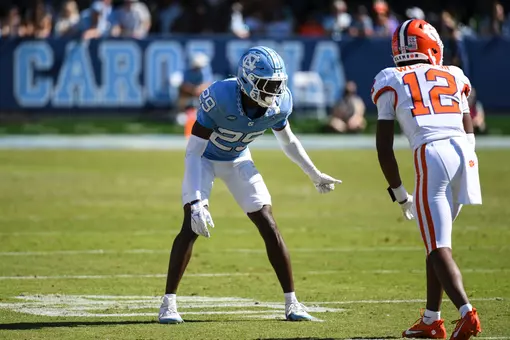
"In the slot you're mostly matched up with linebackers or safeties or a nickelback," Pollock says. "You have to read more coverages because you have to know what to do. On the outside, you're basically on an island. In the slot there are a lot of variables."
Variables such as staying alert for blitzes. Matt Baker calls the play in the huddle. But if he notices an impending blitz or a coverage change at the line of scrimmage, he'll adjust his throw. They're called read routes, and they're beautiful when executed correctly but can also be disastrous. Pollock doesn't always have a set route. Instead, he has to diagnose the way the play is being defended. That starts before the play, when he tries to draw as much information as possible from the safeties. "Eight out of ten times, the way they're lined up can tell me the coverage," he says.
Once the ball is snapped, it's all about reaction. If the linebacker nearest him goes inside, he goes outside. If the safety cheats in, he goes long. When the slot receiver and quarterback both make the same read, it can result in a big play. When they make different reads, it can result in an interception.
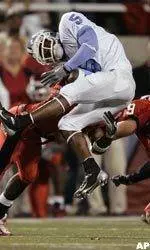
It can also result in helmet-rattling hits. The middle of the field, where the slot receiver usually operates, is the territory of headhunting defensive backs. If the quarterback makes a small throwing error--leaving the ball too high or throwing it behind his target--the receiver is exposed. Defensive backs usually have two options for seeing themselves on SportsCenter: they can either get beaten for a touchdown or deliver a crushing tackle. They prefer the latter.
Which makes it especially notable that Pollock has been one of Carolina's most durable receivers. He's played in 39 of UNC's 41 games during his career, missing a game against Georgia Tech in his first season because of a hyperextended knee and the road trip to Louisville two weeks ago because of knee surgery.
The senior would much rather catch a tough pass over the middle against a hard-hitting safety than watch his teammates play without him.
"That Louisville game, that was tough," he says of the game he watched on television from Chapel Hill. "I was still on medication but I was able to watch the whole game. I thought I was hallucinating the way they were putting points up on us."
Pollock is the one used to accumulating record-breaking numbers; he made a school record 71 catches during the 2003 season. Sam Aiken had obliterated everyone else on the list the season before, notching 68 receptions at a school where 55 had been the previous one-year record. Aiken was that prototype sure-handed outside receiver. Pollock was different.
Friends call him "Watt;" you can call him anything as long as you make an effort to pronounce (it's Ja-WAR-ski POE-lock) and spell (don't forget that extra "r" in Jarwarski) it correctly. He remembers getting most of his catches that record-breaking season by zipping past outmatched linebackers. But he also remembers something else.
"We didn't win," he says with a grimace about the 2-10 campaign. "I had always been used to winning. Those passes I caught didn't mean anything because we weren't winning games."
So he got special enjoyment from last year's bowl season, plus the big win over Miami, a home state school that didn't pay him much recruiting attention. He's not a big talker off the field (unless the topic is the latest college football video game, a subject on which he's the team's acknowledged expert), but it's clear he arrived in Chapel Hill with a few subtle scores to settle. To a Florida kid, football is fundamental. The players who receive recruiting attention from the Floridas and Florida States and Miamis ascend to the highest tier. Everyone else battles for attention elsewhere.
An unclear academic situation complicated Pollock's status. On the very first day of freshman practice in the summer of 2001, John Bunting singled out his new receiver as one of the stars of the day. But Pollock was a partial qualifier, which meant he had to sit out game competition his first year. In those days, partial qualifiers were shrouded in mystery, which meant fans weren't exactly sure of Pollock's status until he didn't take the field at Oklahoma.
The rules were simple: he had to sit out his first year and had four years to graduate. If he graduated in four years, he could "earn back" the fifth year of eligibility granted to other college players. Pollock was listed as a senior throughout 2004 but earned his extra year. It was confusing to outsiders--you won't find him on this year's EA Sports "College Football 2006" game because game designers thought he'd exhausted his eligibility, a situation that miffs the game-loving Pollock.
"When I got here, there were a lot of people who thought I couldn't make it," he says. "But the people here stuck by me, and I think I've proven a lot of people wrong."
He'd worked under those conditions before. As an 8-year-old, he was the self-proclaimed "sandlot king" of Bradenton. Always one of the first players picked in the regular neighborhood games of football, that's where he says he first developed his shifty moves.
But after just two years of playing the sport competitively, his mother, Oretta Pollock, removed him from the sport. She wasn't pleased with his academic progress and made a simple rule: no studying, no football. It took Jarwarski, the youngest of five brothers, four years to earn his way back onto the football field.
That's where he'll be Saturday afternoon, having made outstanding progress in his recovery from his knee surgery. Odds are that he'll break Brown's record either against Virginia or next weekend at Miami, when he'll have approximately 30 family members in the stands for his last regular season trip to his home state. He hopes the record-breaking pass comes on a touchdown but has only one real requirement: it has to come in a victory. And he says when he returns to Chapel Hill in the future, you don't have to remember him as a record-breaker.
"I want people to say, `He had a lot of heart,'" Pollock says. "I want them to remember I went out and played every play, that I took a lot of hits and was a smart player and a team player."
And never showed the slightest hint of fear.
At least not on the football field.
Adam Lucas is the publisher of Tar Heel Monthly and can be reached at alucas@tarheelmonthly.com. He is the coauthor of the official book of the 2005 championship season, Led By Their Dreams, and his book on Roy Williams's first season at Carolina, Going Home Again, is now available in bookstores. To subscribe to Tar Heel Monthly or learn more about Going Home Again, click here.