University of North Carolina Athletics
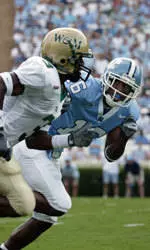
Lucas: Improved Play Speaks for Secondary
November 10, 2005 | Football
Nov. 10, 2005
By Adam Lucas
The defensive back position has a long history of flashy, fast-talking players. Deion Sanders is the patron saint, of course. Long before he was a suit on Sunday morning NFL pregame shows, he was "Prime Time," the rapping, running dean of cornerbacks.
At Carolina, there was Dre' Bly, who spent as much time flapping his arms begging for crowd participation as he did picking off passes (which means it was a considerable amount). Bly was only the latest version of a position group that was christened the "Rude Boyz" in the early 1990s when Jimmy Hitchcock and Bracey Walker were patrolling the position for the Tar Heels.
Under Marvin Sanders, Carolina defensive backs have slowly returned to respectability after a handful of down years that saw them treat opponents in very accommodating--not at all rude--fashion. Prior to the arrival of Sanders in 2004, opponents had thrown for 77 touchdowns during the previous four seasons, including 25 aerial scores in 2003 and 24 in 2002. How much had things changed in Chapel Hill? In 1997, when the Tar Heels fielded one of their best defenses ever, opponents managed just 15 touchdowns total--air and ground combined.
Teams have found the end zone just nine times through the air through nine games this season. Opponents have managed just three pass plays of 40 yards or more after having 33 such plays in the previous three seasons. Sanders has built enough depth at the position that a season-ending injury to starting cornerback Jacoby Watkins has so far been weathered. Rather than being forced onto the field as true freshmen, a stable of rookies is being allowed to redshirt.
But as for developing that Prime Time-type persona, well, that's simply not the style of this particular group of defensive backs.
"That's not what I have at all with this group," Sanders says. "I have a confident group. But it's not a braggadocios group. They play hard and love the game, but that's not their style. There's a thin line between confident and cocky. A lot of time that flash is just covering up something else. Our guys play hard. Every DB is going to get beat at some point. But the question is whether he thinks the other guy got lucky or whether he drops his head and worries about it."
Here's a snapshot of the new guard among Carolina defensive backs. Two weeks ago, Trimane Goddard was summoned to the weekly Tar Heel football media session. Every Tuesday, John Bunting and two players meet with the media. Bunting fields questions for approximately 30 minutes and the players each spend about 15 minutes with the pen-and-pad crowd. It is, in many ways, an honor for a player to be invited. They don't invite inconsequential players, after all, so being selected by the school's sports information staff means the player is playing meaningful snaps and making some type of contribution to the team.
Before the Miami game, Goddard received the honor. Except he didn't see it as an honor. He showed up on time, of course (actually, even a few minutes early). But then he turned to assistant football sports information director John Martin and said, "Do I have to do this?"
It wasn't a case of stage fright. Wasn't a case of feeling uncomfortable with the media--Goddard, who always looks everyone in the eye and makes liberal use of "sir" and "ma'am" when answering questions, will evolve into a media favorite over the next two seasons. Instead, it was this: Goddard had an optional study session he wanted to attend for one of his classes.
This is not rude. This is almost too good to be true.
There was some skepticism when the Tar Heel coaches moved Goddard from cornerback--where he played respectably as a true freshman in 2004--to safety before this season. His 5-foot-11, 185-pound frame seemed more suited for corner rather than the tackling-intensive position of strong safety.
But forget about his size. Pound-for-pound, he has been one of Carolina's best football players throughout the 2005 campaign.
"Trimane is a great athlete," Sanders says. "He was one of those multisport guys in high school. He gives us that playmaking ability. When the ball is in the air, he goes and gets it. He understands the game, so as long as he plays with the right technique he is going to be a very good player."
That athleticism--his leaping interception in the end zone at Miami would be appropriate in a defensive back textbook--exhibited by the Robersonville native is the perfect example of Sanders's recruiting strategy. Every football coach has a checklist of attributes they're seeking when they go recruiting. Sanders, who still retains his defensive back coaching duties in addition to his new post as defensive coordinator, thinks it's advantageous to look beyond the football field when scouting potential defensive backs.
"I want to see if they can play basketball," he says. "I want to see them run down on the fast break, have someone throw them a pass, and catch it and make a layup. That's the same thing as going back with a receiver looking for the ball and that tells me the guy has the athleticism we want."
He's got plenty of it in the Carolina secondary this season. In recent years, the Tar Heels have always had one hard-hitting safety. This year, with Goddard and Kareen Taylor, they have two. Cornerback has churned out consistent quality play. Even the loss of Watkins, a player Sanders called a potential All-ACC candidate in the preseason, wasn't disastrous. The Heels simply plugged in Quinton Person, who was a revelation against Virginia. When Person was limited against Boston College, they turned to Bryan Bethea, a high-motor player known by teammates as "O.C." for his out-of-control style of play.
The Tar Heels have so far avoided the temptation to dip into a talented class of true freshmen. Jermaine Strong, Bryan Dixon, Andre Coleman, and Jordan Hemby have drawn raves from Sanders, but he believes they'll be much better players with the benefit of a redshirt year--an advantage Taylor and Goddard didn't receive.
Across the field from the revolving cornerback door has been Cedrick Holt, who is as consistent as he is quiet.
"Cedrick Holt is probably our best tackler in the secondary," Sanders says. "Last year he struggled a little bit with that but now it's happening for him. He has a weird way of doing it, but he gets guys down."
Don't feel bad if you've never noticed the Wadesboro native who wears number-13. That's the way he wants it. He's having an All-ACC type year--through 8 games he'd broken up 6 passes and picked off a pair; his previous career totals were 7 breakups and 0 interceptions--but won't get much attention in the media balloting because of his exceptionally quiet approach to the game.
You can usually find Holt, along with his secondary mates, hanging out in the players' lounge. They are the sprinters of a football team, the fast-twitch guys who are placed at the position early in their career because of their speed. Get them together and you'll occasionally hear some jawing, especially around the time of strength-and-conditioning testing, as 40 times are sacrosanct to a defensive back.
But at least with this group, you'll rarely see it on the field.
"I think that's because we're so focused on what we have to do on the field," Person says. "Sometimes when you talk too much you tend to get distracted from what you have to do. That's why we try to shy away from that."
With that, Person's interview is finished. He has his helmet in his hand and his practice jersey is grass-stained. It's getting dark earlier these days in Chapel Hill, and he still has some film to watch.
But like any defensive back, he has to get in the last word. When he walks away and then turns back, you brighten. Could this be a hint of the true defensive back mentality? Maybe he wants to talk trash about your shirt or point out some of his stats you should be sure to mention. This, folks, could be a story-maker.
He meets your eyes and nods.
This is what he says:
"Hey, you have a nice night, now."
Adam Lucas is the publisher of Tar Heel Monthly and can be reached at alucas@tarheelmonthly.com. He is the coauthor of the official book of the 2005 championship season, Led By Their Dreams, and his book on Roy Williams's first season at Carolina, Going Home Again, is now available in bookstores. To subscribe to Tar Heel Monthly or learn more about Going Home Again, click here.
Players Mentioned