University of North Carolina Athletics
Lucas: A Different Kind of Justice
November 22, 2005 | Football
Nov. 22, 2005
Tar Heel Monthly is the premier magazine devoted to the stories and personalities behind UNC athletics. Click here for subscription details and information on how to get our football preview and basketball championship commemorative issue free.
The following story originally ran in the December issue of the magazine.
By Adam Lucas
Here is the irony: before he was born, everyone was worried about Doug Justice's heart. Doctors were worried. His parents--especially his parents--were worried. Family friends were worried. When his mother, Patty Justice, found out she was pregnant with him, family history dictated a bevy of extra doctor visits to check and re-check the baby's heart. There were health issues in the family's past that no one wanted to repeat.
"There was a lot of anxiety leading up to his birth," says Walt Justice, Doug's father and Patty's husband. "We had a lot of additional test and extra doctor visits. I think they gave us an honorary doctorate because of how many trips we made to the hospital."
On April 1, 1982, Douglas John Justice was born in Manheim, Pa.
No one ever questioned his heart again.
Carolina football practice is finished on Thursday, Sept. 1. It is the beginning of a long Labor Day weekend with no football to be played for the Tar Heels, and John Bunting has granted his squad some respite from the gridiron grind. It is approaching 6:30 and players are quickly shifting into relaxation mode.
Except for Doug Justice. While his teammates leisurely meander from the practice field to Kenan Football Center, he hustles across Stadium Drive, down the Kenan Stadium steps, and into the locker room, where he begins stripping off his practice jersey as soon as he crosses the threshold. It is obvious he has big plans for his bye weekend. Maybe a raucous Thursday night party. Maybe a quick weekend trip with his fiancée, Erin Griswold. So what's on the agenda, Doug?
"I've got to hurry," he says. "I'm going to watch Steve play."
Steve is Doug's younger brother, a sophomore center at Wake Forest. The Demon Deacons are hosting Vanderbilt on this night, but the game starts at 7 p.m. and Winston-Salem is easily a 90-minute drive from Chapel Hill.
"Yeah, I know," he says brightly. "But I can still make it for the second half!"
So you understand that this is not a story about a football player. It is not even a story about a student-athlete.
It is none of those things. It is a story about a family.
The drawing hung in a place of honor in the Justice family home, first in Manheim, Pa., and then in Port Orange, Fl., where they moved in 1990. It was a depiction of a very happy home, with smiling children poking out of every window and a lush front yard. It is exactly the kind of sketch you'd expect to see in a home that plays host to three children, the kind they would bring home from school and immediately see taped to the refrigerator. It is, in many ways, exactly the way you would want your children to view your home--bright colors, smiling faces, a happy place.
Except none of the Justice boys--Doug, Steve, or older brother Kevin--drew the picture. And it's one of the first images Doug Justice mentions when he is asked why he finds it imperative to be active in the community.
"Growing up, we had that picture on the wall," he says. "It was of the Ronald McDonald House that my family helped build in Hershey. It was a fun picture. My parents always instilled in us that it was important to help other people and that's what that picture is about."
So maybe now you understand why this is a family that doesn't simply get together for the weekend. They get together for the weekend with a purpose.
Two years ago, Steve Justice drove from Winston-Salem to Chapel Hill to spend some time with his brother. Two college kids, two brothers with a very close relationship. What would they do? Maybe head to Franklin Street and wreak a little havoc? Maybe stock up on beverages and rattle some windows?
Maybe not.
"That was when we were working on the first Habitat for Humanity house that we built, and Steve came up to spend time with me and help us build the house," Doug says. "We had six or seven guys from our team working on it and he came over from Wake to help us out."
In the Justice family hammering, sawing, and sanding for the less fortunate constitutes a party. Now do you understand why that picture hung on the wall in a prominent location?
No, not yet. Not really. Doug Justice has been a Carolina football player for four years but no one really knows.
Doug is two years older than Steve and five years younger than Kevin. That five-year gap occasionally sparks comments from new family friends. You know the type of comments--things anyone might say. "Oh, Doug must have been such a surprise!" "Just decided you wanted one more, huh?"
He was a surprise. And Walt and Patty Justice did want more children. They usually smile and nod. They are too polite to do otherwise. Too polite to make any mention of 1980, a year when their lives and family changed forever.
In August of 1979, Patty Justice gave birth to her second son, Daniel. Doctors knew almost immediately that something wasn't right and eventually diagnosed him with an abnormality that affected half the infant's heart. The family made regular 21-mile treks from Manheim to the Hershey Medical Center and became intimately familiar with the difficulties of complex pediatric care.
Daniel was never fully healthy. He died in May at the age of 8 months having never taken a step, never strapped on a backpack and toddled off to school, never ridden a bike, never done any of the things parents assume will be part of their lives with their children.
"That was the turning point in our lives," Patty says. "Suddenly my life took on a whole new meaning. We had gone through so much but I also saw how blessed we were. We had a difficult situation but we were able to get through it in help. With Daniel, we had a month or so where we were able to come to grips with the fact that he wasn't going to live.
"We met other people at the hospital whose children had been stricken suddenly. We met parents whose daughters were cheerleaders one day and the next day needed a heart transplant. You make plans, you think about doing different things with your children, and the next day it's all gone. That's what we saw."
How long would it take you to get over that? How long to accept burying your child? One year later, Walt Justice still wasn't there. Then he picked up the telephone.

 |
|
Staff from the Hershey Medical Center had begun calling parents whose children had been treated at the pediatric heart unit. A Ronald McDonald House was in the planning stages for central Pennsylvania and volunteers were needed.
"When Daniel died, my wife and I reacted very differently," Walt says. "She was more at peace with what had taken place. I was angry. When I got that call, I went up for a meeting. It became pretty clear that I could either keep the attitude I had and be bitter or snap out of it and use our situation to help someone else.
"Something like that can destroy you. But I didn't want to waste my life being angry and make it even worse."
So he went to the first meeting. And the second. And the third. And eventually found a place on the steering committee for the building, which was finished in 1984. Now families who had to spend time with their children at the Hershey Medical Center had a place to call home. The Hershey Ronald McDonald House has 20 bedrooms with private bathrooms and a communal living room and kitchen.
When the building was finished, the Justice family was just beginning to get involved. A "house parent" lived at the house full-time to serve as a kind of liaison for the families staying there. He answered the questions everyone has when they're staying in a new place for an extended period of time--where to do laundry, where to grab something to eat, where to find the nearest mall--and helped the house operate on a day-to-day basis. One weekend per month, Walt and Patty Justice would load up Kevin, Doug, and Steve and move into the house to give the house parent a break.
The kids saw it almost as a mini-vacation. Doug remembers playing in the yard with the other children staying there. His parents remember, with a laugh, that their middle child frequently landed in trouble for riffling through the food stored in the kitchen pantry that was marked for other families.
"That's my first recollection of community service," Doug says. "One weekend per month we'd move into the house and my parents would be the chaperones for the families staying there who had kids in the hospital. We'd clean up their rooms, just try to be there for them and be a servant for people going through tough times."
Walt and Patty Justice were never preachy to their kids about the need to help others. They just went out and did it. No grand speeches or making sure they were getting some attention for their good deeds. Just actions. In the late 1980s, Walt and Patty had to lead a church youth group trip around the Midwest. It was a two-week bus tour, the kind of lengthy trip that seemed to call for the kids to stay with their grandparents. That option never occurred to Walt and Patty Justice. They simply packed up their three sons and loaded them onto the bus.
"They were the center of attention," Patty says. "They loved it. We had a wonderful time and it was one of the best experiences we've had."
There were two main components of the Justice household: service and athletics. Wrestling matches in the living room were commonplace. The family eventually had to put pillows and sleeping bags around the stone hearth of their fireplace to avoid injuries. Usually, the wrestling ended only when something--a piece of furniture, usually--broke.
If it was sunny, the family was outside playing football, with Doug stuffing pillows in the shoulders of his shirt to make it appear he was wearing shoulder pads. Or maybe the game of choice was baseball, with Patty filling the role of all-time pitcher because she wasn't very good at any of the other positions. If it was raining, the game moved inside with a rolled-up piece of paper. Hitters had to run around the family room "bases" on their knees.
Walt was an assistant football coach at the local high school when he noticed something unusual: Doug, who was in 8th grade, could throw the football farther than the starting quarterback on the varsity team. He was given a shot to play quarterback on his team, but the coaches soon learned something that made him an ill fit for the position: "He didn't want to throw the ball," Walt says. "He wanted to pull it down and run over people."
That ability to run over people eventually made him a highly recruited linebacker. Schools from across the country came to Port Orange to watch him play and he committed to Michigan.
But then the Wolverines landed an above-average amount of pledges, and then a Michigan coach was on the telephone asking Doug Justice to delay his enrollment. Essentially, they had run out of room for him.
"I remember his face when he got off the phone," Patty Justice says. "He was shocked. But he never seemed worried about it."
He went back to his list of schools and found a school very similar to Michigan in its blend of big-time athletics and big-time academics, a school even closer to home--the University of North Carolina.
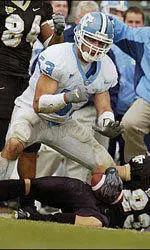
After redshirting as a freshman, he spent three years toiling on outmanned Carolina defenses. He was the first Tar Heel linebacker since Tommy Thigpen in 1989 to start as a freshman, and his 97 tackles that season were the most since Dwight Hollier made 117 stops in 1988. That's exclusive company among Carolina linebackers, but it wasn't nearly enough to halt a 3-9 slide that continued to 2-10 the next year.
He played as heavy as 252 pounds during that stretch, having been encouraged by Dave Huxtable to add weight to plug the middle. But that was probably at least 15 pounds more than his ideal weight, and he trimmed down to 232 for what should have been a stellar senior campaign.
The weight loss worked--he was playing his best football and anchoring a much-improved Carolina defense this fall. He had a team-leading 15 tackles through one and a half games. And then the injury, a broken fifth metatarsal in his right foot against Wisconsin.
For some players, a season-ending--to say nothing of potentially career-ending--injury sparks depression. Football is something that has consumed their lives, and some players have compared it to losing a family member. It didn't have that same effect on Doug Justice, who spent six weeks in a walking boot after having surgery to insert a 3-inch screw into his right foot. The day after the Wisconsin game, he called quarterback Matt Baker, who along with Martin Jernigan, Jeff Longhany, and Arthur Smith has been a regular Wednesday dinner companion. Baker still hadn't heard the severity of his friend's injury.

|
|
"He was just calling to see how I was doing," says Baker, who had taken some hard shots against the Badgers. "I had seen him limping around but that was it. And he wanted to check and see how I was doing. It wasn't until we kept talking that I found out it was broken."
His season--and most likely, his career--was over. But the walking boot didn't prevent him from doing other parts of his normal routine. He could still participate in Get Kids In Action, a UNC-sponsored program that helps fight childhood obesity. He could still visit the UNC Children's Hospital every Friday before home games, where he's been known to write "Matt Baker (aka Doug)" on his nametag as a playful jab at his friend. He could still participate in Habitat for Humanity. He could still visit elementary school classrooms and read to students. He could still find time to hit the books hard enough to maintain a grade point average that has made him a three-time Academic All-ACC selection.
"When we go out to eat on Wednesdays, we'll talk about what we've done that day or that week," Baker says. "It's amazing to sit there and listen to Doug talk about all the stuff he does. Half the time we're sleeping while he's working."
Justice was named to the 2005 American Football Coaches Association Good Works Team and is a semifinalist for the Draddy Trophy, which is better known as the "Academic Heisman." He does not seem particularly impressed by the honors. In fact, when they are mentioned, it's one of the first times he doesn't make eye contact, instead looking down at the floor as though he's being called a teacher's pet.
Other football players--most notably Warrick Dunn--have recently chastised reporters for focusing on the good guy angle at the expense of their football prowess. Justice doesn't seem to mind that he might be known more for his community service than his tackles.
"Why would you get tired of being a good guy?" Justice says. "I love helping people. I don't want the recognition. I don't need to see my name in the paper. I just think it's great to go out and help people. It would be nice to be known as a good football player but if someone is going to say something about me, I'd rather hear them say, `He was a good football player but a great person.'"
That's exactly what they're saying.
"You see a lot of people do things to show people they're a good guy," says Baker. "When the media isn't looking, they don't act the same way. That's not how Doug is. He will do the exact same things if no one is looking and he gets zero press."
Doug Justice and Erin Griswold will be married in May of 2006. They met through their older brothers and carried on a long-distance relationship while she played soccer at UC-Santa Barbara and he played football at Carolina. After two years, Griswold decided to transfer closer to Chapel Hill to further their relationship. It worked out, of course, but at the time she was moving all the way across the country with no guarantees.
But something about him made her willing to give up her starting position on the soccer team. Something about him made her believe she was doing the right thing.
Now you know him. Now you know exactly why she believed, don't you?
His heart.
Adam Lucas is the publisher of Tar Heel Monthly and can be reached at alucas@tarheelmonthly.com. He is the coauthor of the official book of the 2005 championship season, Led By Their Dreams, and his book on Roy Williams's first season at Carolina, Going Home Again, is now available in bookstores. To subscribe to Tar Heel Monthly or learn more about Going Home Again, click here.