University of North Carolina Athletics
Countdown to Kickoff: Talking Tackles
August 24, 2005 | Football
Aug. 24, 2005
By Adam Lucas
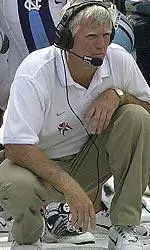
Ken Browning moved across the hall--and across the ball--this year. In the Kenan Football Center, the offensive offices are on one side of the hallway, the defensive offices on the other side. Browning moved from coaching tight ends to defensive tackles this year. It's a return to a position where he has had tremendous success with the Tar Heels, including an almost decade-long run when every defensive tackle he coached was drafted by or signed with an NFL squad.
The below conversation between Browning and Adam Lucas is outtakes from an extensive interview that forms the backbone of a Tar Heel Monthly cover story focusing on Browning and the tackle position that will run in the next issue.
Adam Lucas: Are you excited to be back on this side of the ball?
Ken Browning: I enjoyed offense. I had a bunch of it in my background, so it wasn't a hard adjustment. But the defensive line position can impact the game so much. From that standpoint, I'm looking forward to getting back. Any time you've had as much success as we've had here in the past, you want to see it get back to that level.
AL: What position did you play (Browning played at Northern Durham and Guilford College)?
KB: I was a defensive end and tight end. I was an undersized guy, although back then kids weren't as big. I was probably taller and leaner than the guys I played against. That had so much to do with teaching me the importance of pad level and leverage. I try to pick out old films to show our players, and I've picked out some 2000 tape. A lot of times when kids just see a Ryan Sims or a Vonnie Holliday, they say, `Well, that guy was a first-round pick.' I understand that but I also want them to see Anthony Perkins making outstanding plays, Will Chapman, Ross McAllister, guys like that. All of them walked on. It's more than just physical attributes. You've got to have a certain amount of size and bulk but that won't take the place of great leverage and pad level.
AL: What's the prototype for a defensive tackle?
KB: It's hard to generalize. In terms of personality, we have had all kinds. For example, Vonnie was not a very loud guy at all. Others have been much more talkative. On the field, it takes a great motivation level. Sometimes that can be learned as a player develops. Many times, if you see a guy who isn't putting out effort, it's because they haven't made a lot of plays before. Once they learn how to make plays--and they all want to make plays--it's a great motivating factor for them. They get the feel of making a play or two and that creates more self-motivation.
AL: You're not very loud on the practice field in most situations. Why does that coaching style work?
KB: I still remember what it was like to be a player. As old as I am, the kind of guy I wanted to play for is still fresh in my mind. Sometimes coaches think they're the only ones who motivate a player. That's not true. To a degree, guys play because they are self-motivated. You can't motivate a guy to play harder. I know that. I'm not going to waste but so much time with a guy who doesn't to play. If he'll do what I ask of him in practice, he'll learn how to make plays. Most everybody I have coached wants to make a play. And they'll play hard if they feel like they have a chance to make a play. When I got here, people told me Rick Terry wouldn't run from here to the door. My thinking was that he probably didn't want to run because he didn't think he would make a play. Once he figured out he could make a play, he would run. That motivates them in the offseason. They think, `If I run hard enough, long enough, I will make more plays.'
It's not what you tell them as much as what you help them learn how to do. They know when they are getting better. That's the greatest motivating factor that exists for a player. At that point, they trust you. Then they buy into what we're trying to do and at that point it is a snowball effect.
I don't think they mistake my approach for weakness. My intention is to work them hard and give them every bit of knowledge that I can. They know I'm interested in them being a better player. I enjoy players a lot, but it doesn't interfere with my ability to discipline them or get them to conform. I can like a player and not like everything he does.
 |
Countdown to Kickoff: 17 Days
|
AL: Where do your tackles stand in terms of having that confidence you talk about that they can make a play?
KB: I don't know yet. I don't like to judge them too early. I won't even completely know after the Georgia Tech game. I hope we're still getting better the last game of the year. As a coach, what you hope rubs off on the players is that kind of personality, that we're always getting better. I can prepare them for Saturdays but I won't take any snaps on Saturday. It's up to them. That's one reason I don't scream and yell, because they can't hear me scream and yell on Saturdays. They've got to have it in their head and heart when it counts. The only way to ingrain that in them is to repeat it and correct them in practice. What bores one guy in a meeting might be the only way another guy can get it, so they have to accept each other's differences.
AL: Is coaching ever finished?
KB: No, there's always something that can be done better. That's one of the beautiful things about the game. As long as I've been doing it, there's so much more I can learn. I don't think you ever get to the point as a player or a coach that you have all the answers. If I'm ever in that position, it'll be time to go do something else.
AL: When you moved from Northern Durham to Carolina in 1994, why was it the right time to make that move?
KB: That was a very hard move for me to make. We had just won the state championship and I felt like we might have the chance to do it again the next year. Some people think I did it because there was nothing more to accomplish at the high school level. That's not it at all. Once you win one state championship, what do you want to do? You want to do it again. I guess the biggest thing was just having a different challenge. When Coach (Mack) Brown called me, it wasn't like I had never entertained that notion before. In fact, I had talked to him about a job in 1989. I was the second guy they wanted and the first guy got the job.
AL: How have you managed to stay here through three head coaches?
KB: I was at Northern Durham for 18 years, so I guess I'm just a homebody. A lot of it depends on how the transition is done. Sometimes you have friends on the staff that leave. If you're the guy that is left here, you feel like you were in a combat mission and were one of the few that came back. It's hard because you've been in a foxhole with some of those friends who are leaving. Then you have to try to fit in with the new guys.
AL: The tackles have said the biggest thing they've noticed in camp is that there's no wasted time with you. Why is that a point of emphasis for you?
KB: I try to eliminate everything in practice that doesn't help them be a better player on Saturday. I also try to remember that sooner or later, that third-team guy is going to play. I don't like to see a dropoff when that happens. Hopefully we won't have any injuries, but if we do, we've got to have somebody ready to go. Sometimes that's hard for kids to understand. If a guy is a number-three, he may not understand why I'm pushing him. But that guy could be a number-one tomorrow. And if you're a two, then you're like a one to me, because you're going to be playing.
AL: How did your background impact your coaching style?
KB: My father's work ethic really impacted me. We grew up in a really hard-working environment. People talk about how hard coaching is and I just laugh at them. This isn't hard. Hard was growing up in that farming environment. A typical day in the summertime started between 4:30 and 5:30 and might be finished around 10 or 10:30 at night. You'd stop to eat and that's it. The work was more physical then. We were a small farm, so we didn't have a lot of the machinery. A typical day could be anything--it could be milking cows, clearing a field, digging up a tree stump. It was just part of the routine. I grew up in a family of eight, so we all learned about sharing and we learned about hard work. One of the things my father told me really stuck with me. He said, `There are a lot of things I can't give you, but I know you'll always be able to make a living because you know how to work.'
Some people say, `Coaches work all the time.' Well, that's true, but it doesn't seem like work. Sure, there are parts you enjoy more than others, but overall I've enjoyed the heck out of it. I'm so excited about getting this season kicked off. We've got a new challenge, and that's being better on defense. Being a part of meeting that challenge is exciting to me.
Adam Lucas is the publisher of Tar Heel Monthly and can be reached at alucas@tarheelmonthly.com. He is the coauthor of the official book of the 2005 championship season, Led By Their Dreams, and his book on Roy Williams's first season at Carolina, Going Home Again, is now available in bookstores. To subscribe to Tar Heel Monthly or learn more about Going Home Again, click here.