University of North Carolina Athletics
Countdown to Kickoff: Long Road to Leadership
August 31, 2005 | Football
Aug. 31, 2005
Tar Heel Monthly is the premier magazine devoted to the stories and personalities behind UNC athletics. Click here for subscription details and information on how to get our football preview and basketball championship commemorative issue free.
The following story originally ran in the September issue of the magazine.
By Adam Lucas
Carolina led Miami 21-14 at halftime and the Tar Heel locker room was getting an earful.
Junior linebacker Tommy Richardson was on his way to a team-high seven tackles. But his most important contribution might have come during a brief outburst at halftime.
"Play for each other! Don't worry about missing a tackle. If you miss it, he's going to be there," he said, jabbing a finger at a defensive teammate. "If you miss it, he's going to be there. If you miss it, I'm going to be there."
Ten months later, he looks back on the explosion and smiles.
"For whatever reason, last year's team wasn't really the type to get rowdy in the locker room," he says. "So I'm not sure what happened at halftime of that Miami game. But I felt like it was going to be a turning point. Up to that point we had a tendency to overthink everything. The schemes weren't hard, but we were always worried about missing a tackle or being out of the gap. And the offense was always worried about whether we'd be able to hold the other team long enough for the offense to win the game. I wanted us to just get out there and play, and all of a sudden we started doing what Coach Bunting always talks about and rallying to the ball."
There were few more unlikely candidates to morph into a leader at one of the most critical moments of the season. Even holding a 21-14 lead, few in the crowd of 58,000 honestly expected to end the evening dangling from a freshly toppled Kenan Stadium goalpost. The Tar Heels were coming off a 46-16 embarrassment at Utah and, at 3-4, a bowl game seemed like a fantasy.
And then there was Richardson's background. He'd twice turned down coaching staff requests to move to linebacker earlier in his career. Just one month earlier, he'd been suspended for the Georgia Tech game after exchanging harsh words with strength and conditioning coach Jeff Connors during a conditioning session--a session that was itself punishment for an earlier transgression.
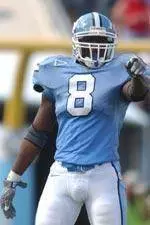
But it wasn't while watching his teammates pull out an important win over the Yellow Jackets without him that his season turned around. It was two weeks later when he stood on the sideline at Doak Campbell Stadium in Tallahassee, with almost 35 members of the family sweating in the stands behind him, and didn't play a single snap. He was dressed out for the game, had the number-8 jersey pulled on just right. But the coaching staff never put him into the game.
It was a long afternoon for a player usually so energetic coaches find him creeping up on the sideline while the offense is on the field. "Get back!" they bark, only to watch him edging towards the field, unable to contain his emotions, a few plays later.
"Georgia Tech was the awakening," Richardson says, "but Florida State was the turning point. I thrive off the energy from my family and was so excited to have them there. But I just had to sit there and watch us lose and I was powerless to do anything. I didn't want to look back at them because I didn't want them to see the anguish on my face. I didn't want anyone to see me cheering too loud for my teammates because I didn't want anyone to think I was OK with being on the bench. It hurt."
The Miami native was used to being in leadership positions. He'd been the president of the student body in high school, but he always preferred to lead by example rather than by instruction.
But pride had already created one bump in his Carolina career; when the coaches asked him to play nickel linebacker as a freshman, he declined, feeling that at 205 pounds he wasn't heavy enough. He declined a move to linebacker again as a sophomore--he still thought of himself as a safety. But then, realizing transfer Gerald Sensabaugh hadn't been brought in from East Tennessee State to sit on the bench, he made the move to linebacker during spring practice before his junior year.
 |
Countdown to Kickoff: 10 Days
|
After drawing the dreaded Did Not Play against the Seminoles, he decided not to let his pride dictate his actions again. He initiated a conversation with the coaching staff about his playing time, about the lonely afternoon on the sidelines trying to support his teammates while concealing his disappointment. Relationships thawed, fences were mended. And the Carolina defense gained an important contributor.
He turned into a valuable utility man, playing all three linebacker positions at some point during the 2004 campaign. He notched 29 tackles in the final four games of the regular season after shifting to weakside linebacker and finished tied for second on the squad (behind Sensabaugh, who just as Richardson suspected in the spring started every game) with 67 stops.
He's expected to be one of the cornerstones of a unit with significant pressure in 2005. Seniors dot the defensive depth chart--Doug Justice next to Richardson at middle linebacker, Tommy Davis and Chase Page on the defensive line, Cedrick Holt in the secondary. For several years, seemingly ever since the departure of Julius Peppers and Ryan Sims, the Tar Heels have been young on defense. They're no longer young. Now they are veterans expected to produce.
Richardson has thrived in that role. He became one of the organizers of the team-led voluntary practice sessions this summer, where he turned into a helpful asset for young members of both the secondary and the linebacking corps. He's been a frequent film-watching partner for freshman Chase Rice, a high-motor young player expected to contribute to the linebacking rotation this fall. And in July, he even hosted a pool party for his teammates at which approximately 70 of his teammates ("And a few ladies," he notes with a grin) enjoyed one of the rare days without strength and conditioning workouts.
It's a mark of how respected he's become in the locker room that one of his biggest supporters is Connors, the man he had the disagreement with last season that caused the Georgia Tech suspension.
"I like kids who are emotional because it shows me how much they care," Connors says. "Tommy cares about football. Anything we do he shows great passion. He gets respect from his teammates because they know he has a physical presence, toughness, and passion. That's what leaders have to have."
"People respect the fact that he puts so much into the game," John Bunting says. "He's one of our smarter players and he's tough. He plays with a lot of enthusiasm, and he has totally rubbed off on people in that way."
It's no surprise that he's used to being around people. He and his five sisters were raised by his grandparents, Eva and Walter Fair, who would sometimes shoehorn nine people into a 5-bedroom house. He's quick to point out that it wasn't the most hardscrabble of Miami neighborhoods, but it wasn't a gated community, either: "There was robbing and cheating and shooting," he says.
Not in his house, though. The rules were simple: when the streetlights come on, the kids come home. Failure to comply led to severe punishments. Even when the rules were followed, thick skin was required to maintain a smile in a household with numerous siblings and cousins. He's better known as T-Rich around the Kenan Football Center these days, but in Miami his family nicknamed him (this is the part where he hopes his teammates have stopped reading) No-Butt.
Richardson has spoken to his father only once in his life--a lengthy phone call on New Year's Day, 2000. He says his father, whom he declines to call his father and instead refers to as "my sperm donor," gave lengthy explanations for being out of his life. The Tar Heel captain waves those excuses away with his hand.
"I'm not mad at him," he says. "If he hadn't been the way he was, I might not have had the relationship I have with my grandfather. I never looked at it as not having a father. I had my grandfather."
Although the family nearly had enough people to field their own football team, Tommy played only basketball until his junior year in high school. His coach finally persuaded him to try out and he spent one game as the starting quarterback before switching to safety. He's always had an accelerated learning curve--one preseason to learn the quarterback position, one week to learn safety, one spring practice and training camp to learn linebacker.
Now he thinks he's found a home at weakside linebacker. He connected quickly with new linebacker coach Tommy Thigpen. Always a student of the game--and a student off the field, as he'll graduate this December--Richardson told Thigpen at one of their first meetings he didn't want to just be All-ACC. He wanted to be All-American.
"He said he saw that in me and he was going to get it out of me," Richardson says. "That blew me away. I've got enough energy to just run around and make 10 tackles. But he's going to get me to where I make 15 tackles and make even more plays. You can make 10 tackles and not make impact plays. I'm going to make impact plays."
He'll start trying to have that impact against Georgia Tech on Sept. 10. Just like last year against Florida State, he'll have his family in the stands cheering him on.
This time, though, they're unlikely to have to look for him on the sideline. They'll find him on the field.
Adam Lucas is the publisher of Tar Heel Monthly and can be reached at alucas@tarheelmonthly.com. He is the coauthor of the official book of the 2005 championship season, Led By Their Dreams, and his book on Roy Williams's first season at Carolina, Going Home Again, is now available in bookstores. To subscribe to Tar Heel Monthly or learn more about Going Home Again, click here.