University of North Carolina Athletics
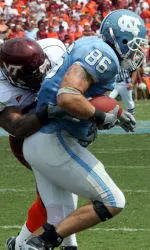
THM: Hamlett Keeps Things Simple
October 25, 2006 | Football
Oct. 25, 2006
Tar Heel Monthly is the premier magazine devoted to the stories and personalities behind UNC athletics and is one of the only full-color, all-glossy college sports publications in the country. Click here for subscription details and information on how to get our basketball preview free.
The following story originally ran in the October issue of the magazine.
By Adam Lucas
It's OK to be scared of Jon Hamlett.
Just look at him. He is a scary guy, right? He's got the tattoos, one on each bicep and his initials on his triceps. He stands 6-foot-4, 255 pounds. And he's got long, flowing black hair that gets sweaty and sticks to his shoulder pads when he rips his helmet off on the Carolina sideline.
He stalks around the practice field, rarely speaking. And on this day, he is sitting by himself during the lunch hour at the Kenan Stadium training table. Other players congregate, sitting four or six to one of the round tables. Hamlett sits alone.
You pull up a chair and take a seat. Not next to him, but one seat away. You know, just in case. If you say something that angers him, you want to be out of arm's reach. You stumble through a question, something about that day's practice, and wait for the booming voice that must be contained in that intimidating body.
He says...well, what does he say?
You can't hear him. You slide one seat closer.
Cautiously.
Kenny Browning laughs at the notion of Jon Hamlett as a scary individual.
"Uh, in what way?" the ever-polite Carolina assistant coach asks.
Tar Heel tight ends coach John Gutekunst just looks puzzled.
"Scary? Sorry, I've never thought of him that way," he says.
But don't they understand? Haven't they seen him?
Answer: yes, they've seen him. But they've also done more than that--they've interacted with him.
During the preseason, many families of the players came to the first scrimmage of the year on a sunny Saturday in Kenan Stadium. Joni Hamlett, Jon's mom, made the trip to see her baby...er, her tough guy.
She was approached by Vince Jacobs, Sr., the father of true freshman tight end Vince Jacobs.
"I just wanted to thank you," he told her. "Jon has been such a good leader for Vince. He has made his transition to college so much easier."
Sophomore tight end Richard Quinn echoes the sentiment.
"Every time I have a problem, I go to Jon," he says. "He's a good role model. He has been a great leader and he gives me tons of advice."
Ask Hamlett about this moment and he looks a little sheepish.
"I'm not one of those guys who wants the freshmen to carry my bags from practice," he says, again using that soft voice that makes you lean in to hear him. "I want to help them out. That's what I would've wanted someone to do for me, so why wouldn't I do it for them?"
It turns out that this is a real question. He looks at you, expecting an answer. You shrug.
"I try to be respectful all the time," he says. "That's part of being respectful. I'll help them do anything they need help with."
Hamlett has a way of making complicated things seem simple. This is one of those things. A teammate needs help, he provides it.
That includes letting Quinn live with him for a week during the summer of 2005 when the rookie didn't have a place to stay before the start of training camp. It includes tutoring him on the mechanics of blocking, of drilling the importance of refining his steps rather than just trying to physically maul the opponent.
Tight ends coach John Gutekunst is a stickler for being on time. And yet, for a vast majority of the position group meetings during the 2006 season, he's been one of the last people to arrive in the meeting room.
"At 85 percent of the meetings, Jon is already in there when I get there," Gutekunst says. "He's either watching tape by himself or the other guys are in there with him. He started it himself, and then the other guys started coming because they know they can learn something. He's trying to help himself be a better player, but he's also trying to help the other guys. He's really taken them under his wing."
Offensive coordinator Frank Cignetti's plan for his offense this season was supposed to include Quinn paired with Hamlett in numerous two-tight end sets. Quinn's season-ending shoulder injury changed those plans, and the Tar Heels have struggled to get Hamlett involved.
When he's not catching passes, though, he's still important to the offense. He arrived as an accomplished pass-catcher and has developed into a reliable blocker.
This is the part of the story where he's supposed to demand a bigger role in the offense. Perhaps demand a certain number of catches, or maybe draw up a few plays with the tight end as the first option.
Instead, this is what he says: "I don't know how many balls I'm going to catch this year. When I first came here, I was the little guy and the other guys were bigger than me, so I was the receiver and they were the blockers. Now I'm the bigger guy and the roles will probably change. I can still catch the ball, and I know that. But my job is to do what they tell me to do. And if they tell me to block, that's what I want to do."

 |
|
This time, it's Hamlett doing the shrugging. It seems simple.
Jack Woodell was an Air Force man, but he loved the water. He'd taken his bride to Topsail Beach for their honeymoon in 1951, and they returned as often as possible. He was a B-52 navigator who flew numerous missions in Russia during the Cold War. The long-range heavy bombers were built for versatility, including the ability to carry two thermonuclear weapons to any point in the Soviet Union. The planes were designed for function, not comfort, and there were many times when Woodell sat in a cramped B-52 and dreamed about the serenity of Topsail Beach.
He and his wife would eventually have two children, both girls, and when daughter Joni Hamlett made the couple grandparents with the arrival of Jon Hamlett on June 29, 1984, Jack Woodell had an immediate thought: he needed to take Jon to Topsail.
Baby Jon made his first trip to the beach before he was six months old, and he was surf fishing with his grandfather by the time he was five years old. They've returned to the ocean almost every summer since, most recently this summer, when 22-year-old Jon stood next to 80-year-old Jack and reeled in the latest catch.
Their family would look out into the surf and see the two men standing next to each other and wonder what they were talking about. The answer, many times, was nothing. They didn't have to. Being in the water was enough. And being together was enough.
Jon knew his grandfather had played football at North Carolina. He had to know--one of his first newborn outfits had been a Carolina football ensemble courtesy of his grandparents, and the family became frequent visitors to Chapel Hill for Lettermen's Day football games. But it wasn't always football talk in the Atlantic Ocean.
"He was never talkative on our beach trips," Woodell says. "But going to the beach and getting up at 5 a.m. with him to go surf fishing is one of my very favorite memories. He was--and is--such a down-to-earth person. We were more than grandfather and grandson. We were friends."
On a good day, you can still catch Hamlett fishing somewhere near Chapel Hill. And when he returns home to Lynchburg, one of his first priorities is calling close friend Rob Hackemeyer and lining up their next fishing trip.
The friends are in a constant battle over the relative merits of their pickup trucks. Hamlett was the first to get his driver's license, and he immediately put a lift on his truck to make it more impressive. But then Hackemeyer got his license, which was soon followed by an even bigger lift on his truck.
"He really wants my truck," Hackemeyer says with a laugh. "Even he will tell you that."
Hackemeyer wasn't sure how their relationship would change when he saw his buddy moving up the depth chart at Carolina. He thought maybe the phone calls would stop, or maybe there wouldn't be as much time to fish or shoot skeet. A close-knit group of high school friends that includes Stevie Ray Lloyd, who now plays football at Liberty, scattered for college.
Distance has separated them. But it's hard to notice any other differences.
"When he comes home, he calls me and we'll go fishing," Hackemeyer says. "Not a lot of guys who make it big will do that. They forget about their high school friends. But I really think he's happiest when there's no one around except his buddies and we can just hang out."

|
|
Looking at him, you'd expect Hamlett to stride into the water and rip the fish out of the lake with his bare hands. It turns out, though, that he uses a regular rod and reel.
There are people who assign negative connotations to the word "simple." To them, a lack of complexity is a detriment. To others, though, it's a luxury.
Give Jon Hamlett a boat, a few friends, and some hungry fish, and you've got heaven. Just the way his grandfather taught him.
"I will never forget one specific day," Woodell says. "Jon was in the 8th grade. He put his arm around my shoulder and I realized that even though I was six feet tall, he was looking down at me. A big smile came over his face. It was one of my life's greatest simple pleasures."
Most recruiting visits to Carolina include a team meal, a football game, and a sampling of Chapel Hill social life.
Jon Hamlett's had an extra feature.
As a high school football standout, he was one of the most highly recruited tight ends in the country and was ranked among the top 15 at that position by Rivals.com.
"I thought he was going to become a big, strong athlete with some skill catching the ball," says Kenny Browning, who recruited Hamlett for the Tar Heels. "They used him a lot of different ways in high school, and when he came to our camp I was very impressed with his intelligence. You could tell he had the tools."
Hamlett grew up in Lynchburg, almost exactly halfway between Charlottesville and Blacksburg, the homes of Virginia's two biggest football powerhouses. His recruitment had all the makings of an epic battle. Maybe he could even be a "hat guy," one of those players who strings his recruitment along until the last possible second, and then dramatically pulls a hat out of a bag to announce his college choice.
That's how it could have been. Knowing what you know now about Jon Hamlett, though, it shouldn't really surprise you that he had no interest in being a hat guy. He had no interest, even, in being recruited during his senior year.
"People were constantly calling me at night, wanting to talk to me about what schools I liked and where I might go," Hamlett says. "I don't get caught up in all that stuff. I'm not trying to be mean, but I'm just not that type of person. Being recruited was almost becoming my whole life."
The pull to his home-state schools wasn't as strong as many assumed. He had the family connection to Carolina, where Woodell had played offensive line during the Justice Era.
Today, Woodell is modest about his Tar Heel career--"I think I got a scholarship because it was rainy at practice one day, and that slowed Charlie Justice down just long enough for me to tackle him," he says with a laugh--but his legacy played an important role in bringing his grandson to Chapel Hill.
"When Jon was 9, we were sitting there in the Kenan Stadium stands for one of the Letterman's Days," says his mother, Joni. "He looked up at me and said, `I would love to play here.'"
As he became a prospect, his grandfather accompanied him on one of his visits to Chapel Hill. They did all the usual visit-to-Chapel-Hill must-sees. And they also made it down to the Kenan Stadium field, where Woodell showed Hamlett the exact spot where he played the final play of his college football career.
"An incomplete pass from Dick Bunting," he remembers now with a slight sigh.
Both parties say his grandfather never pushed Hamlett to attend Carolina. He consistently advised his grandson to do what was best for him, not what was best for his grandfather.
But with such a deep connection to the Tar Heels, Hamlett really had no other choice. He was one of the first recruits in his class to commit, pledging to Carolina even before the end of his junior season.

|
|
"I'm not a guy who thinks a lot about the future," Hamlett says. "But the night Carolina offered me a scholarship, I didn't sleep at all. All I could think about was how awesome it would be to play there."
He played immediately. Everyone involved--including John Bunting--would probably tell you he played before he was ready. But Bobby Blizzard was hurt and the Tar Heel tight end ranks were depleted, so there was true freshman Jon Hamlett becoming one of 12 true freshmen who played during the dismal 2003 season.
"For him, it was a matter of getting his strength level to the point that he could do some physical things," Browning says. "He went through some time as a freshman where he had to learn the speed of the game, and it took him a little while to learn that criticism wasn't a personal thing, it was a coaching thing."
He caught 11 passes that first season, and his receptions have increased each year since. Don't worry if you haven't noticed him. That's the way he likes it. He might clap his hands after a big catch, might even raise his arms after a touchdown, but that's the extent of the emotion you'll see from him.
He watches games like a tight end scholar, making it a point to catch Jeremy Shockey and the New York Giants whenever he can.
Wait a minute, Jeremy Shockey? Loudmouthed Jeremy Shockey? This is a Jon Hamlett role model?
"Not so much all the flashy stuff," Hamlett says. "But he makes plays and you can't say you don't want a guy like that."
If the Giants aren't playing on a Sunday afternoon, you're likely to find Hamlett at a local golf course. Go ahead, guess what kind of golfer he is. Remember, he's 6-foot-4, 255. If you were 6-foot-4, 255, how would you hit a golf ball?
Don't lie. You'd take a huge backswing and then you'd rip the golf ball like it stole something from you. You'd forget the definition of "lay it up" and you'd try to hit over lakes and across bunkers and stride purposefully down the fairway sticking your chest out after one of your mammoth drives.
So how does Hamlett play? Remember, this is a man who thinks for 14 seconds before answering--go ahead, count it out, it's a long time--when asked a simple question about a scrimmage. He is a thinker, not a basher.
"Most people think I go up there and try to bomb the ball," he says. "I used to do that when I was younger. I mean, I can hit a 4-iron 230 yards. But my short game has really gotten better. I don't try to do too much. That's what gets people in trouble. If you get in trouble off the tee, you don't try to crush it through a small gap just to get it on the green. You have to be smart. You have to know when to take your chances."
"We'll cut up every once in a while," says frequent playing partner and Carolina punter David Wooldridge, who claims to until recently have been hitting a Wal-Mart driver farther than Hamlett. "I might catch him throwing down a separate ball. But when he's in the zone, I know not to talk to him. When he's working, he doesn't want anything bothering him."
Hamlett has become a bit of an icon at Hillandale Golf Course in Durham, one of his favorite courses in the area. In the middle of computer analysts and research technicians and salesmen trying to squeeze in a few holes, you don't often find an imposing solo player who has trimmed his hair just once in the past two years (despite pleas from his mother).
He usually shows up alone and casts around for playing partners. At first, they weren't always easy to find. Now, though, he's developed a handful of friendships with other golfers, and most everyone in the pro shop knows that if you want a quality round, you can do much worse than touring the course with Jon Hamlett.
What is it, you wonder, that allows a college senior and--occasionally--a senior citizen to put their distinct backgrounds aside for a couple of hours?
"People find out pretty quickly that I'm not this crazy Undertaker guy," Hamlett says, referencing the pro wrestler known for his imposing stare and long hair. "I'm quiet most of the time. I'm from the country. I drive a truck. I listen to country music. I try to help people out when I can."
He shrugs.
"It's pretty simple."
Adam Lucas's third book on Carolina basketball, The Best Game Ever, chronicles the 1957 national championship season and is available now. His previous books include Going Home Again, focusing on Roy Williams's return to Carolina, and Led By Their Dreams, a collaboration with Steve Kirschner and Matt Bowers on the 2005 championship team.