University of North Carolina Athletics
Lucas: Tate Becomes All-Around Weapon
October 9, 2007 | Football
Oct. 9, 2007
By Adam Lucas
Hakeem Nicks ponders the question as if he's preparing a profound response.
The query is simple: what qualities make a good kick or punt returner?
Nicks scratches his chin. His mouth widens into a broad smile. And then he says just one word:
"Brandon."
The Brandon in question is Brandon Tate. And you have to go to his teammates to find out more about him, because the Burlington product can outrun most anyone on the team, can make diving catches, and can score touchdowns in bunches--but he absolutely, positively, can't be begged to talk about himself.
Players with his same skill set are usually packed with bravado. Watch Devin Hester--a player Tate says he likes to study--drop back to return a kick for the Chicago Bears and the former Miami Hurricane is a cyclone. Before the ball is kicked, he raises his arms above his head and turns in a circle to soak in the crowd staring at him. He waves his arms, urging them to get even louder.
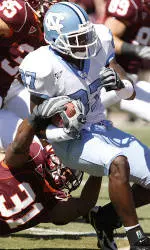
Then watch Tate drop back to return a kick. He already has one punt return touchdown this year. He is only the ninth player in NCAA football history to return a punt and kickoff for a touchdown in the same game. He has earned the right to swagger a little.
But he doesn't. He simply drops back, checks the wind, and gets ready to run.
"I don't like to bring all that attention to me," he says. "I just want to be in my own zone and I just want to make plays. I don't need all that attention."
Whether he wants it or not, his junior season has brought even more attention. Tate was primarily a return specialist in his first two years at Carolina. That had been his role ever since his very first training camp, when he quickly shot past other more heralded freshmen onto the depth chart because no Tar Heel could tackle him on kick returns during scrimmages.
"In a way, you can teach someone to be a kick returner," Tate says. "You can learn how to read the field and watch the blocks. But you also have to have a knack for it."
Nicks, who also has returned kickoffs during his Carolina career, puts it more simply: "I'm a pretty good kick returner. But when Brandon gets the ball, you get out of the way and let him work his magic. You just have to have that certain thing, and he's got a lot of it."
Tate is not, perhaps, the quickest player on the roster in pure 40-yard dash time. But put pads on him and ask him to accelerate and he reaches top speed in a hiccup. As opponents quickly learned, one crease in their coverage was all he needed to turn a routine return into a big play.
It seemed logical that such big-play ability would translate well to the receiver position. But he had trouble cracking the receiver rotation and made just five catches in his first two years.
"I always knew I could play receiver, but I never really got the chance," he says. "These coaches have given me the chance."
That's because on an offense that needs more big-play targets, offensive coordinator John Shoop knows Tate is one of the few Tar Heels who is a legitimate touchdown threat every time he touches the ball. To take advantage of those skills, Shoop has tried to be more creative in the ways Tate touches the ball, including occasional handoffs and a few reverses--like the gamebreaking 54-yarder for a touchdown against Miami.
The junior speedster has rewarded that creativity by turning into a very reliable target in the passing game. His 159.2 all-purpose yards per game lead the team and rank second in the conference. His 21.4 yards per catch average is easily the highest on the roster, and although he's made some big plays by sprinting past the secondary, he's also made some very difficult catches in big third-down situations--including an on-one-knee grab that prolonged a drive at Virginia Tech and a remarkable 46-yard diving reception against Virginia.
He's been an essential part of a position group at wide receiver that was more notable in 2006 for the passes they didn't catch than for the passes they did; in 2007, the Nicks/Tate/Brooks Foster trio all rank among the league's leaders in receiving yards.
From Tate's perspective, there's just one negative to his junior year breakout--he's getting even more of that unnerving attention. Not just off the field, but also on the field. The player who couldn't crack the receiver rotation now demands constant eyeballing from opposing defenses.
"The last couple games, I've noticed a lot more double coverage," he says. "When we line up, I'll hear someone yell, `Who's got 87?'
"I don't mind that kind of attention. I just think it means that I must be pretty good at what I'm doing."
Adam Lucas most recently collaborated on a behind-the-scenes look at Carolina Basketball with Wes Miller. The Road To Blue Heaven will be released on October 1. Lucas's other books on Carolina basketball include The Best Game Ever, which chronicles the 1957 national championship season, Going Home Again, which focuses on Roy Williams's return to Carolina, and Led By Their Dreams, a collaboration with Steve Kirschner and Matt Bowers on the 2005 championship team.