University of North Carolina Athletics
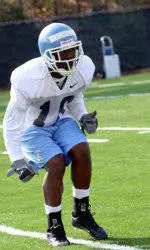
Lucas: Instincts Carry Burney Up Depth Chart
April 12, 2007 | Football
April 12, 2007
By Adam Lucas
The ball is in the air, and Kendric Burney is in motion immediately. His first step is the key, because it's that instantaneous reaction that determines whether he'll be too late. He closes fast, feet flying across the green grass, and arrives in plenty of time to make the play.
But what kind of play? He might be tracking fly balls in center field at Boshamer Stadium. Or he could be hunting down an errant pass from his cornerback position during Butch Davis's first spring practice at Carolina. Burney began the baseball season with the Diamond Heels, where he served as a late-inning defensive replacement in center and also made one pitching appearance.
As soon as spring ball began, though, he transitioned across the street to the gridiron practice field, where he's rocketed up the depth chart and currently holds a spot as a first-team cornerback opposite Jermaine Strong.
"The biggest challenge has been getting my rest," Burney says. "At first, I thought I could hang out, stay up late, do my schoolwork, and still pull it off. But my body started to wear down. As long as I keep my grades up, I love juggling two sports. As long as the coaches agree, everything is good."
Davis made great use of multi-sport athletes at Miami, as he frequently watched some of his best players compete for the track team. Baseball is a tougher proposition, as the beginning of the season conflicts with spring ball.
Burney is on a football scholarship, so he knew he had an obligation on the gridiron. But he's also close with several members of the baseball team, which boasts a core of players who--like Burney, a Jacksonville native--are from North Carolina and have played with and against each other for several years in youth leagues. After spring ball concludes with the spring game this Saturday, he'll switch back to baseball for a stretch run the Diamond Heels hope will last until late June.
The sport-swapping sometimes relegates lesser athletes to mere novelties. But Burney, who was one of the most-buzzed about players in 2006 football training camp before redshirting, has made a quick impression on his new coaches.
"He's been a very pleasant surprise," defensive coordinator Chuck Pagano says. "When we first got here, he wasn't around because of baseball, so we didn't have a feel for him as a person or for what he could do physically. Once we watched him run around, change directions, and move, we knew we had a good athlete here. And when we got him on the field and cut him loose we saw he has great instincts. He's one of those guys who knows where the ball is. He has great playmaking ability."
The ultra-polite Burney--after a full year in the program, he's still calling most staffers "Mr." and punctuates his answers with "yes, sir"--is playing outside in Carolina's base package and moving into the slot when the Tar Heels go to five defensive backs. And he's quickly discovered that his natural instincts serve him well in Davis's speed-based philosophy.
"I'm cleaning up some small mistakes and playing more aggressively," Burney says. "They want me to play with my instincts. Playing center field and defensive back is the same thing. It's reaction time, seeing the ball out of the quarterback's hand, and breaking on it. Working on those small things will make me more effective."
At 5-foot-9, Burney's instincts are important, because he doesn't have textbook size for a cornerback. But his jumping ability can make up inches quickly if his instincts put him in position to make a play.
Combining a nose for the ball with a better grasp of Pagano's concepts is the next task.
"Once he has a really good grasp of the defenses and coverages and schemes you will see--in a lot of them--a big jump," Pagano says. "Our whole idea is to not slow them down thinking. If they're slowed down, their talents don't take over. Our job as a defensive staff is to say, `Are we doing too much, to the point that these guys can't play?' Kendric has done a good job and we're continuing to chip away at his refinement."
For Burney, whose countenance is fixed in a seemingly permanent smile, it's refreshing to see him happy again on the football side. He's still in his first year at Carolina, but he's already had exposure to two very different college sports teams--one a 2006 football team that struggled to a 3-9 finish, the other a 2007 baseball team that is coming off a national championship series appearance and primed for another deep postseason run.
During the month of spring ball, Burney has already noticed that a formerly striking difference in the locker rooms of the two sports has evaporated.
"I see a big difference in football," he says. "Last year we had a lot of arguments and discontent. Over in baseball, if you have a problem, you just talk about it. Now it's the same way in football. When we get to the football center, we're a family."
Adam Lucas's third book on Carolina basketball, The Best Game Ever, chronicles the 1957 national championship season and is available now. His previous books include Going Home Again, focusing on Roy Williams's return to Carolina, and Led By Their Dreams, a collaboration with Steve Kirschner and Matt Bowers on the 2005 championship team.